The 1 Mukhi Rudraksha is surrounded by more confusion, misinformation, and commercial exaggeration than any other Rudraksha bead. A common question searched online is whether the 1 Mukhi Rudraksha is genuinely real and, if so, what form it naturally occurs in. Claims about perfectly round 1 Mukhi Rudraksha beads dominate online marketplaces, yet traditional knowledge and scientific examination tell a very different story. Understanding the natural forms of the 1 Mukhi Rudraksha is essential before you decide to buy Rudraksha online.
Why the Authenticity of 1 Mukhi Rudraksha Is Widely Questioned
The 1 Mukhi Rudraksha is extremely rare in nature. Its symbolic association with Lord Shiva and spiritual liberation has led to intense demand, which in turn has created a large market for misrepresentation.
Most confusion arises because:
- Natural 1 Mukhi Rudraksha is seldom found
- The bead does not commonly occur in round form
- Artificial carving is easy to disguise
- Buyers are unfamiliar with natural growth patterns
As a result, many beads sold online as “1 Mukhi” are either modified or incorrectly identified.
What Does “Mukhi” Actually Mean in Rudraksha?
A mukhi is a natural cleft or division on the surface of a Rudraksha bead. These clefts are not lines drawn on the surface but natural separations formed as the seed matures.
In the case of the 1 Mukhi Rudraksha:
- There is only one natural cleft
- The surface remains largely undivided
- The bead represents complete oneness
Understanding this definition is essential before evaluating authenticity.
The Naturally Occurring Form of 1 Mukhi Rudraksha
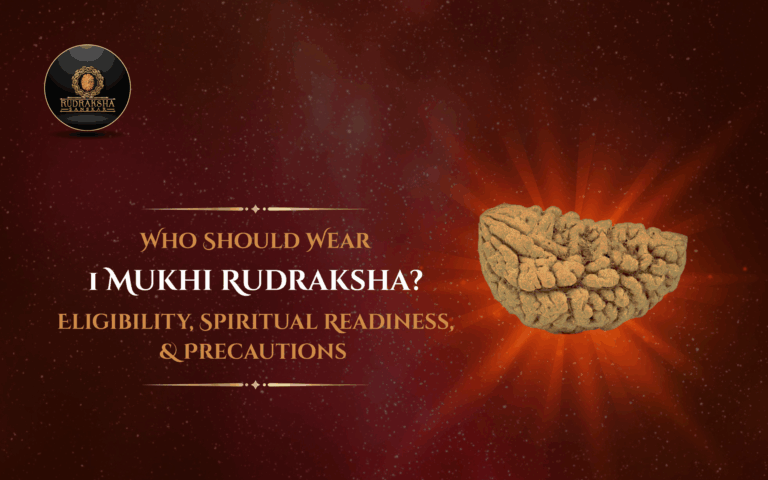
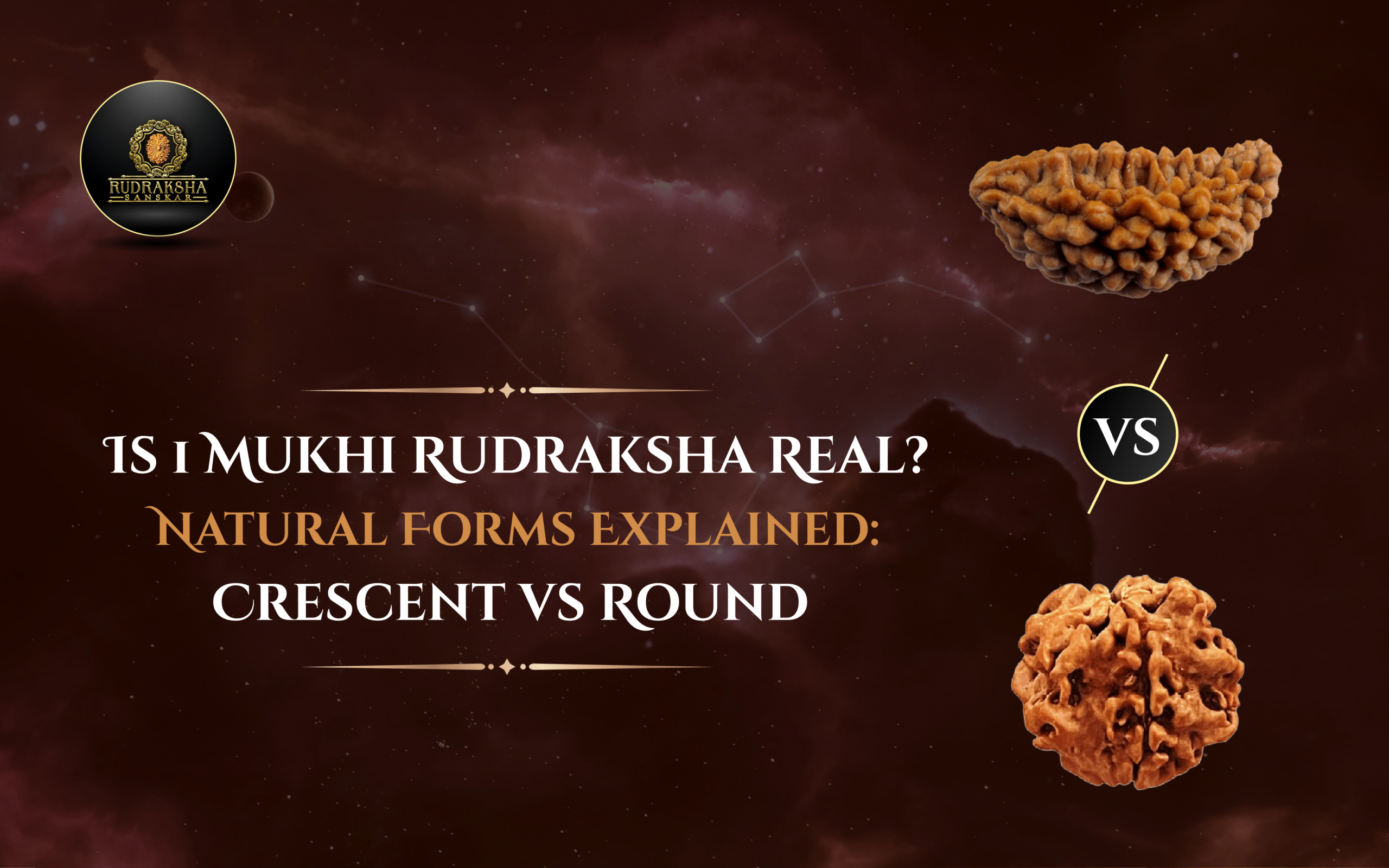
Crescent (Half-Moon) Shape – The Natural Reality
According to traditional Rudraksha texts and modern botanical studies, the crescent-shaped (half-moon) form is the most naturally occurring form of the 1 Mukhi Rudraksha.
Key characteristics of the crescent form:
- Flat or slightly curved shape
- One clear natural cleft
- Uneven organic texture
- Found mainly in specific Himalayan regions
This form aligns with the symbolic association of Lord Shiva, whose iconography often includes the crescent moon.
Round 1 Mukhi Rudraksha: Why It Is Extremely Rare
Naturally round 1 Mukhi Rudraksha beads are exceptionally rare, bordering on near-mythical occurrence. While a few verified specimens may exist, they are not found in commercial quantities.
Key points about round 1 Mukhi beads:
- They do not occur naturally in large numbers
- Most round beads sold online are not genuine
- Many are modified lower-mukhi Rudraksha
- Certification is mandatory for any round claim
A round shape alone does not determine mukhi count.
How Fake Round 1 Mukhi Rudraksha Beads Are Created
Most round “1 Mukhi” Rudraksha beads sold online are created through:
- Chemical filling of natural grooves
- Mechanical polishing to erase mukhi lines
- Reshaping lower-mukhi beads
- Surface carving followed by polishing
These methods create visually convincing beads that fail under microscopic or lab examination.
Why Crescent-Shaped 1 Mukhi Rudraksha Is Often Rejected by Buyers
Ironically, many buyers reject genuine crescent-shaped 1 Mukhi Rudraksha beads because they do not match commercial expectations.
This happens because:
- Buyers expect round symmetry
- Online imagery promotes unrealistic shapes
- Crescent form is misunderstood as “incomplete”
- Education around natural forms is lacking
This misunderstanding has fueled the dominance of fake products.
Scientific and Lab Perspective on 1 Mukhi Rudraksha Forms
Recognized gemological and botanical labs confirm that:
- Mukhi lines cannot be removed naturally
- Crescent forms show organic seed development
- Round shapes without clefts indicate modification
- Internal structure reveals authenticity
This is why lab testing is essential when you buy authentic Rudraksha online, especially for the 1 Mukhi category.
How to Verify Whether a 1 Mukhi Rudraksha Is Real
Before purchasing, verify:
- Presence of only one natural cleft
- Absence of artificial smoothing
- Organic surface pores
- Lab certification confirming natural formation
Avoid sellers who rely solely on visual claims without documentation.
Why Certification Is Non-Negotiable for 1 Mukhi Rudraksha
For all other mukhi types, visual inspection can sometimes suffice. For 1 Mukhi Rudraksha, certification is mandatory due to:
- High fake rate
- Extreme rarity
- High financial risk
- Frequent mislabeling
When you plan to buy Rudraksha online, insist on lab reports that clearly mention natural mukhi formation.
Common Myths About 1 Mukhi Rudraksha
- All round 1 Mukhi beads are genuine
- Crescent-shaped beads are incomplete
- Visual appearance is enough to judge
- Price alone guarantees authenticity
Each of these assumptions leads to incorrect purchases.
Buying Tips: How to Buy Authentic Rudraksha Online Safely
If you are considering a 1 Mukhi Rudraksha:
- Accept the crescent form as natural
- Demand lab certification
- Avoid “perfectly polished” beads
- Choose sellers who educate, not exaggerate
Choosing to buy authentic Rudraksha online requires patience and understanding, not urgency.
Frequently Asked Questions
Is crescent-shaped 1 Mukhi Rudraksha genuine?
Yes. It is the most naturally occurring form.
Are round 1 Mukhi Rudraksha beads fake?
Most are modified. Genuine round forms are extremely rare and must be certified.
Why are fake 1 Mukhi Rudraksha so common?
High demand combined with low natural supply drives manipulation.
Conclusion
The 1 Mukhi Rudraksha is real, but it is not what most people are shown online. Its natural crescent form is often misunderstood, while artificially modified round beads dominate the market. Distinguishing reality from marketing is essential.
Before you decide to buy Rudraksha online, understanding the true natural forms of the 1 Mukhi Rudraksha protects you from misinformation and financial loss. Choosing to buy authentic Rudraksha online from transparent, knowledgeable sellers ensures spiritual integrity and long-term trust.