Few Rudraksha create as much confusion as 1 Mukhi Rudraksha.
It is rare, closely associated with Lord Shiva and often sold with dramatic claims. Then comes the shape debate: one seller says only a round 1 Mukhi is genuine, another says the crescent or kaju-shaped bead is the authentic form.
The useful answer is less dramatic.
1 Mukhi describes the natural face of the Rudraksha, not a guaranteed shape. Shape, origin, rarity and authenticity are separate things, and none should be assumed from a product name alone.
Before paying a premium for an original 1 Mukhi Rudraksha, understand what the bead represents and what evidence should accompany it.
What Does 1 Mukhi Rudraksha Mean?
“Mukhi” refers to the natural face or division on a Rudraksha.
A 1 Mukhi, also called Ek Mukhi Rudraksha, has a single natural Mukhi formation.
Traditionally, it is directly associated with Lord Shiva and represents oneness, inner awareness and a movement away from duality. This is why its spiritual meaning is usually discussed around:
- meditation
- self-inquiry
- detachment
- inner silence
- Shiva consciousness
- deeper spiritual discipline
That is different from presenting the bead as a quick solution for money, status or material problems.
Its traditional importance lies more in what it represents spiritually than in a promise of external results.
Who Can Wear 1 Mukhi Rudraksha?
There is no useful reason to turn 1 Mukhi into a fear-based object that only a tiny group is “allowed” to touch.
But that also does not make it the best first Rudraksha for everyone.
It is most relevant for people who already have a serious interest in:
- Shiva worship
- meditation
- spiritual study
- self-inquiry
- disciplined sadhana
- inward-focused practice
An experienced meditator or devotee may find its symbolism more aligned with their practice than someone whose only reason for buying it is that “1 Mukhi is the most powerful.”
Can householders wear 1 Mukhi?
Yes, being married, employed or involved in family life does not automatically prevent someone from wearing Rudraksha.
The more useful question is:
Does the traditional meaning of this Mukhi actually match what you are looking for?
If your primary goals are general Shiva devotion, daily japa and beginning a Rudraksha routine, 5 Mukhi Rudraksha is usually a much simpler starting point.
Rare does not automatically mean appropriate.
Who Should Not Rush Into Buying 1 Mukhi?
Consider another starting point if:
You have never worn Rudraksha before.
A simpler bead lets you understand wearing, care and daily practice without immediately making a high-value purchase.
You are buying because someone created fear.
Statements such as “you must wear this immediately” or “your life will not improve without it” are selling tactics, not responsible spiritual guidance.
You expect guaranteed material results.
1 Mukhi should not be sold as a guaranteed route to wealth, career success, healing or another specific outcome.
You cannot verify the bead.
For a Rudraksha this rare, “trust me, it is original” is not enough.
Round vs Crescent 1 Mukhi: What Is the Truth?
This is where buyers need to separate shape from authenticity.
Two descriptions commonly appear in the market:
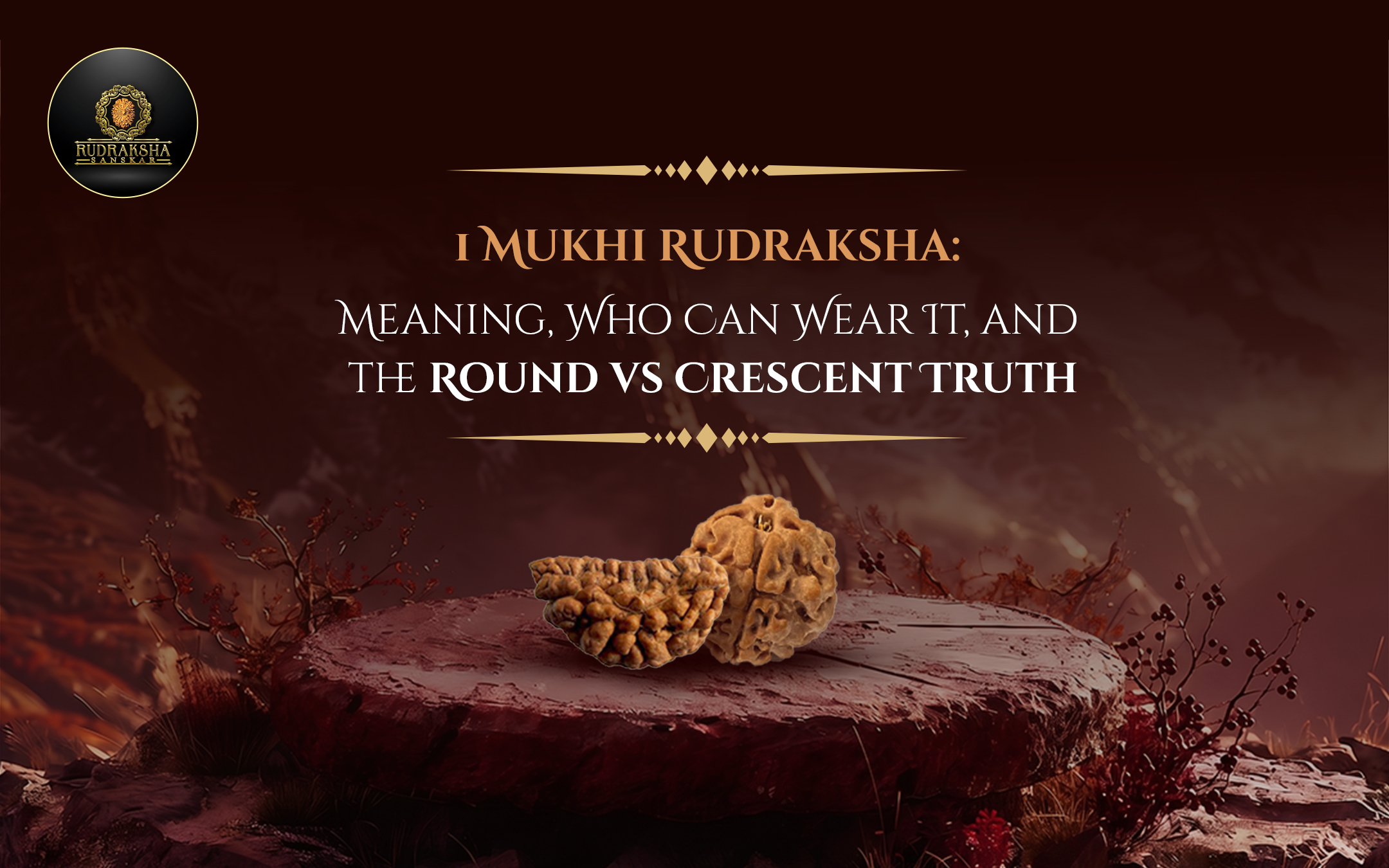
Crescent or Kaju-Shaped 1 Mukhi
Elongated, crescent or cashew-like 1 Mukhi are frequently seen in the market and are often associated with Indian or South Indian material.
Their shape can look very different from the familiar round form of common 5 Mukhi Rudraksha.
That does not make them fake simply because they are not round.
Round 1 Mukhi
Naturally round or near-round 1 Mukhi specimens are discussed and traded as exceptionally uncommon beads.
Because rarity can create a major price premium, a claimed round 1 Mukhi deserves more scrutiny, not less.
Do not assume that a round bead must be genuine because it looks more like the Rudraksha you expected.
The Important Rule
A crescent shape does not prove authenticity.
A round shape does not prove authenticity either.
And shape alone should not be used to prove geographic origin.
If a seller claims a specimen is a rare round Nepali 1 Mukhi, that is a much bigger claim than simply saying “this bead looks round.” The origin, natural Mukhi formation and exact specimen should be supported independently.
That is the real round-versus-crescent truth.
What Should You Check Before Buying 1 Mukhi Rudraksha?
Because 1 Mukhi commands high attention and can carry a significant price, verification should be specimen-specific.
Look for:
One Natural Mukhi Formation
The face should appear naturally formed rather than cut, carved or polished into place.
The Exact Bead Photograph
For a rare individual Rudraksha, you should know whether the photograph is of the specimen you will actually receive.
Dimensions and Weight
These give you measurable information that can be matched against the certificate.
Rudraksha Sanskar’s live 1 Mukhi inventory, for example, lists individual beads by exact dimensions, weight, origin and certification number rather than treating every 1 Mukhi as identical.
A Bead-Specific Certificate
A certificate should correspond to the individual specimen.
Look for information such as:
- certificate number
- Mukhi
- dimensions
- weight
- natural face count
- stated origin
- testing information
For higher-value pieces, supporting X-ray or laboratory examination adds another layer of verification.
Read our Rudraksha authenticity guide before purchasing a rare Mukhi online.
Does a Round 1 Mukhi Cost More?
Often, rarity claims have a major effect on price.
But the correct order is:
verify first → understand rarity → assess the price.
Not:
high price → therefore genuine.
Even within Rudraksha Sanskar’s current 1 Mukhi catalogue, individual specimens vary in size, weight, origin and price.
Those differences are normal for a natural product.
What you should avoid is paying a large premium solely because a seller uses words such as:
“round,”
“rare,”
“Nepal,”
or “one of a kind”
without supporting the claim with bead-specific information.
How Should You Wear 1 Mukhi Rudraksha?
If you have chosen an authentic bead and want to begin wearing it as part of Shiva practice, keep the initiation simple.
Monday is traditionally preferred by many devotees.
You can:
- Bathe and prepare a clean Shiva puja space.
- Keep the Rudraksha near the Shiva Lingam or image.
- Perform your usual Shiva worship or Jal Abhishek.
- Chant Om Namah Shivaya.
- Wear the bead or initially keep it with you during meditation according to your practice.
If you have received guidance from a guru or established tradition, follow that guidance instead of combining instructions from multiple internet sources.
With 1 Mukhi, Verification Comes Before Rarity
The fascination around 1 Mukhi is understandable.
It represents Shiva, it is uncommon and its appearance differs significantly between specimens sold under the 1 Mukhi category.
But those same qualities make it easy to oversell.
Do not buy a crescent bead simply because someone says every crescent is genuine. Do not pay a massive premium for a round bead simply because someone says every round specimen is rare.
Shape is something you observe. Authenticity is something you verify.
Choose 1 Mukhi because its traditional meaning fits your spiritual practice, and then insist that the exact bead, certificate and seller description agree with one another.
If you plan to buy Rudraksha online, explore the certified 1 Mukhi Rudraksha collection from a trusted seller like Rudraksha Sanskar and review the exact specimen details before purchasing.
FAQs
Yes. In Rudraksha tradition, 1 Mukhi is directly associated with Shiva and the symbolism of oneness and higher awareness.
There is no blanket gender or household restriction, but it is better suited to someone who understands its spiritual significance rather than a beginner buying purely because of rarity.
Naturally round or near-round specimens are discussed in the Rudraksha market, but they are considered exceptionally uncommon. Shape alone cannot prove authenticity.
No. Crescent or kaju-shaped 1 Mukhi are widely recognised in the market. The bead still needs proper authentication.
Do not make the decision from shape alone. Authenticity, natural formation, origin verification and the reason you want the bead matter more than simply choosing the rarer-looking shape.
Most beginners do not need to start there. A genuine 5 Mukhi is generally a more practical first Rudraksha for everyday Shiva devotion and japa.