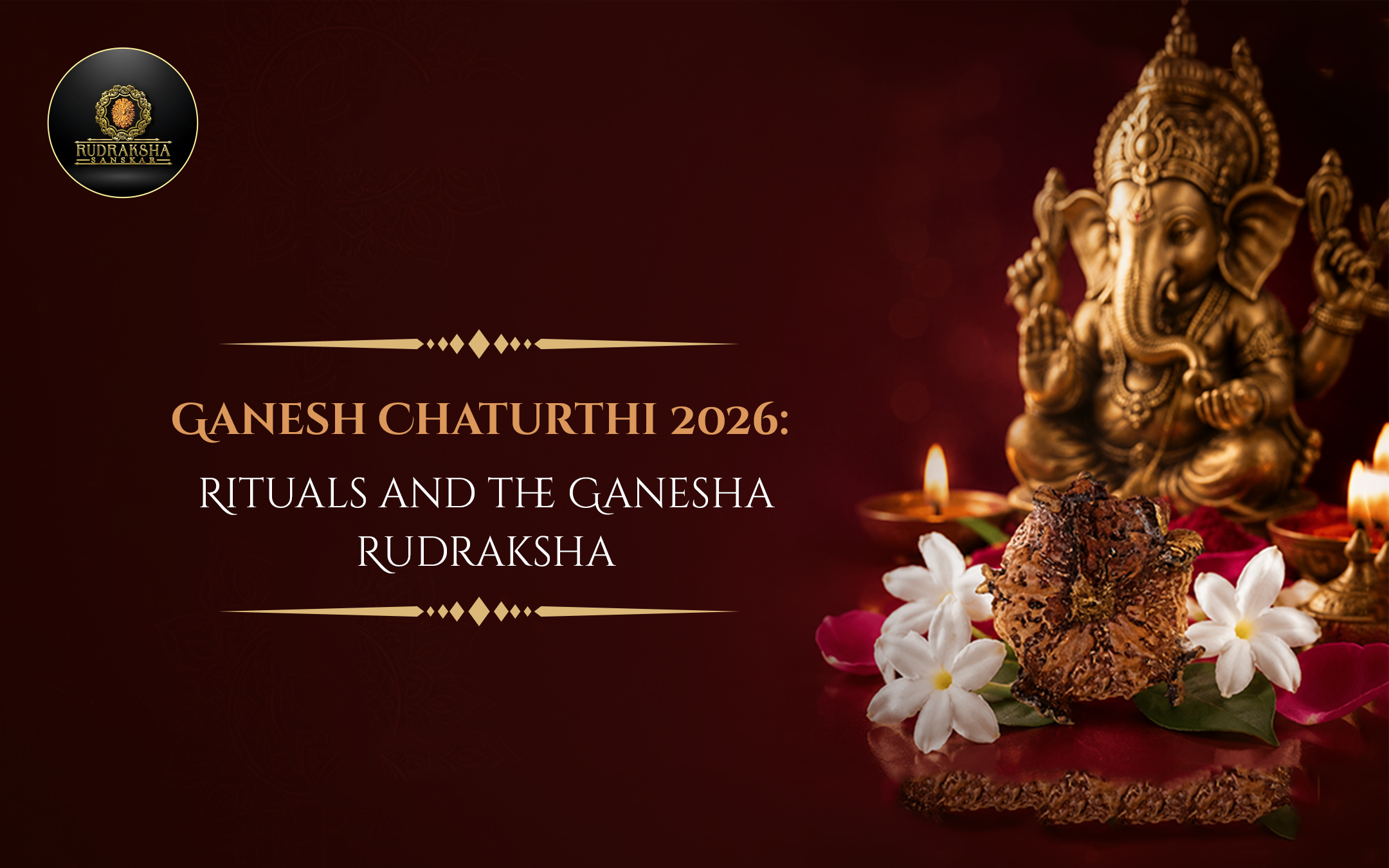
Ganesh Chaturthi 2026 falls on Monday, 14 September, beginning the annual celebration of Lord Ganesha as the deity of wisdom, auspicious beginnings and the removal of obstacles.
For devotees bringing Ganpati home, the day revolves around sthapana, puja, durva, modak, mantra and Aarti. For others, it can be a quieter day of prayer before beginning something important.
There is also a Rudraksha formation that shares this symbolism unusually closely.
Ganesh Rudraksha develops with a natural protrusion resembling Lord Ganesha’s trunk. It is not carved into that shape, and it is not restricted to one particular Mukhi.
That makes Ganesh Chaturthi a meaningful time to understand the formation, especially if you already intended to include one in your spiritual practice.
Ganesh Chaturthi 2026 Date and Puja Time
Ganesh Chaturthi is observed on Bhadrapada Shukla Chaturthi.
In 2026:
- Ganesh Chaturthi: Monday, 14 September
- Chaturthi Tithi Begins: 7:06 AM on 14 September
- Chaturthi Tithi Ends: 7:44 AM on 15 September
- Ahmedabad Madhyahna Puja: 11:21 AM to 1:49 PM
- Mumbai Madhyahna Puja: 11:20 AM to 1:48 PM
- Ganesh Visarjan: Friday, 25 September 2026
Puja timings vary by city, so devotees outside these locations should use their local Panchang rather than copying another city’s muhurat.
Why Is Ganesh Chaturthi Celebrated?
Ganesh Chaturthi celebrates Lord Ganesha, traditionally worshipped as Vighnaharta, the remover of obstacles, and as a deity connected with intelligence, wisdom and auspicious beginnings.
This is why Ganesha is commonly invoked before:
- beginning a new business
- entering a new home
- starting education
- launching an important project
- performing major ceremonies
- beginning a new spiritual practice
Ganesh Chaturthi takes those same ideas and places them at the centre of several days of worship.
The festival is not simply about asking for every obstacle to disappear.
Its symbolism also points toward the qualities required to move through obstacles intelligently: patience, clear judgment, humility and persistence.
A Simple Ganesh Chaturthi Puja Vidhi at Home
Family practices differ, particularly between Maharashtra, Gujarat and other regions.
If your family already has an established Ganpati tradition, continue with it.
For a simple home observance:
1. Prepare the Puja Space
Clean the area and place the Ganesh murti on a raised, clean platform.
Decorations can be elaborate or simple depending on your household.
The devotion does not depend on the scale of the setup.
2. Perform Ganesh Sthapana
Place the murti during the appropriate Madhyahna puja period followed in your city.
Begin with a prayer inviting Lord Ganesha into the puja space.
3. Offer Durva
Durva grass is one of the offerings most strongly associated with Ganesha worship.
Offer clean durva according to your family practice.
4. Offer Flowers and Modak
Red flowers are commonly offered to Ganesha, while modak is traditionally regarded as one of his favourite offerings.
Fresh fruit and other simple naivedya may also be included.
5. Chant the Ganesh Mantra
A simple mantra is:
Om Gan Ganapataye Namah
It can be repeated during the puja or used for japa.
6. Perform Aarti
Complete the worship with Ganesh Aarti according to the tradition followed in your home.
In Maharashtra, Sukhkarta Dukhharta remains one of the most familiar Ganesh Aartis.
7. Continue Daily Worship Until Visarjan
Families keep Ganpati for different lengths of time.
Some perform Visarjan after one and a half days, while others keep the murti for three, five, seven or the full festival period.
Follow your household tradition rather than assuming every family must keep Ganpati for the same duration.
What Is Ganesh Rudraksha?
A Ganesh Rudraksha is a naturally occurring Rudraksha formation with a protruding section resembling the trunk of Lord Ganesha.
The word naturally matters.
The formation should grow as part of the bead itself rather than being carved or attached afterward.
Ganesh Rudraksha can occur with different Mukhi counts.
For example, a bead may be:
- 8 Mukhi Ganesh
- 11 Mukhi Ganesh
- another Mukhi with Ganesh formation
So Ganesh does not describe the number of faces.
It describes the additional natural physical formation.
Rudraksha Sanskar’s current Ganesh collection includes multiple Mukhi variations, with individual beads listed by exact dimensions, weight and certification number.
Why Is Ganesh Rudraksha Associated With New Beginnings?
The connection comes directly from Lord Ganesha.
Ganesh Rudraksha is traditionally considered around:
- new beginnings
- overcoming obstacles
- clearer decisions
- education
- business beginnings
- professional transitions
- confidence when starting something unfamiliar
That makes its symbolism particularly appropriate around Ganesh Chaturthi.
But the same boundary applies here as with every Rudraksha:
the bead does not do the work for you.
Someone starting a business still needs planning.
A student still needs to study.
Someone changing careers still needs skills and preparation.
The Rudraksha belongs to the spiritual intention behind the beginning, not as a substitute for practical action.
Is Ganesh Chaturthi a Good Day to Start Wearing Ganesh Rudraksha?
It can be a meaningful day to begin if you already have an authentic Ganesh Rudraksha.
The festival’s entire symbolism aligns naturally with the formation.
A simple approach is:
- Keep the Rudraksha in the Ganesh puja space.
- Perform your normal Ganesh Chaturthi worship.
- Offer your prayers and durva to Lord Ganesha.
- Chant Om Gan Ganapataye Namah.
- Wear the bead after the puja according to your practice.
There is no need to invent an elaborate special activation ceremony.
And there is even less reason to buy an unverified bead in a hurry because Ganesh Chaturthi is approaching.
A meaningful date does not make a carved fake genuine.
Ganesh Rudraksha Is Not the Same as 8 Mukhi
This confusion is common.
An 8 Mukhi Rudraksha has eight naturally formed faces and is traditionally associated with Lord Ganesha.
A Ganesh Rudraksha is identified by the natural trunk-like protrusion.
So:
8 Mukhi = Mukhi classification
Ganesh Rudraksha = natural formation
An 8 Mukhi can exist without a Ganesh formation.
A Ganesh Rudraksha can also occur with another Mukhi count.
For the complete distinction, read our 8 Mukhi Rudraksha and Ganesh Rudraksha comparison.
How Do You Know if a Ganesh Rudraksha Is Natural?
Because its value comes from the unusual formation, this is one bead where physical inspection matters greatly.
Follow the Surface Texture
The rough natural texture of the Rudraksha should continue through the protrusion.
Be cautious if the supposed trunk looks:
- unusually smooth
- polished differently
- sharply cut
- separated from the natural surface pattern
Look for Tool Marks
A carved fake may show:
- sharp edges
- scraped areas
- artificial grooves
- cuts around the base of the protrusion
A natural growth generally looks more irregular.
Do Not Expect a Perfect Elephant Trunk
Natural Ganesh Rudraksha resembles Ganesha symbolically.
It does not need to look like a miniature sculpture.
In fact, a suspiciously perfect trunk deserves closer examination.
Check the Exact Specimen
For a valuable bead, look for:
- multiple-angle photographs
- Mukhi count
- dimensions
- weight
- origin
- certificate number
Rudraksha Sanskar’s current Ganesh collection contains individually identified beads rather than relying on one generic photo for the entire category.
For the detailed authentication process, see our Ganesh Rudraksha guide.
Who May Consider Ganesh Rudraksha?
Students
Its traditional connection with intelligence and clarity makes it relevant for students beginning a new course, academic year or important period of study.
Entrepreneurs
Starting a venture naturally aligns with Ganesha’s symbolism around auspicious beginnings and obstacles.
Professionals Starting a New Role
A promotion, career change or greater responsibility can all represent a meaningful new phase.
Devotees of Lord Ganesha
Not every Rudraksha needs to solve a problem.
Someone with an existing devotional connection to Ganesha may choose the formation simply because of what it represents spiritually.
A Ganesh Chaturthi Reminder: Do Not Turn Faith Into a Deadline
Festivals naturally increase interest in related spiritual items.
That also increases urgency.
You may see claims such as:
“Buy before Ganesh Chaturthi.”
“Wear only on this date.”
“Last chance for Ganesha blessings.”
There is no need to approach a rare natural Rudraksha that way.
If the bead is not properly verified before the festival, wait.
You can worship Ganesha without owning Ganesh Rudraksha.
And you can begin wearing an authentic Ganesh Rudraksha after Ganesh Chaturthi rather than buying a questionable one just to meet the date.
Begin With Ganesha, but Do Not Rush the Bead
Ganesh Chaturthi is ultimately about beginning well.
That is what makes Ganesh Rudraksha such a natural spiritual connection to the festival.
The formation represents Ganesha not because someone carved his shape into a bead, but because an unusual protrusion developed naturally.
That natural origin is part of its significance.
Celebrate Ganesh Chaturthi with your family’s puja, modak, mantra and Aarti. If you already own a genuine Ganesh Rudraksha, the day can be meaningful for beginning your wearing practice.
If you are still choosing, take your time.
And if you plan to buy rudraksha online, review the exact Ganesh Rudraksha formation, Mukhi and certification details before making your purchase.
FAQs
Ganesh Chaturthi falls on Monday, 14 September 2026.
The full Ganeshotsav concludes with Anant Chaturdashi and Ganesh Visarjan on Friday, 25 September 2026.
No. Floating or sinking alone cannot establish Mukhi authenticity or prove that a bead has not been modified.
Mukhi rarity, origin, natural formation, overall quality and market availability can all affect the price. Size is only one factor.
No. Price is not an authentication method.
For a higher-value individual Rudraksha, yes. Ideally, the certificate information should correspond directly with the specimen shown on the product page.
You can browse individual listings in the Rudraksha Sanskar shop, where many current products display certification numbers and bead-specific specifications.