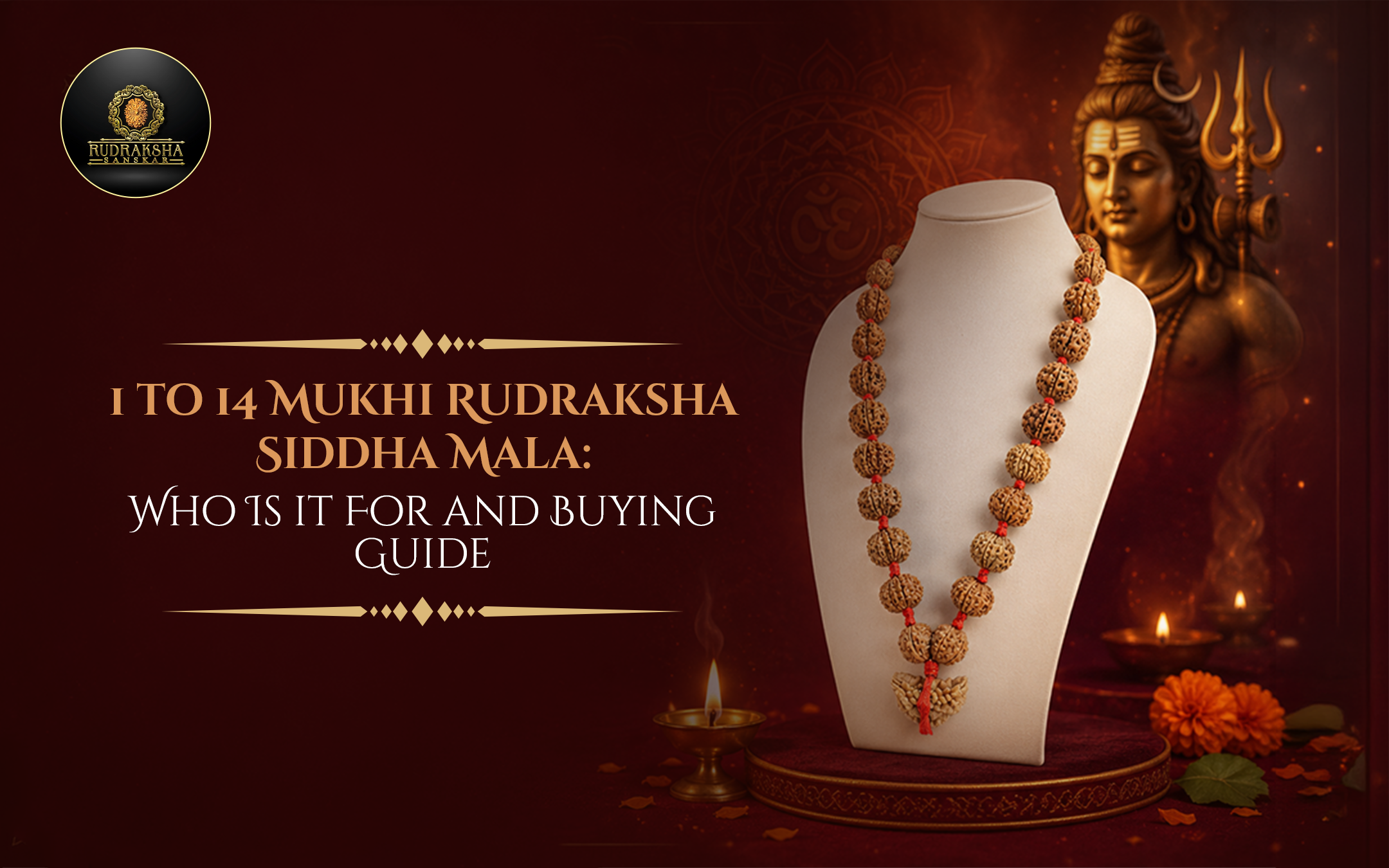
A 1 to 14 Mukhi Rudraksha Siddha Mala is not simply a larger version of a regular Rudraksha mala.
It is a structured combination bringing together Rudraksha from 1 Mukhi through 14 Mukhi, often with additional natural formations such as Gauri Shankar and Ganesh Rudraksha.
That makes it very different from wearing a single 5 Mukhi or 7 Mukhi bead for one specific traditional purpose.
A Siddha Mala is generally chosen by someone looking for a broad combination rather than one narrowly targeted Mukhi.
It can also be expensive because the mala includes several rare Mukhi. So before buying a 1 to 14 Mukhi Rudraksha Mala, it is important to know exactly what should be included and why two malas that look similar can have dramatically different prices.
What Is a 1 to 14 Mukhi Rudraksha Siddha Mala?
At its simplest, the combination contains:
- 1 Mukhi
- 2 Mukhi
- 3 Mukhi
- 4 Mukhi
- 5 Mukhi
- 6 Mukhi
- 7 Mukhi
- 8 Mukhi
- 9 Mukhi
- 10 Mukhi
- 11 Mukhi
- 12 Mukhi
- 13 Mukhi
- 14 Mukhi
Many Siddha Mala combinations also include:
Rudraksha Sanskar’s current inventory reflects this structure. One live Siddha Mala, for example, includes a South Indian 1 Mukhi, North Indian 2 Mukhi, Nepali 3 to 14 Mukhi, plus Gauri Shankar and Ganesh Rudraksha.
Another version uses Indonesian beads for most of the combination.
That difference alone can change the price substantially.
What Does Each Mukhi Add to the Combination?
The purpose of Siddha Mala is not that every bead does the same thing.
Each Mukhi carries its own traditional association.
| Mukhi | Traditional Association |
| 1 Mukhi | Shiva, spiritual awareness |
| 2 Mukhi | Unity, emotional harmony |
| 3 Mukhi | Agni, confidence and renewal |
| 4 Mukhi | Knowledge and communication |
| 5 Mukhi | Shiva practice, meditation and discipline |
| 6 Mukhi | Focus and self-control |
| 7 Mukhi | Stability and prosperity |
| 8 Mukhi | Ganesha, obstacles and new beginnings |
| 9 Mukhi | Durga, strength and courage |
| 10 Mukhi | Vishnu, balance and protection |
| 11 Mukhi | Hanuman, courage and discipline |
| 12 Mukhi | Surya, visibility and leadership |
| 13 Mukhi | Fulfilment, influence and ambition |
| 14 Mukhi | Awareness, judgment and higher responsibility |
These are traditional spiritual and astrological associations.
The Siddha Mala does not guarantee that all fourteen areas of life will suddenly improve.
Its significance lies in bringing multiple traditional Rudraksha associations into one structured combination.
Who Is a 1 to 14 Mukhi Siddha Mala Actually For?
This is not automatically the best choice for everyone.
Experienced Rudraksha Wearers
Someone who has already worn individual Mukhi and now wants a broader combination may find Siddha Mala more relevant.
They already understand:
- daily wearing
- Rudraksha care
- individual Mukhi differences
- how the beads fit into their spiritual routine
That makes the step into a full combination much more considered.
Serious Spiritual Practitioners
A Siddha Mala may also appeal to someone whose practice is not centred around solving one isolated concern.
Instead, they may want a combination representing:
- spiritual discipline
- knowledge
- courage
- stability
- clarity
- leadership
- devotion
In that situation, the broad structure makes more sense than choosing one Mukhi alone.
Business Owners and Senior Professionals
Rudraksha Sanskar’s current Siddha Mala positioning also includes business owners, leaders and professionals.
This is understandable because the combination includes Mukhi traditionally associated with:
- communication
- financial stability
- decision-making
- discipline
- visibility
- leadership
But again, wearing fourteen Mukhi does not replace business judgment or professional skill.
Collectors
A properly assembled mala containing 1 through 14 Mukhi can also be interesting to serious Rudraksha collectors, especially where the beads are individually identifiable and verified.
Who Probably Does Not Need a Siddha Mala Yet?
A First-Time Rudraksha Wearer
If you have never worn Rudraksha before, beginning with fourteen different Mukhi is usually unnecessary.
A genuine 5 Mukhi Rudraksha is far simpler for daily Shiva worship, meditation and japa.
You can always consider combinations later.
Someone Looking for One Specific Traditional Purpose
If your only concern is communication, perhaps 4 Mukhi deserves research.
If your concern is traditional Saturn-related stability, perhaps 7 Mukhi is more relevant.
If your interest is Surya, visibility and leadership, 12 Mukhi may be enough.
A full Siddha Mala is not automatically better simply because it contains more beads.
Someone Choosing Only Because It Sounds Powerful
Words like “Siddha,” “complete,” and “1 to 14 Mukhi” naturally sound impressive.
That should not be the only reason to spend on the combination.
Understand what is actually inside it first.
Why Does the Price Vary So Much?
This is one of the most important parts of buying a Siddha Mala.
Current Rudraksha Sanskar inventory shows just how wide the price range can be.
Some Indonesian-heavy Siddha Mala combinations are listed around ₹8,600 to ₹11,600.
Nepali-heavy combinations currently appear around ₹51,000 to ₹81,000, while a version containing a Nepali 1 Mukhi Sawar with Nepali 2 to 14 Mukhi, Gauri Shankar and Ganesh Rudraksha is listed at ₹1,11,000.
That variation comes from several factors.
Origin
A Siddha Mala may combine beads from:
- Nepal
- Indonesia
- South India
- North India
Nepali beads are generally larger and more prominently textured, which often increases price.
Which 1 Mukhi Is Included
This can have a major impact.
A South Indian 1 Mukhi and a rare Nepali Sawar-type 1 Mukhi do not sit at the same market value.
Size
Larger beads, particularly rare Nepali Mukhi, can add substantial cost.
Rare Mukhi Quality
The 13 and 14 Mukhi alone can influence the final price significantly depending on origin, size and specimen quality.
Additional Formations
Ganesh and Gauri Shankar may add another rarity premium where genuine natural formations are included.
What Should You Check Before Buying?
A 1 to 14 Mukhi Siddha Mala requires more checking than a simple everyday mala.
1. Confirm All 14 Mukhi Are Actually Present
Do not assume the product title is enough.
The seller should be able to identify every bead from 1 through 14 Mukhi.
2. Check the Origin of Each Group
A mala may contain mixed-origin Rudraksha.
That is not automatically a problem.
But it should be disclosed clearly.
For example, a current Rudraksha Sanskar Siddha Mala specifies:
- 1 Mukhi: South Indian
- 2 Mukhi: North Indian
- 3–14 Mukhi: Nepali
- Ganesh: Nepali
- Gauri Shankar: Nepali
That is useful buying information because it explains the composition and price.
3. Look for Certification
Current Siddha Mala listings from Rudraksha Sanskar carry individual certification numbers such as:
DCL/2026/B/0050
and provide downloadable certificate PDFs.
For a high-value combination, this kind of documentation matters.
4. Inspect the Rare Beads More Closely
Pay particular attention to:
- 1 Mukhi
- 13 Mukhi
- 14 Mukhi
- Ganesh
- Gauri Shankar
These are the beads where rarity can contribute significantly to price.
5. Ask for Exact Product Photographs
A premium Siddha Mala should ideally be sold using photographs of the actual combination you will receive.
You should not be evaluating an ₹80,000 mala using a generic stock photograph.
Nepal vs Indonesian Siddha Mala: Which Is Better?
Neither answer is universally correct.
Indonesian Combination
Usually:
- smaller
- lighter
- more affordable
- easier for people who prefer compact beads
Nepali Combination
Usually:
- larger
- heavier
- more visually pronounced
- more expensive
A Nepali-heavy mala may appeal to a collector or someone who prefers larger prominent Rudraksha.
An Indonesian combination may make more financial and practical sense for someone who wants the full Mukhi structure without paying the premium attached to large Nepali specimens.
Do not reduce the choice to:
Nepal = real
and
Indonesia = inferior.
Both can be genuine.
Should You Wear a Siddha Mala Every Day?
That depends on the size and way the combination has been prepared.
A compact combination may be comfortable for regular wearing.
A larger Nepali Siddha Mala can be heavier and may suit someone who prefers to use it primarily during:
- meditation
- puja
- spiritual practice
- important religious observances
Practical comfort matters.
There is little benefit in buying a combination you dislike wearing.
Buy the Combination, Not Just the Name
A 1 to 14 Mukhi Siddha Mala sounds impressive because it contains so many important Rudraksha in one place.
That is exactly why the buying process should be slower, not faster.
Check what is actually included.
Understand where the beads come from.
Look closely at the rare Mukhi.
Verify the certification.
And decide whether you genuinely need a complete combination or whether one carefully chosen Mukhi would serve your purpose better.
If you want to compare current 1 to 14 Mukhi Rudraksha Mala options, review the exact composition, origin and certificate details before choosing.
And if you plan to buy rudraksha online, use Rudraksha Sanskar’s main site to compare certified individual beads and ready-to-wear combinations before making the purchase.
FAQs
It is a structured combination containing Rudraksha from 1 Mukhi through 14 Mukhi, often with Ganesh and Gauri Shankar formations added.
It can be worn by beginners, but most first-time wearers do not need such a complex or expensive combination. 5 Mukhi is usually simpler.
The price reflects the rare Mukhi included, their size, origin, quality, certification and additional formations such as Ganesh or Gauri Shankar.
Not automatically. Nepali versions are generally larger and more expensive, while Indonesian combinations are smaller and often more affordable.
For a high-value 1 to 14 Mukhi combination, certification and clear bead-level identification are strongly worth checking.
Yes, if the size and construction are comfortable for daily wear. Larger combinations may be more practical for puja or meditation.