“Himalayan Rudraksha” sounds like a specific type of Rudraksha.
It is not a Mukhi.
It is not a separate spiritual category.
And it does not mean that every bead described as Himalayan was collected high in the snow-covered mountains.
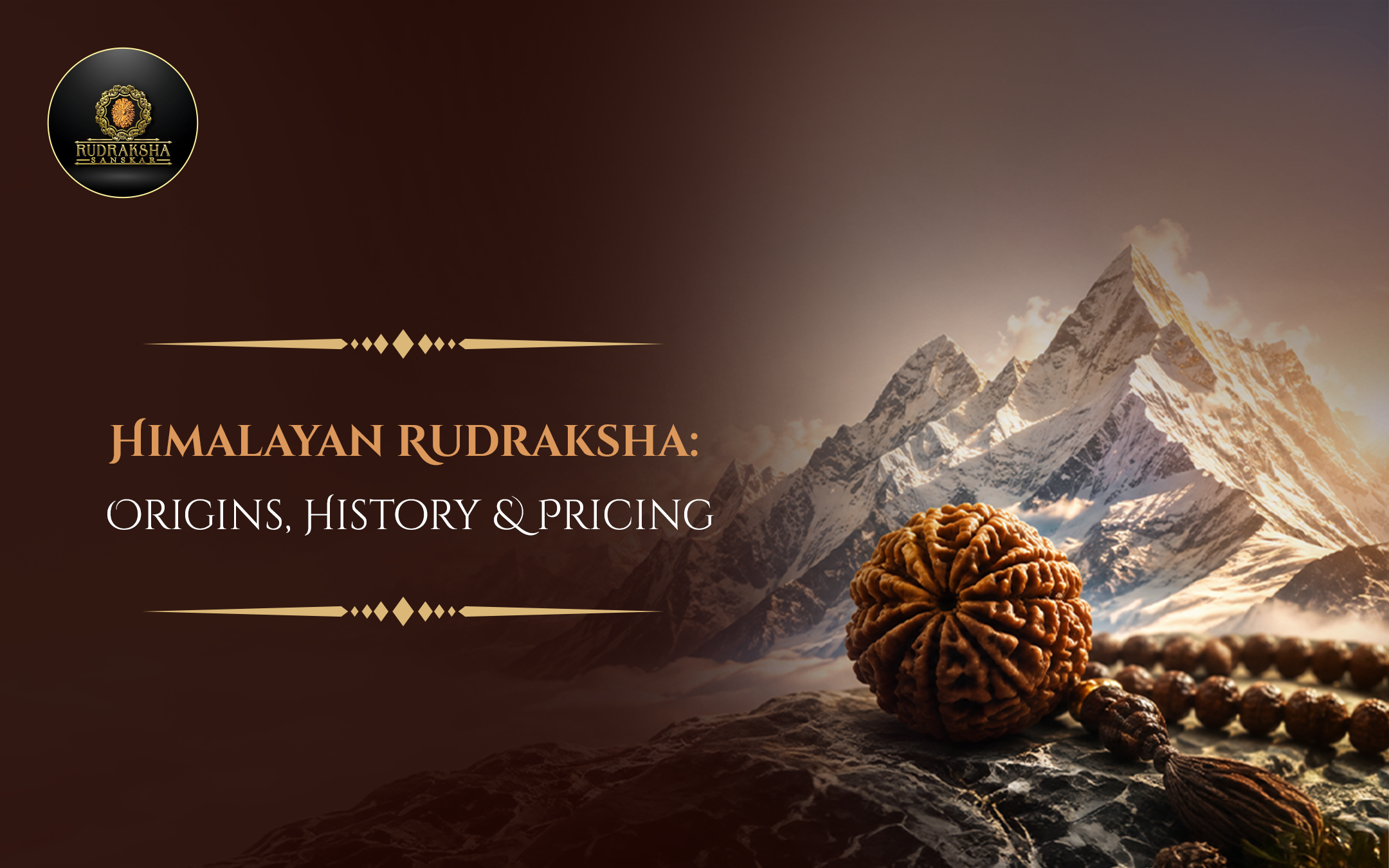
In the Rudraksha market, Himalayan Rudraksha generally refers to beads associated with Nepal and the Himalayan foothill region, particularly the larger, deeply textured Rudraksha for which Nepal is known.
For a buyer, the distinction matters because origin can influence size, appearance, availability and price.
But origin alone does not establish authenticity.
Before paying a premium for Himalayan or Nepal Rudraksha, it helps to understand where the bead actually comes from, why Nepal became so important to the Rudraksha tradition and what determines its price today.
What Is Himalayan Rudraksha?
Rudraksha is the seed or stone found inside the fruit of trees from the Elaeocarpus genus, particularly Elaeocarpus ganitrus.
The tree grows across a much wider geographic range than the name “Himalayan Rudraksha” might suggest.
Rudraksha is associated with regions including:
- Nepal
- Himalayan foothills of India
- other parts of India
- Indonesia
- parts of Southeast Asia
So technically, not every Rudraksha is Himalayan.
When sellers use the term Himalayan Rudraksha today, they are usually distinguishing larger Nepal-origin or Himalayan-region beads from smaller Indonesian or Java Rudraksha.
That makes “Himalayan” primarily an origin and market-description term, while Mukhi remains the classification of the individual bead.
Why Is Nepal So Closely Associated With Rudraksha?
Nepal occupies a special place in modern Rudraksha sourcing because its climate supports Elaeocarpus ganitrus, particularly across suitable hill regions.
Eastern Nepal is especially known for Rudraksha cultivation and trade.
The seeds produced there are often recognised for being:
- comparatively large
- heavier
- deeply textured
- strongly segmented
- marked by prominent Mukhi lines
These physical characteristics make Nepal Rudraksha visually distinctive.
They also make individual faces easier to inspect on many specimens.
This is one reason Nepal-origin Rudraksha often commands a premium in the Indian market.
But that premium should be understood as a combination of origin, physical characteristics, rarity and demand, not proof that every Nepali bead is automatically better for every wearer.
Rudraksha Has a Much Older History Than the Modern Trade
The importance of Rudraksha did not begin with online stores, certification laboratories or modern Nepal-India commerce.
Its significance comes from longstanding Hindu spiritual traditions, particularly Shaivism.
The name itself is traditionally understood through:
Rudra = a name or aspect of Shiva
Aksha = eye or tear
This gives rise to the familiar traditional meaning of Rudraksha as the “tears of Shiva.”
Rudraksha beads have long been used for:
- Shiva worship
- mantra japa
- meditation
- malas
- personal spiritual practice
The association is particularly visible in Shaiva traditions, where Rudraksha is closely connected with the identity and worship of Shiva.
Over time, different Mukhi counts also developed specific traditional associations with deities, planets and spiritual qualities.
That is how the market eventually came to distinguish everything from common 5 Mukhi beads to extremely rare higher Mukhi specimens.
What Makes a Himalayan Rudraksha Look Different?
A Nepal or Himalayan-origin bead will often look quite different from a Java or Indonesian Rudraksha.
Nepal / Himalayan Rudraksha
Typically:
- larger
- heavier
- more deeply grooved
- more strongly textured
- visibly pronounced Mukhi lines
Indonesian / Java Rudraksha
Typically:
- smaller
- lighter
- more compact
- finer in texture
- subtler Mukhi lines
Neither description determines whether a bead is genuine.
They reflect different physical characteristics associated with origin.
A genuine Indonesian Rudraksha does not become inferior simply because it is smaller.
Likewise, a large Nepali bead does not become authentic simply because somebody calls it Himalayan.
Does Himalayan Rudraksha Have Different Benefits?
This is where marketing claims need some restraint.
The traditional identity of a Rudraksha is primarily connected with its Mukhi and formation, not simply its country of origin.
For example:
A 5 Mukhi Nepal Rudraksha and a genuine 5 Mukhi Indonesian Rudraksha are both 5 Mukhi.
The Nepal bead may be:
- larger
- heavier
- easier to inspect visually
- rarer at a premium size
- more expensive
But it is misleading to turn those physical differences into guaranteed claims that the larger bead must produce stronger spiritual results.
Origin affects the specimen and market value.
Mukhi and formation remain central to its traditional classification.
Why Is Himalayan Rudraksha More Expensive?
There is no single “Himalayan Rudraksha price.”
Pricing depends on several factors working together.
1. Mukhi Count
This is usually the biggest factor.
Common Mukhi are naturally more available.
Rare higher Mukhi can become extremely expensive.
A large 5 Mukhi Nepal bead may still cost far less than a smaller but genuinely rare 14, 16 or 21 Mukhi.
2. Size
Large, well-formed Nepal Rudraksha can carry substantial premiums.
This is why two Nepali beads with the same Mukhi can have very different prices.
Larger size may mean greater collector demand and lower availability.
It does not automatically mean greater spiritual power.
3. Rarity
Higher Mukhi and unusual natural formations can dramatically affect value.
Examples include:
- 14 Mukhi and higher
- Ganesh formations
- Gauri Shankar
- Garbh Gauri
- Sawar
- Trijuti
The rarer the genuine natural formation, the more carefully it should be verified before paying a premium.
4. Physical Condition
A well-developed specimen with clear natural structure can command more than a damaged or poorly formed bead of the same category.
5. Certification and Traceability
For higher-value Himalayan Rudraksha, buyers should expect stronger documentation.
That may include:
- exact dimensions
- weight
- stated origin
- certification number
- X-ray information where available
- photographs of the actual bead
The more expensive the specimen, the less reasonable it becomes to buy based only on a product name.
What Does Himalayan Rudraksha Cost in India in 2026?
The range is enormous.
Current Rudraksha Sanskar inventory illustrates why a single price cannot describe Nepal-origin Rudraksha.
The point is the difference. The range can easily start from Rs.1000 – Rs. 2.5L+
A Himalayan Rudraksha can cost a few thousand rupees or several lakhs depending on Mukhi, size and rarity.
For live specimens and current pricing, browse the Himalayan and Nepal Rudraksha options in the Rudraksha Sanskar shop.
Does a Higher Price Mean a Better Rudraksha?
Not necessarily.
Suppose one person wants a Rudraksha for everyday Shiva worship.
A genuine 5 Mukhi may suit that purpose perfectly.
Another person may be specifically searching for a certified rare 14 Mukhi Nepal specimen.
The second bead may cost dramatically more.
That does not make the first person’s spiritual practice “less powerful.”
Price reflects scarcity and physical characteristics.
It should not become a ranking system for devotion.
How Can You Verify a Himalayan Rudraksha?
Check the Mukhi Carefully
Every claimed face should form naturally.
Look for continuous natural lines rather than grooves that appear artificially cut.
Ask for the Origin
If a product is being sold specifically at a Himalayan or Nepal premium, the seller should clearly disclose the stated origin.
“Himalayan quality” is not the same statement as “Origin: Nepal.”
Check Size and Weight
These help identify the individual specimen and allow meaningful comparisons between similarly classified beads.
Inspect the Exact Bead
Avoid judging an expensive Rudraksha from a generic category photograph.
For a rare specimen, ask for multiple angles.
Match the Certification
Certificate details should correspond with the bead being purchased.
Rudraksha Sanskar’s current shop provides individual certification numbers across its inventory, with X-ray references also available for many rare specimens.
For a detailed checklist, read how to identify an original Rudraksha.
Himalayan vs Indonesian Rudraksha: Which Should You Buy?
Choose according to your purpose rather than assuming the more expensive origin is always necessary.
Consider Himalayan/Nepal Rudraksha if:
- you prefer larger beads
- prominent Mukhi lines matter to you
- you want an individually identifiable specimen
- you are looking for rare higher Mukhi
- collecting is part of your interest
Consider Indonesian Rudraksha if:
- you prefer smaller beads
- you want a lighter mala
- budget matters
- you are comfortable with finer Mukhi lines
Both can be authentic.
Origin is a choice, not a competition.
Himalayan Is the Origin Story, Not the Whole Identity
“Himalayan Rudraksha” is useful terminology when it tells you something meaningful about where a bead comes from.
It becomes less useful when it is treated as a vague premium label.
A Rudraksha still needs to be evaluated individually.
What is its Mukhi?
What is its size?
Where is it actually from?
Is the formation natural?
Does the certificate match the specimen?
And does the price make sense for those characteristics?
Those questions matter more than the word “Himalayan” printed above the product.
If you plan to buy rudraksha online, compare the exact Mukhi, origin, dimensions and certification of individual Rudraksha Sanskar specimens rather than choosing from the origin label alone.
FAQs
The term generally refers to Rudraksha associated with Nepal and the Himalayan foothill region, especially the larger and deeply textured beads commonly sourced from Nepal.
The terms are often used interchangeably commercially, although “Himalayan” is geographically broader than Nepal.
Large size, pronounced structure, demand and the availability of rare Mukhi can all contribute to higher prices.
Not automatically. They differ physically in size and surface structure, but both can be genuine Rudraksha.
There is no fixed price. Common Mukhi may cost relatively little, while rare large Nepal-origin Mukhi and special formations can reach several lakhs.
Larger size can increase rarity and price, but it should not be treated as proof of stronger spiritual effects.
Check the natural Mukhi lines, exact photographs, dimensions, weight, stated origin and bead-specific certification.