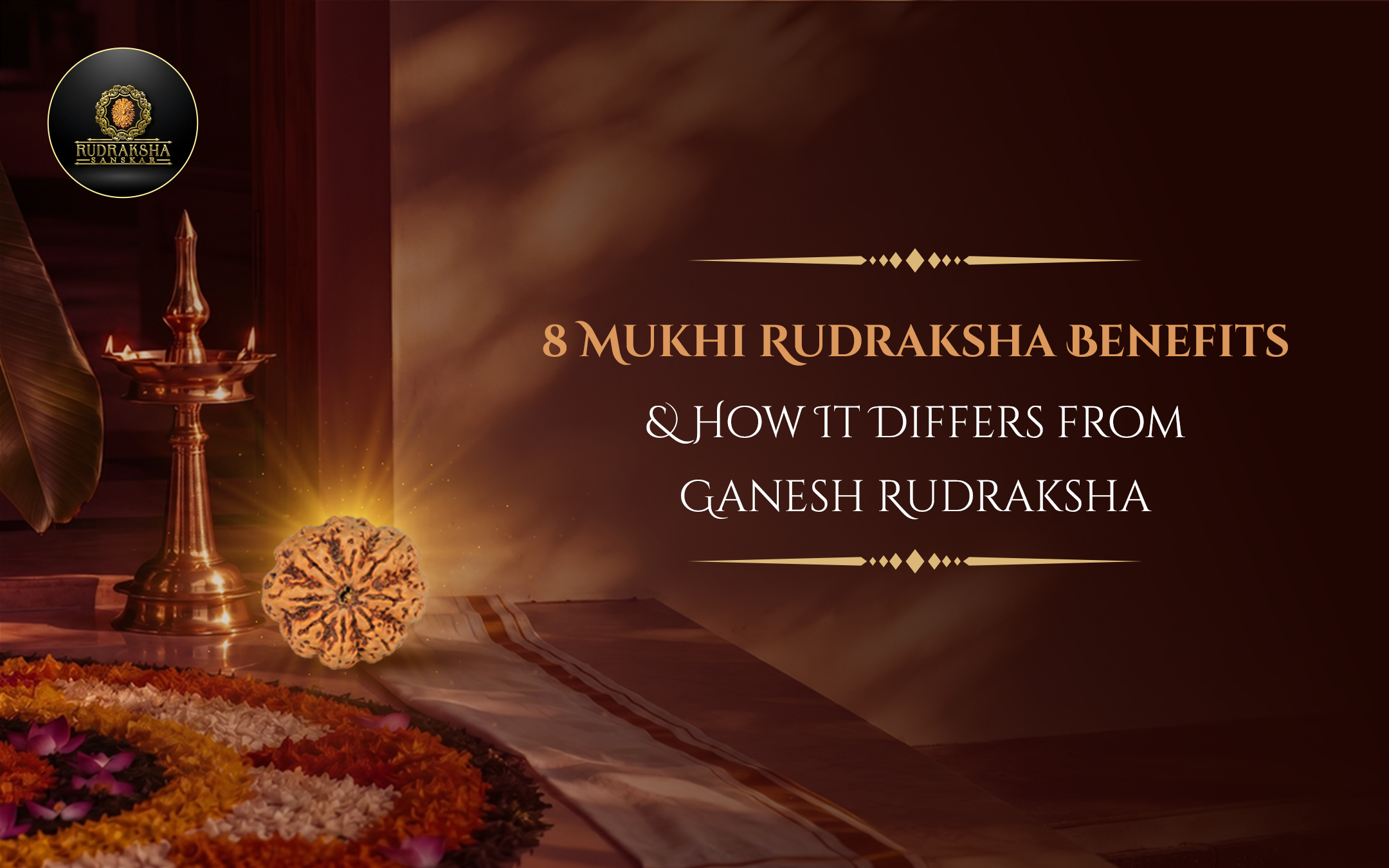
The 8 Mukhi Rudraksha and Ganesh Rudraksha are often treated as if they are the same bead.
They are not.
Both are traditionally associated with Lord Ganesha, which explains the confusion. But physically, they are identified in completely different ways.
An 8 Mukhi Rudraksha is defined by eight naturally formed Mukhi lines running across the bead.
A Ganesh Rudraksha is identified by a natural trunk-like protrusion on its surface.
That means an 8 Mukhi can be a normal 8 Mukhi without Ganesh formation, while a Ganesh Rudraksha can occur with a different Mukhi count altogether.
Understanding that difference matters before choosing either one.
What Is an 8 Mukhi Rudraksha?
An 8 Mukhi Rudraksha has eight naturally formed lines running from one end of the bead to the other.
Traditionally, it is associated with Lord Ganesha, the deity linked with wisdom, new beginnings and the removal of obstacles. Rudraksha Sanskar also associates 8 Mukhi astrologically with Rahu, particularly in traditional discussions around confusion, uncertainty and unexpected obstacles.
This explains why the bead is commonly considered by people facing:
- repeated obstacles
- indecision
- confusion
- fear around important choices
- delayed progress
- new career or business phases
These are traditional associations, not guaranteed outcomes.
8 Mukhi Rudraksha Benefits: What Does It Traditionally Represent?
The strongest theme around 8 Mukhi is not “success without obstacles.”
It is clarity when obstacles appear.
1. Clarity in Decision-Making
8 Mukhi is traditionally associated with structured thinking and clearer decisions.
Someone repeatedly postponing an important choice may therefore relate more naturally to this Mukhi than someone simply looking for general spiritual practice.
2. Support During New Beginnings
Because of its connection with Lord Ganesha, 8 Mukhi is often considered when starting:
- a business
- a new job
- higher studies
- an important project
- a major life transition
The symbolism is about beginning with greater clarity and fewer self-created blocks.
3. Facing Repeated Obstacles
Some obstacles are external.
Others come from hesitation, overthinking or repeated poor decisions.
Traditional 8 Mukhi guidance often focuses on helping the wearer approach these situations with more confidence and direction.
4. Rahu-Related Traditional Guidance
In astrological practice, 8 Mukhi is also associated with Rahu.
It may therefore be discussed for periods traditionally linked with confusion, sudden disruptions or uncertainty.
This should not be interpreted as a guaranteed way to “remove Rahu.” Astrology-based Rudraksha selection is better understood as a supportive traditional practice.
What Is Ganesh Rudraksha?
A Ganesh Rudraksha is classified by its natural physical formation, not by one specific Mukhi number.
Its distinguishing feature is a naturally occurring protrusion that resembles the trunk of Lord Ganesha.
That protrusion must be natural.
A regular Rudraksha that has been carved to create a trunk shape is not an authentic Ganesh formation. Rudraksha Sanskar’s current authentication guidance makes this distinction explicit.
Ganesh Rudraksha is traditionally associated with:
- obstacle removal
- wisdom
- auspicious beginnings
- clarity
- success in new undertakings
- Lord Ganesha devotion
The symbolism overlaps strongly with 8 Mukhi.
The physical classification does not.
8 Mukhi vs Ganesh Rudraksha: The Difference
The simplest comparison is this:
| Feature | 8 Mukhi Rudraksha | Ganesh Rudraksha |
| Identified by | Eight natural Mukhi lines | Natural trunk-like protrusion |
| Classification | Mukhi-based | Formation-based |
| Traditional deity | Lord Ganesha | Lord Ganesha |
| Main symbolism | Obstacles, clarity, decisions | Ganesha blessings, beginnings, obstacles |
| Can occur with other Mukhi? | No, it must have eight faces | Yes |
| Main authenticity check | Count eight natural lines | Verify natural protrusion |
This is why saying “Ganesh Rudraksha means 8 Mukhi Rudraksha” is incorrect.
They share the same deity association but describe different physical characteristics.
Can an 8 Mukhi Also Be a Ganesh Rudraksha?
Yes.
This is where the classification becomes useful.
If an 8 Mukhi bead has:
eight natural Mukhi lines
and also
a naturally formed Ganesh-like protrusion
then it can reasonably be described as an 8 Mukhi Ganesh Rudraksha.
Likewise, Ganesh formations can occur on other Mukhi.
Rudraksha Sanskar’s current Ganesh inventory includes Ganesh Rudraksha identified with other Mukhi counts, including 11 Mukhi specimens.
So Ganesh is an additional natural formation, not a replacement for Mukhi count.
Which One Should You Wear?
That depends more on your intention than on which sounds rarer.
Choose 8 Mukhi if:
- you want a Ganesha-associated Rudraksha with a clearly defined Mukhi
- your focus is on repeated obstacles or indecision
- you are considering traditional Rahu-related guidance
- you want a more straightforward Mukhi-based selection
Consider Ganesh Rudraksha if:
- your devotional connection is specifically with Lord Ganesha
- you value the natural Ganesha-like formation itself
- you are interested in a rarer physical Rudraksha formation
- you understand that its underlying Mukhi still matters
If you are completely new to Rudraksha
Neither is automatically necessary.
For general Shiva worship, meditation or everyday japa, 5 Mukhi Rudraksha is still a simpler first bead.
Do not choose 8 Mukhi or Ganesh merely because “obstacle removal” sounds relevant to almost everyone.
The more specific the intention, the more useful the selection becomes.
Which One Is Rarer?
A regular 8 Mukhi is defined by its Mukhi count.
Ganesh Rudraksha requires an additional natural formation.
That unusual growth can make genuine Ganesh specimens more distinctive and, depending on the underlying Mukhi, potentially rarer.
But rarity should not be confused with suitability.
A genuine 8 Mukhi may be exactly what someone needs from a traditional perspective, even if a Ganesh formation costs more.
Higher price does not mean better spiritual fit.
How to Identify an Original 8 Mukhi Rudraksha
A genuine 8 Mukhi should have:
- eight natural Mukhi lines
- lines continuing naturally along the bead
- natural pores and surface texture
- no suspicious carved grooves
- no artificial colouring or excessive polishing
Rudraksha Sanskar’s current 8 Mukhi authenticity guidance specifically warns against artificially carved lines, synthetic beads and chemically treated surfaces.
For premium individual pieces, also look for:
- exact photographs
- dimensions
- weight
- origin
- certificate number
- X-ray information where available
The current 8 Mukhi Rudraksha collection includes individual bead listings with SKU-level certification numbers rather than relying only on a generic authenticity claim.
How to Identify an Original Ganesh Rudraksha
The main question is simple:
Was the protrusion naturally formed?
Look for:
- organic integration with the bead
- natural surface texture continuing through the protrusion
- no visible cutting or carving
- no glue
- no artificial attachment
- clear photographs from several angles
A suspiciously perfect elephant trunk should make you more cautious, not more impressed.
For more detail, see the Ganesh Rudraksha authenticity guide.
Same Ganesha Symbolism, Different Rudraksha
The confusion between 8 Mukhi and Ganesh Rudraksha is understandable because both are closely connected with Lord Ganesha.
But once you look at the bead itself, the difference is straightforward.
Eight natural faces make it an 8 Mukhi.
A natural trunk-like formation makes it Ganesh Rudraksha.
One describes Mukhi count.
The other describes a rare physical formation.
Choose an 8 Mukhi when its traditional association with clarity, obstacles and Rahu-related guidance fits your purpose. Consider Ganesh Rudraksha when the natural Ganesha formation itself has devotional meaning for you.
Whichever you choose, verify the physical feature being claimed before paying for rarity.
If you plan to buy Rudraksha online, explore the 8 Mukhi Rudraksha and Ganesh Rudraksha collections from a trusted seller like Rudraksha Sanskar and compare the exact bead details before purchasing.
FAQs
No. 8 Mukhi is identified by eight natural faces. Ganesh Rudraksha is identified by a natural trunk-like protrusion.
It is traditionally associated with Lord Ganesha. Rudraksha Sanskar also connects it with Rahu within astrological practice.
Traditionally, it is associated with overcoming obstacles, clearer decisions, confidence during uncertain phases and new beginnings.
Yes. Ganesh describes the natural protrusion, so the formation can appear on Rudraksha with different Mukhi counts.
Yes, if it has eight natural faces plus a genuine naturally formed Ganesh protrusion.
Neither is universally better. Choose according to the traditional purpose, physical formation and your devotional intention rather than rarity alone.
 7 Mukhi Nepali Kantha ( 16-18mm )
  5 Mukhi Nepali Kantha - Certificate: DCL/2026/B/0027