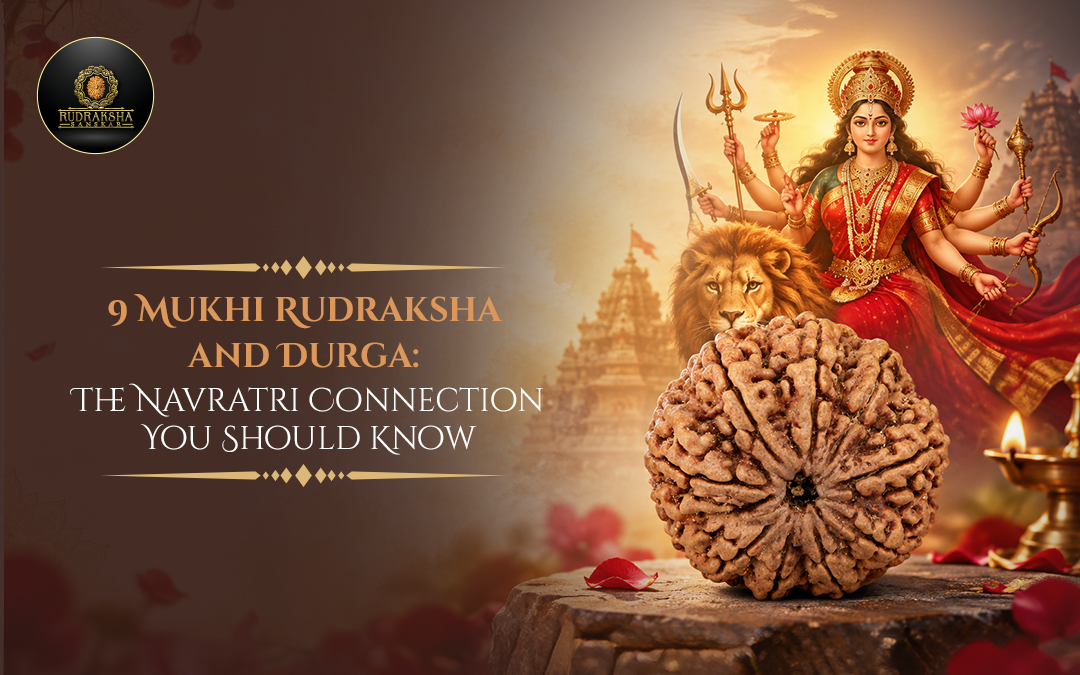
Nine nights. Nine forms of Goddess Durga. And a Rudraksha with nine natural faces.
Is there a spiritual connection between them?
For many devotees, the answer lies in the traditional symbolism of the 9 Mukhi Rudraksha, which is widely associated with Goddess Durga and her divine energy, known as Shakti.
Navratri celebrates the Divine Mother through nine nights of worship, devotion and spiritual reflection.
The 9 Mukhi Rudraksha carries a similar devotional association with strength, courage and overcoming difficulties.
But does this mean the bead is specifically mentioned in every Navratri tradition? And should devotees wear it during the festival?
Let’s explore the connection through mythology, traditional beliefs and practical guidance.
What Is the 9 Mukhi Rudraksha?
The 9 Mukhi Rudraksha is a naturally formed Rudraksha with nine distinct facial divisions, called Mukhi.
These divisions appear as natural grooves running along the bead’s surface.
In several contemporary Rudraksha traditions, the 9 Mukhi is associated with:
- Goddess Durga
- Navdurga, the nine forms of the Divine Mother
- Shakti, or divine feminine energy
- Courage and determination
- Protection symbolism
- Ketu in certain astrological interpretations
However, religious associations can differ across traditions.
For example, the Shiva Purana’s Rudraksha classification also associates the nine-faced bead with Bhairava.
This does not necessarily invalidate the Durga association. It shows that Rudraksha symbolism has developed through different religious interpretations.
Why Is 9 Mukhi Rudraksha Associated With Goddess Durga?
Goddess Durga represents divine strength, protection and the victory of righteousness over destructive forces.
In Hindu mythology, one of her best-known stories is the defeat of Mahishasura.
According to the Devi Mahatmya, Mahishasura becomes a powerful threat to the gods.
Durga emerges as a formidable divine warrior and defeats him after an intense battle.
The story represents the triumph of divine power over arrogance, oppression and destructive tendencies.
The 9 Mukhi Rudraksha is associated with Durga in several devotional traditions because of its symbolism involving strength and protection.
Its nine faces are also interpreted by some practitioners as representing the nine forms of Goddess Durga.
The connection is primarily devotional and symbolic, rather than a claim that the bead itself appears in every account of Durga’s mythology.
The Nine Forms of Durga and Their Navratri Significance
During Sharad Navratri, devotees commonly worship the nine forms of Goddess Durga, collectively known as Navdurga.
Each form represents a distinct aspect of divine feminine power.
| Navratri day | Form of Durga | Common traditional symbolism |
| Day 1 | Shailaputri | Stability, devotion and strength |
| Day 2 | Brahmacharini | Discipline, patience and spiritual dedication |
| Day 3 | Chandraghanta | Courage and protection |
| Day 4 | Kushmanda | Creation, vitality and positive energy |
| Day 5 | Skandamata | Motherhood, compassion and nurturing |
| Day 6 | Katyayani | Determination and courage |
| Day 7 | Kalaratri | Fearlessness and overcoming darkness |
| Day 8 | Mahagauri | Purity, peace and renewal |
| Day 9 | Siddhidatri | Spiritual fulfilment and wisdom |
These nine forms are central to the devotional experience of Navratri.
Some Rudraksha traditions connect the nine faces of 9 Mukhi with Navdurga collectively.
However, there is no universally established rule assigning each individual Mukhi line to a particular form of Durga.
The connection is better understood as a representation of the Divine Mother’s combined spiritual qualities.
What Is the Connection Between Navratri and 9 Mukhi Rudraksha?
Navratri means nine nights.
The festival celebrates the Divine Mother through worship, fasting, prayer, music and other regional traditions.
For devotees who follow the Durga association of 9 Mukhi Rudraksha, the festival may be a meaningful time to reflect on the bead’s symbolism.
Three themes help explain this connection.
1. Courage During Difficult Times
Durga’s victory over Mahishasura represents strength in the face of adversity.
The 9 Mukhi Rudraksha is traditionally associated with courage and determination.
For a devotee, it may serve as a reminder to face challenges with patience and inner strength.
2. Protection and Spiritual Confidence
Durga is widely worshipped as a protective divine presence.
Similarly, 9 Mukhi Rudraksha is often associated with protection in contemporary spiritual interpretations.
This should be understood as religious symbolism, not a guarantee of safety from accidents, illness or other harm.
3. Devotion to Shakti
Navratri places the worship of Shakti at its centre.
The 9 Mukhi Rudraksha may appeal to devotees who want a physical reminder of their connection with Goddess Durga.
Its meaning comes from the spiritual practice and tradition followed by the wearer.
Is 9 Mukhi Rudraksha Especially Powerful During Navratri?
This is a common question.
Navratri is considered an auspicious period for worshipping Goddess Durga.
Some devotees choose to begin wearing a 9 Mukhi Rudraksha during the festival as part of their personal religious practice.
However, there is no reliable basis for claiming that the bead becomes measurably more powerful during these nine nights.
Its physical characteristics do not change because of the festival.
What may change is the significance of the occasion for the devotee.
Prayer, meditation and spiritual reflection can make Navratri a personally meaningful time to begin wearing the bead.
The festival provides devotional context, not proof of increased supernatural effectiveness.
How Is 9 Mukhi Connected With Ketu?
Beyond its association with Goddess Durga, 9 Mukhi Rudraksha is also linked with Ketu in certain contemporary astrological traditions.
Ketu is commonly associated with detachment, introspection and spiritual transformation.
Some practitioners recommend 9 Mukhi within astrological practices concerning Ketu.
However, these associations should not be treated as scientifically established methods of changing planetary influences or guaranteeing particular outcomes.
The Durga connection and Ketu association belong to different interpretive traditions.
A person interested in the bead should understand which tradition they are following rather than assuming every association has the same scriptural origin.
9 Mukhi vs 8 Mukhi: Which Is Better for Navratri?
The 8 Mukhi Rudraksha is commonly associated with Lord Ganesha.
The 9 Mukhi is widely associated with Goddess Durga in contemporary devotional practice.
Their symbolism differs.
8 Mukhi: Ganesha, wisdom, new beginnings and overcoming obstacles.
9 Mukhi: Durga, Shakti, courage and protection symbolism.
For someone specifically interested in Navdurga worship, the 9 Mukhi may have a more direct devotional association.
However, this does not mean 8 Mukhi is spiritually inferior.
The appropriate choice depends on the person’s tradition and purpose.
How to Wear 9 Mukhi Rudraksha During Navratri
If you wish to begin wearing a 9 Mukhi during Navratri, keep the process simple and respectful.
Choose an Authentic Bead
Before considering rituals, verify the Rudraksha itself.
Check its nine natural Mukhi, surface condition and available documentation.
Follow Your Family or Spiritual Tradition
Different families and religious lineages may follow different practices for preparing or wearing Rudraksha.
There is no need to assume that one commercially promoted ritual is compulsory for everyone.
Begin With Prayer
Some devotees offer prayers to Goddess Durga before wearing the bead.
A commonly recited Durga mantra is:
ॐ दुं दुर्गायै नमः
Om Dum Durgayai Namah.
This mantra is associated with the worship of Goddess Durga. Its use specifically with 9 Mukhi Rudraksha may vary by tradition.
Wear It Comfortably
The bead may be worn as a pendant or incorporated into a suitable necklace.
Choose a secure thread or setting that protects the Rudraksha from unnecessary friction and damage.
Regular spiritual practice matters more than elaborate accessories.
How to Identify an Original 9 Mukhi Rudraksha
Festival demand can encourage rushed purchases.
Before buying, check the following.
Natural Mukhi lines: The bead should have nine naturally developed facial divisions.
Surface condition: Look for suspicious carving, artificial grooves or repairs.
Exact specimen photographs: Request clear images from multiple angles.
Dimensions and weight: These help identify the actual specimen.
Certificate: Understand what has been examined and whether the report matches the bead.
Seller transparency: Avoid sellers promising guaranteed protection, wealth or instant spiritual results.
Do not rely on water tests or copper coin demonstrations as proof of authenticity.
For more guidance, read how to identify an original Rudraksha.
The Meaning of 9 Mukhi Rudraksha Goes Beyond the Number Nine
The connection between 9 Mukhi Rudraksha and Navratri is rooted in devotion to Goddess Durga.
Navratri celebrates her nine forms and the qualities they represent, including courage, discipline, compassion and spiritual strength.
The 9 Mukhi Rudraksha carries similar symbolism in several contemporary traditions.
But the relationship should be understood thoughtfully.
The bead’s nine faces are natural physical characteristics. Their connection with Navdurga is a devotional interpretation rather than a universally documented origin story.
If you plan to buy rudraksha online, prioritise authenticity and choose a bead that aligns with your spiritual interests. The true significance of the Navratri connection lies in remembering Durga’s qualities throughout life, not only during the nine nights of celebration.
FAQs
The 9 Mukhi Rudraksha is widely associated with Goddess Durga and Navdurga in contemporary Rudraksha traditions. Other religious classifications, including one found in the Shiva Purana, associate the nine-faced bead with Bhairava.
Navratri celebrates nine forms of Goddess Durga, while 9 Mukhi Rudraksha has nine natural faces. Some devotees interpret this as a symbolic connection with Navdurga.
Yes, many devotees choose to wear Rudraksha during religious observances. Follow your personal or family tradition regarding any preparation or prayers.
Yes, certain contemporary astrological traditions associate 9 Mukhi with Ketu. This is distinct from its devotional association with Goddess Durga.
No. Protection is a traditional spiritual association and should not be interpreted as guaranteed physical safety or immunity from harm.
Navratri may be a meaningful time for devotees of Goddess Durga, but an authentic bead can be selected at any time. Verification and suitability matter more than the purchase date.