Rudraksha is strongly associated with Lord Shiva and Hindu spiritual practice, so two questions come up often:
Can non-Hindus wear Rudraksha?
And:
Can children wear it?
The short answer is:
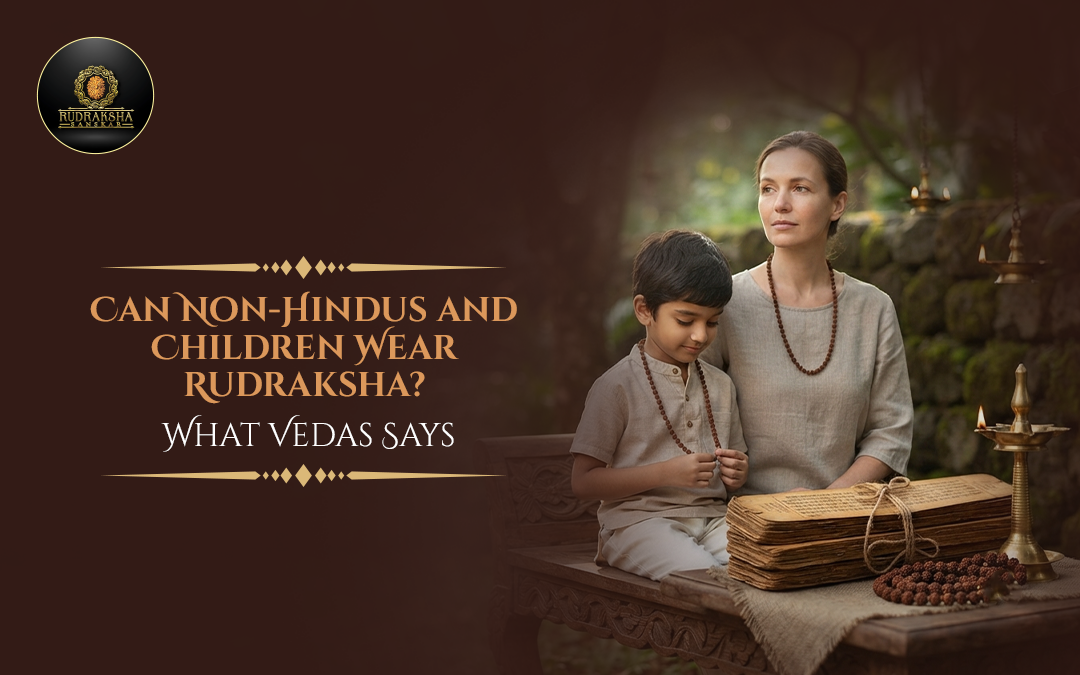
Yes, both can wear Rudraksha. There is no sound reason to turn Rudraksha into an object restricted only to one religion, caste, gender or age group. What matters more is respect, intention, appropriate use and practical safety.
Can Non-Hindus Wear Rudraksha?
Yes.
Rudraksha comes from a Hindu spiritual tradition, particularly Shaiva practice, but that does not mean only Hindus are physically or spiritually allowed to wear it.
A non-Hindu may choose Rudraksha because they are interested in:
- meditation
- mantra
- yoga
- Indian spiritual philosophy
- Lord Shiva
- the symbolism of a particular Mukhi
The important point is respect.
Someone does not need to change religion before wearing Rudraksha.
At the same time, it is better to understand that Rudraksha is not simply decorative jewellery with no cultural meaning.
If you wear it, learn at least the basic significance of the bead.
What Do the Vedas Say About Non-Hindus Wearing Rudraksha?
This question needs careful wording.
The Vedas do not provide a modern religion-based rule saying:
“Only people identifying as Hindu may wear Rudraksha.”
The detailed Rudraksha rules people commonly discuss today come more broadly from later Hindu spiritual texts, Shaiva traditions, Puranic literature and lineage-based practice.
So it is misleading to use “the Vedas say” as if there were a simple verse dividing wearers into Hindu and non-Hindu categories.
A better traditional interpretation is that Rudraksha is a sacred Shiva-associated object whose use depends on devotion, discipline and respect, not modern religious paperwork.
Does a Non-Hindu Need to Chant Hindu Mantras?
Not necessarily.
If someone is comfortable with Shiva practice, they may chant:
Om Namah Shivaya
If they follow another faith or simply want to wear Rudraksha respectfully without adopting a mantra practice, they do not need to force themselves into rituals they do not believe in.
The purpose should be sincere rather than performative.
Can Children Wear Rudraksha?
Yes, children can wear Rudraksha.
There is no blanket traditional prohibition against children.
The bigger issue is safety.
For young children, especially toddlers, consider:
- choking risk
- loose beads
- long necklaces
- weak thread
- beads getting caught while playing
- school or sports activities
A Rudraksha may be spiritually meaningful, but physical safety comes first.
Which Rudraksha Is Suitable for Children?
For most children, there is no need to start with rare or expensive Mukhi.
A simple 5 Mukhi Rudraksha is usually the most practical option for general spiritual practice.
Older students may also explore other Mukhi when there is a clear traditional reason.
For example:
But parents should avoid thinking:
“More Mukhi means better marks.”
A Rudraksha does not replace:
- study
- sleep
- concentration habits
- teaching
- professional support where needed
Should Babies Wear Rudraksha?
Extra caution is needed.
A loose bead or necklace can become a choking or strangulation hazard.
For infants and very young children, it is usually safer not to use a wearable Rudraksha unless the design is specifically safe and constantly supervised.
A family may instead keep the Rudraksha in the puja space until the child is older.
Spiritual intention does not require creating a physical safety risk.
Can Children Perform Rudraksha Puja?
Yes, in a simple way.
A child does not need a complicated ritual.
They can:
- keep the Rudraksha respectfully
- join family puja
- chant Om Namah Shivaya
- wear it after prayer
The purpose should be to introduce spiritual practice gently, not make the child anxious about breaking rules.
Do Children Need Astrological Consultation Before Wearing Rudraksha?
Not for ordinary general wearing.
A simple 5 Mukhi used for Shiva devotion or meditation does not require an elaborate horoscope analysis.
Astrological guidance may be useful when parents are choosing a specific rare Mukhi for a specific planetary purpose.
Even then, avoid fear-based recommendations.
Statements such as:
“Your child must wear this expensive Mukhi immediately or something bad will happen”
should be treated cautiously.
Can Non-Hindus Wear a Rudraksha Mala?
Yes.
A mala may be used for:
- meditation
- japa
- spiritual reflection
- daily wearing
If someone uses Rudraksha within another meditation tradition, they should still treat the mala respectfully because of its cultural and spiritual origin.
Respect does not require pretending to follow beliefs you do not hold.
Is Rudraksha Restricted by Caste?
No blanket caste-based prohibition should be used to prevent ordinary Rudraksha wearing.
Modern fear-based rules around who is “allowed” to wear Rudraksha often go much further than necessary.
The broader traditional emphasis is on:
- sincerity
- spiritual discipline
- respectful conduct
rather than social status.
Rudraksha Should Invite Practice, Not Create Exclusion
Rudraksha has a clear cultural and spiritual home within Hindu and Shaiva tradition.
That should be respected.
But respect is different from exclusion.
A non-Hindu can wear Rudraksha sincerely.
A child can wear it safely.
Neither needs to be frightened by claims that they are “not allowed” simply because of religion or age.
The better questions are:
Do you understand what you are wearing?
Will you treat it respectfully?
Is it safe and appropriate for the wearer?
If the answer is yes, there is no need to create unnecessary barriers.
If you plan to buy rudraksha online, choose a simple, authentic Rudraksha from Rudraksha Sanskar according to the wearer’s purpose and comfort rather than fear-based restrictions.
FAQs
Yes. Rudraksha comes from Hindu spiritual tradition, but there is no universal rule preventing a respectful non-Hindu from wearing it.
Not necessarily, although understanding its Shiva connection is respectful and useful.
Yes, if the bead and jewellery are physically safe and comfortable.
For general use, 5 Mukhi is usually the simplest starting point.
Extra caution is needed because of choking and strangulation risks. Safety should come before ritual preference.
Not for simple everyday practice.
Traditional Rudraksha practice focuses more on spiritual intention and respectful use than modern religious identity labels.