Hariyali Teej 2026 falls on Saturday, 15 August, on Shravana Shukla Tritiya. For New Delhi, Tritiya begins at approximately 6:48 PM on 14 August and ends at 5:30 PM on 15 August, although exact timings vary by city and should be checked against the local Panchang.
For many women, Hariyali Teej is much more than a fasting day.
It brings together the monsoon season, green attire, mehendi, swings, family traditions and, at the centre of it all, the relationship between Lord Shiva and Goddess Parvati. Married women traditionally observe the day with prayers connected with marital wellbeing, while unmarried women may participate with prayers for a suitable life partner.
That Shiva-Parvati connection also explains why Gauri Shankar Rudraksha naturally fits into conversations around Hariyali Teej.
But there is an important distinction between symbolism and promise.
A Rudraksha can represent unity, commitment and devotional intention. It cannot guarantee a marriage, repair a relationship on its own or replace the communication and effort relationships actually require.
Why Is Hariyali Teej Connected With Shiva and Parvati?
Hariyali Teej is traditionally associated with the devotion of Goddess Parvati and her union with Lord Shiva.
The festival remembers Parvati’s determination and spiritual devotion before Shiva accepted her as his consort. Over time, their relationship became one of Hindu tradition’s strongest symbols of partnership, balance, patience and commitment.
That is why Hariyali Teej is particularly associated with married women.
The day is commonly observed with prayers for the wellbeing of one’s spouse and harmony within marriage. Unmarried women also participate in many communities, traditionally praying for a suitable partner and a stable married life.
It is worth keeping the meaning broader than “getting married.”
The Shiva-Parvati symbolism also points toward:
- commitment
- mutual respect
- patience
- emotional balance
- shared spiritual values
- staying present through difficult phases of a relationship
Those are things a festival can remind us to practise. They are not things a ritual can guarantee for us.
How Is Hariyali Teej Traditionally Celebrated?
Hariyali means greenery, and the festival arrives during the monsoon period when the landscape itself is changing.
That seasonal theme appears throughout Teej celebrations.
Women commonly wear green clothing and bangles, apply mehendi, gather with family or friends, sing traditional songs and use decorated swings. Shiva and Parvati are worshipped during the day, and fasting practices vary between families and regions.
A simple Hariyali Teej observance may include:
1. Begin after bathing and preparing the puja space.
Keep images or murtis of Shiva and Parvati according to your family practice.
2. Offer flowers, fruits and traditional puja items.
Green leaves, flowers and seasonal elements often form part of the celebration.
3. Worship Shiva and Parvati together.
The emphasis of Teej is on their union rather than Shiva worship alone.
4. Listen to or read the Teej Katha.
Many families include the traditional Shiva-Parvati story as part of the day’s observance.
5. Keep the vrat according to your tradition.
Some women observe a strict fast, while others follow a simpler vrat diet. Family customs differ, so there is no need to treat one regional practice as universal.
6. Complete the puja according to the family’s evening tradition.
If the fast is being observed, it should be concluded according to the custom being followed.
Anyone who is pregnant, diabetic, taking medication with food requirements or managing another medical condition should adapt the fast safely with appropriate medical guidance.
Devotion does not require putting your health at risk.
Why Is Gauri Shankar Rudraksha Connected With Hariyali Teej?
Very few Rudraksha formations match the symbolism of Hariyali Teej as directly as Gauri Shankar Rudraksha.
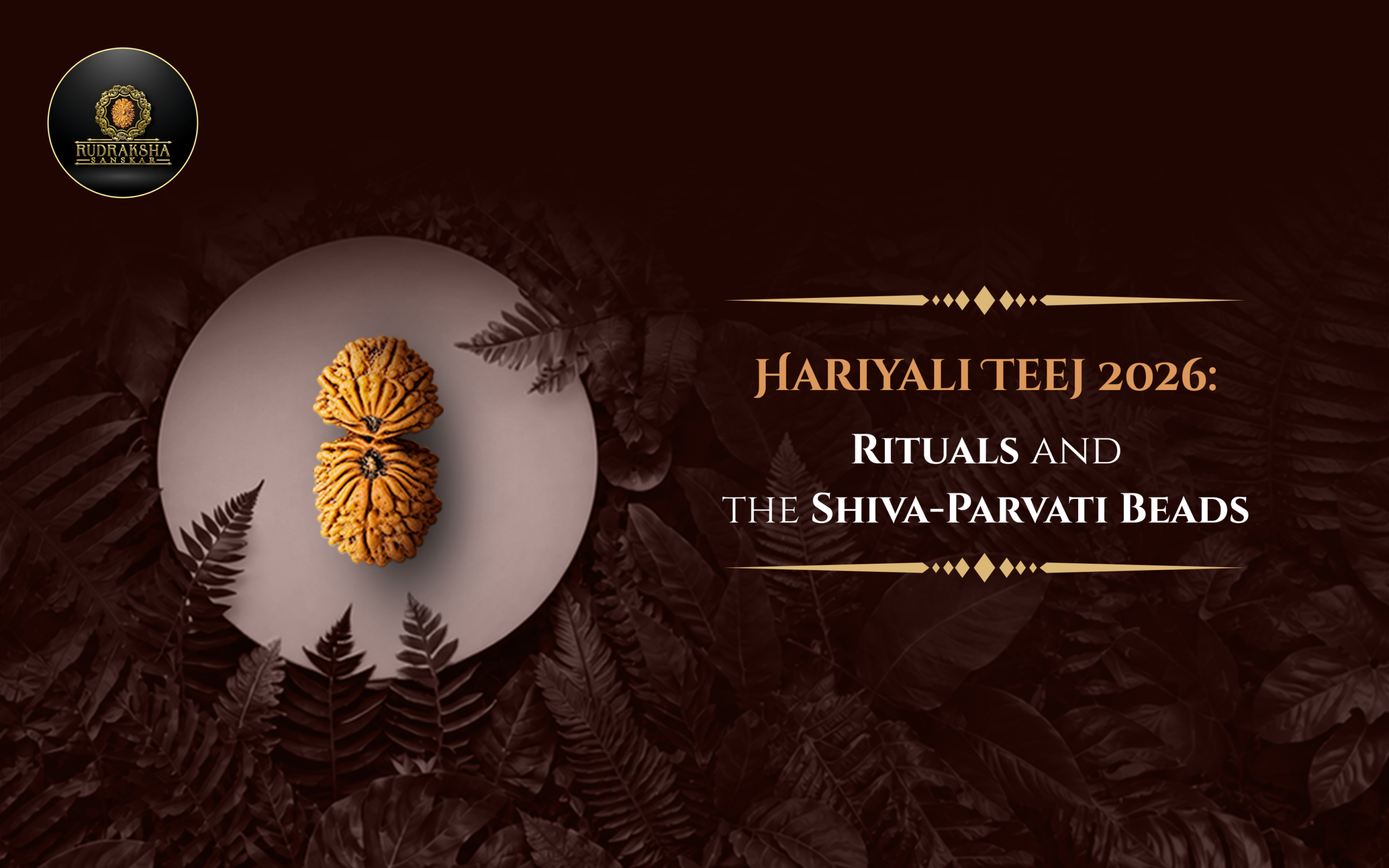
A Gauri Shankar is formed when two Rudraksha beads naturally grow joined together.
Traditionally, the two joined sections represent Gauri and Shankar, Goddess Parvati and Lord Shiva.
That natural union is why the bead is associated with:
- marital harmony
- emotional connection
- mutual understanding
- family balance
- partnership
- Shiva-Parvati devotion
Rudraksha Sanskar’s current Gauri Shankar collection describes the formation specifically as two naturally joined beads symbolising the union of Shiva and Parvati.
The symbolism makes Hariyali Teej a meaningful occasion for someone who already intended to begin wearing one.
It should not, however, create an artificial purchasing deadline.
You do not need to buy a Gauri Shankar overnight because Teej is tomorrow. Authenticity matters more than catching a festival date.
Gauri Shankar vs Garbh Gauri: Which One Fits Teej Better?
The names sound similar, but the symbolism is different.
Gauri Shankar Rudraksha
A Gauri Shankar consists of two naturally joined Rudraksha of comparatively balanced formation.
Its primary symbolism is the union of Shiva and Parvati.
That makes it the more direct choice for someone whose intention is connected with:
- marriage
- partnership
- emotional harmony
- mutual understanding
- Shiva-Parvati worship
For Hariyali Teej specifically, Gauri Shankar is the clearer symbolic match.
Garbh Gauri Rudraksha
A Garbh Gauri Rudraksha is also naturally joined, but one portion is larger and the other smaller.
Its traditional symbolism leans more toward Goddess Parvati’s nurturing and maternal aspect, including the bond between mother and child, family connection and motherhood. Rudraksha Sanskar’s existing Garbh Gauri guidance makes that distinction clear.
Garbh Gauri may therefore be considered where the devotional intention is more closely associated with:
- motherhood
- maternal blessings
- nurturing
- family bonds
- emotional connection
Any fertility or pregnancy-related association should remain within spiritual tradition. Garbh Gauri is not a fertility treatment or medical intervention.
The Simple Difference
| Rudraksha | Natural Symbolism | More Relevant When the Intention Is |
| Gauri Shankar | Shiva and Parvati together | Marriage, partnership, harmony, unity |
| Garbh Gauri | Parvati’s nurturing and maternal symbolism | Motherhood, nurturing, family connection |
Neither should be treated as a guaranteed solution to relationship or fertility concerns.
Can an Unmarried Woman Wear Gauri Shankar Rudraksha?
Yes, within traditional Rudraksha practice, Gauri Shankar is not restricted only to married couples.
Rudraksha Sanskar’s current guidance includes both married couples and individuals seeking relationship harmony among those who may wear it.
For an unmarried woman observing Hariyali Teej, the bead may be approached as a symbol of the qualities she hopes to build into a future partnership: balance, respect, emotional stability and commitment.
That is healthier than treating the bead as a tool that will “attract a husband” by a certain deadline.
Spiritual symbolism can shape intention.
It should not be turned into a guarantee.
Is Hariyali Teej a Good Day to Start Wearing Gauri Shankar?
Symbolically, yes.
Because Hariyali Teej centres on Shiva-Parvati devotion, starting a Gauri Shankar practice on the festival can feel especially meaningful.
If you already own an authentic bead, you can keep the process simple:
- bathe and prepare for Teej puja
- place the Rudraksha near the Shiva-Parvati setup
- perform your usual worship
- chant Om Namah Shivaya
- wear the bead as a pendant or keep it in the puja space according to your practice
Rudraksha Sanskar currently recommends Om Namah Shivaya as a mantra when preparing Gauri Shankar for wearing.
What you should not do is rush into buying a rare formation only because the calendar says 15 August.
A naturally joined Gauri Shankar deserves proper inspection.
What Should You Check Before Buying Gauri Shankar Rudraksha?
The very feature that makes Gauri Shankar special also makes authenticity important.
The two portions should be naturally joined.
Before buying, look for:
- an irregular natural join rather than a suspiciously neat seam
- no visible glue or artificial bonding
- natural surface texture across both sections
- clear product photographs
- dimensions and weight for the specific bead
- certification for higher-value pieces
Rudraksha Sanskar’s live Gauri Shankar collection currently lists individual pieces with exact dimensions and pricing, while its guidance specifically notes that authenticity should be checked by confirming the natural fusion rather than an artificial join.
That visual proof would add far more value to this article than another paragraph simply claiming the bead is original.
Can You Gift Gauri Shankar Rudraksha to Your Spouse on Teej?
Yes, and this is one of the more natural ways to connect the bead with the festival.
A Gauri Shankar can be given as a symbolic spiritual gift between spouses because its physical formation itself represents two joined parts.
But the meaning of the gift matters.
It should represent something such as:
“This reminds us to protect the balance and understanding in our relationship.”
Not:
“Wear this and our problems will disappear.”
A spiritual object works better as a reminder of the values a couple wants to practise than as a replacement for the work those values require.
FAQs
When is Hariyali Teej in 2026?
Hariyali Teej falls on Saturday, 15 August 2026. It is observed on Shravana Shukla Tritiya.
Who observes Hariyali Teej vrat?
The vrat is traditionally observed mainly by married women for marital wellbeing. Unmarried women also participate in many communities while praying for a suitable partner.
Which Rudraksha represents Shiva and Parvati?
Gauri Shankar Rudraksha is the most direct representation. It consists of two naturally joined Rudraksha traditionally symbolising Shiva and Parvati.
Is Gauri Shankar the same as Garbh Gauri?
No. Both are naturally joined formations, but Gauri Shankar primarily symbolises Shiva-Parvati unity, while Garbh Gauri is more closely associated with Parvati’s maternal and nurturing symbolism.
Can unmarried women wear Gauri Shankar Rudraksha?
Yes. It is not limited only to married couples and may be worn as part of Shiva-Parvati devotion or a personal spiritual practice.
Can I start wearing Gauri Shankar on Hariyali Teej?
Yes, if the bead has already been properly selected and verified. The festival’s Shiva-Parvati symbolism makes it a meaningful starting day, but there is no need to rush an unverified purchase simply to meet the date.
Hariyali Teej celebrates one of the most enduring partnership symbols in Hindu tradition: Shiva and Parvati.
That makes the day naturally relevant to marriage, commitment, patience and emotional connection.
It also makes Gauri Shankar Rudraksha an unusually fitting spiritual symbol for the occasion. Two Rudraksha growing naturally together communicate the idea without needing an exaggerated promise attached to it.
Observe the vrat according to your family’s tradition. Celebrate with the colour, mehendi and rituals that make Teej meaningful to you. And if you choose a Shiva-Parvati Rudraksha, choose one because you understand its symbolism and can verify that the formation is natural.
If you plan to buy Rudraksha online, explore the Gauri Shankar Rudraksha collection from a trusted seller like Rudraksha Sanskar and check the exact bead and its authenticity information before choosing.