Rahu Mahadasha is one of the most misunderstood periods in Vedic astrology. It is often described in extreme terms.
Sudden rise. Sudden fall. Confusion. Obsession. Foreign opportunities. Unusual career moves. Unexpected changes.
But Rahu Mahadasha is not automatically negative.
It is a planetary period, not a curse.
Within the 120-year Vimshottari Dasha cycle, Rahu Mahadasha lasts 18 years. Its traditional themes are linked with ambition, unconventional experiences, material desire, foreign connections, technology, illusion, experimentation and situations that push someone outside familiar patterns.
The exact experience depends on where Rahu sits in the birth chart and which Antardasha is running within the 18-year period.
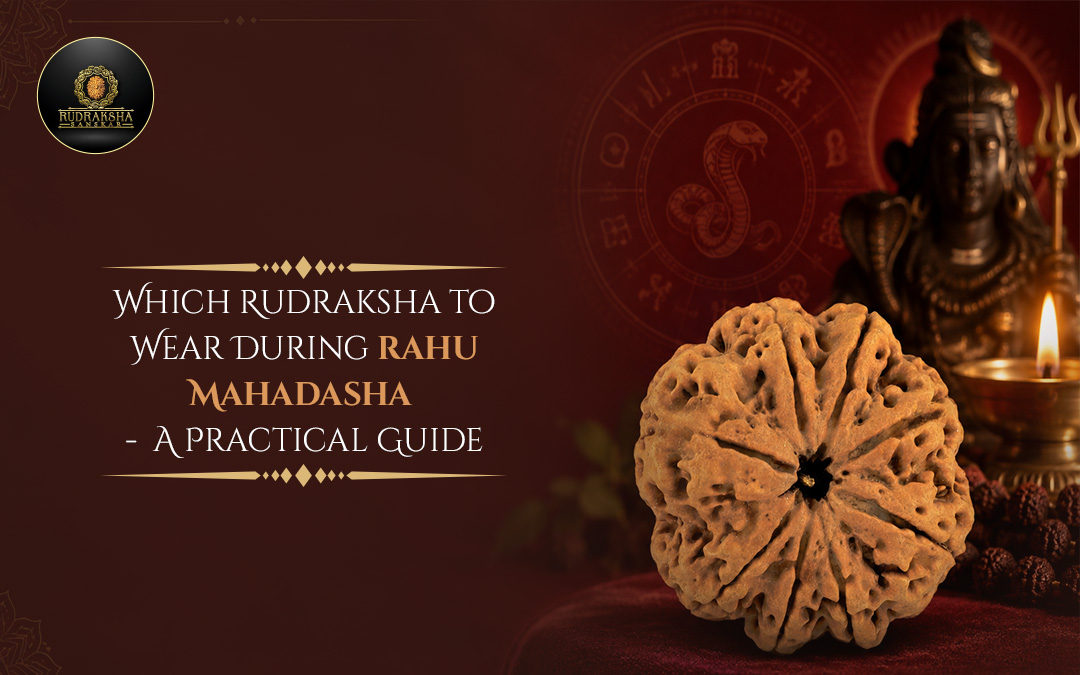
For Rudraksha, the traditional primary recommendation is 8 Mukhi Rudraksha.
What Is Rahu Mahadasha?
Vimshottari Dasha divides life into major planetary periods called Mahadashas.
The full system covers 120 years and assigns each of the nine grahas a fixed period.
Rahu receives 18 years.
In the traditional sequence, Rahu Mahadasha comes after Mars and before Jupiter.
Rahu is not a physical planet in the astronomical sense. In Vedic astrology, Rahu represents the north lunar node and carries symbolic associations with:
- ambition
- desire
- unconventional paths
- foreign influences
- technology
- sudden changes
- experimentation
- illusion
- obsession
- breaking established patterns
This is why Rahu periods can feel intense.
But intensity should not automatically be interpreted as disaster.
How Do You Know If You Are in Rahu Mahadasha?
You cannot determine Mahadasha from your zodiac sign alone.
Vimshottari Dasha calculation starts from the Moon’s Nakshatra at birth.
The ruling planet of that Nakshatra determines the Mahadasha operating at the time of birth, while the Moon’s exact position determines how much of that period remains.
To calculate it properly, you need:
- date of birth
- exact time of birth
- place of birth
An astrology software or Dasha calculator can show the sequence.
However, if you want to understand whether Rahu is functioning constructively or creating challenges in your specific chart, getting the chart read by a competent astrologer is more useful.
That is because Rahu’s house placement, sign, aspects, conjunctions and dispositor all matter.
Antardasha Matters During Rahu Mahadasha
Rahu Mahadasha does not behave the same way for all 18 years.
It contains smaller planetary periods called Antardashas.
These include combinations such as:
- Rahu–Rahu
- Rahu–Jupiter
- Rahu–Saturn
- Rahu–Mercury
- Rahu–Ketu
- Rahu–Venus
- Rahu–Sun
- Rahu–Moon
- Rahu–Mars
A Rahu–Venus period may highlight very different themes from Rahu–Saturn or Rahu–Mars.
This is why a blog can explain general tendencies, but it cannot replace an actual chart interpretation.
Mahadasha gives the larger background. Antardasha changes the immediate emphasis.
What Do People Commonly Experience During Rahu Mahadasha?
Traditional astrology often associates Rahu periods with experiences such as:
- strong ambition
- attraction toward unconventional careers
- foreign travel or foreign connections
- technology and digital work
- sudden professional changes
- heightened desire for recognition
- restlessness
- uncertainty
- obsession with one goal
- experimentation
- breaking away from familiar structures
These are tendencies, not predictions.
For one person, Rahu may coincide with rapid expansion into technology or an international market.
For another, it may highlight confusion, overthinking or repeatedly chasing the wrong opportunity.
The difference depends on the chart.
That is why saying “Rahu Mahadasha is always bad” is too simplistic.
Which Rudraksha Is Traditionally Worn During Rahu Mahadasha?
8 Mukhi Rudraksha: The Primary Choice
The main traditional Rudraksha recommendation for Rahu is 8 Mukhi Rudraksha.
8 Mukhi is associated with Lord Ganesha, the remover of obstacles, and in many Rudraksha traditions it is also connected with Rahu.
The logic between Rahu and 8 Mukhi is practical.
Rahu is traditionally associated with:
- confusion
- sudden changes
- unconventional situations
- intense desire
- uncertainty
- difficulty distinguishing opportunity from distraction
Ganesha symbolism centres on:
- removing obstacles
- better judgment
- clarity
- intelligent beginnings
- navigating complexity
That is why 8 Mukhi becomes the natural traditional recommendation.
The goal is not to “defeat Rahu.”
It is to develop clarity while moving through a Rahu period.
Why 8 Mukhi Makes Sense During Rahu Mahadasha
Someone in Rahu Mahadasha may encounter many possibilities at once.
A new business.
A foreign opportunity.
A dramatic career pivot.
An unusual investment.
A sudden desire to change direction.
The challenge is often not lack of opportunity.
It is knowing:
which opportunity deserves attention and which one is simply distraction.
8 Mukhi’s Ganesha association fits that decision-making theme particularly well.
It can be approached as a spiritual reminder to:
- slow down before major decisions
- examine motives
- separate ambition from obsession
- move through obstacles intelligently
- avoid impulsive reactions to sudden opportunities
That is much more useful than framing the bead as supernatural protection from Rahu.
Is There a Secondary Rudraksha for Rahu Mahadasha?
For most people, 8 Mukhi is enough as the primary traditional option.
Some astrologers may recommend other Mukhi depending on:
- Rahu’s sign
- Rahu’s house
- conjunctions
- the Antardasha
- the planet ruling Rahu’s placement
For example, if Rahu is strongly connected with Saturn or Venus in a specific chart, the astrologer may consider a different combination.
But that is personalised astrology.
There is no need to wear several Rudraksha automatically simply because Rahu Mahadasha lasts 18 years.
Start with the primary logic.
Then add another bead only when there is a clear chart-based reason.
When Should You Start Wearing 8 Mukhi Rudraksha?
Saturday is often considered a suitable day in Rahu-related spiritual practice, although some traditions may use Wednesday or another day depending on lineage.
A simple wearing vidhi can be:
- Bathe and wear clean clothes.
- Keep the Rudraksha in your puja space.
- Offer your normal prayer to Lord Ganesha or Shiva.
- Chant the Rahu Beej Mantra or a Ganesha mantra.
- Wear the bead respectfully.
A commonly used Rahu Beej Mantra is:
Om Bhram Bhreem Bhraum Sah Rahave Namah
A Ganesha devotee may also chant:
Om Gan Ganapataye Namah
If your guru or astrologer has given you another mantra, follow that tradition instead.
What Else Is Traditionally Done During Rahu Mahadasha?
Rudraksha is only one part of traditional practice.
Rahu Mantra Japa
Regular Rahu mantra repetition may be recommended, particularly on Saturdays or according to the astrologer’s guidance.
Daan
Traditional Rahu-related donation practices may include items such as:
- black sesame
- dark-coloured cloth
- blankets
- food donations
- support for people in need
The exact daan differs across traditions.
The principle is more important than the object: give sincerely rather than treating donation as a transaction with fate.
Saturday Practice
Saturday is commonly associated with remedies involving Saturn and Rahu in several traditions.
Someone may include:
- mantra
- charity
- simple fasting
- disciplined spiritual practice
Avoiding Rahu-Like Excess
This may be the most practical traditional advice.
Rahu symbolism can become distorted through:
- obsession
- shortcuts
- deception
- addictive behaviour
- constant comparison
- chasing status
During a Rahu period, consciously practising restraint may be more meaningful than collecting remedies.
What Should You Avoid During Rahu Mahadasha?
There is no universal list of activities that guarantees good or bad results.
But traditional Rahu symbolism suggests caution around:
- impulsive major decisions
- unrealistic promises
- excessive risk-taking
- shortcuts that compromise ethics
- obsession with recognition
- trusting every sudden opportunity
- becoming consumed by fear about astrology
Rahu Mahadasha does not mean you should stop taking opportunities.
It means discernment matters more.
Rahu often represents situations that do not follow the usual route.
Technology.
Foreign opportunities.
Unconventional careers.
Sudden ambition.
Unexpected changes.
Sometimes these open powerful new directions.
Sometimes they create distraction.
That is why 8 Mukhi Rudraksha makes sense as the traditional Rahu bead. Its Ganesha symbolism is about moving through obstacles intelligently and choosing direction with greater clarity.
The goal is not to escape Rahu Mahadasha. It is to move through the period with better judgment.
And remember that Rahu’s placement and the running Antardasha can substantially change the interpretation.
If you plan to buy rudraksha online, compare the certified 8 Mukhi Rudraksha options from Rudraksha Sanskar and choose the bead according to genuine astrological guidance rather than fear around Rahu.
FAQs
Rahu Mahadasha lasts 18 years in the Vimshottari Dasha system.
8 Mukhi Rudraksha is the primary traditional recommendation because of its Rahu association and connection with Lord Ganesha.
Rahu is associated with uncertainty, ambition and illusion, while 8 Mukhi carries Ganesha symbolism around clarity, obstacle navigation and intelligent decisions.
No. Its effects depend heavily on Rahu’s placement and the rest of the birth chart.
Yes. The Antardasha can substantially change how the 18-year period is interpreted.
Saturday is commonly used, although traditions differ.