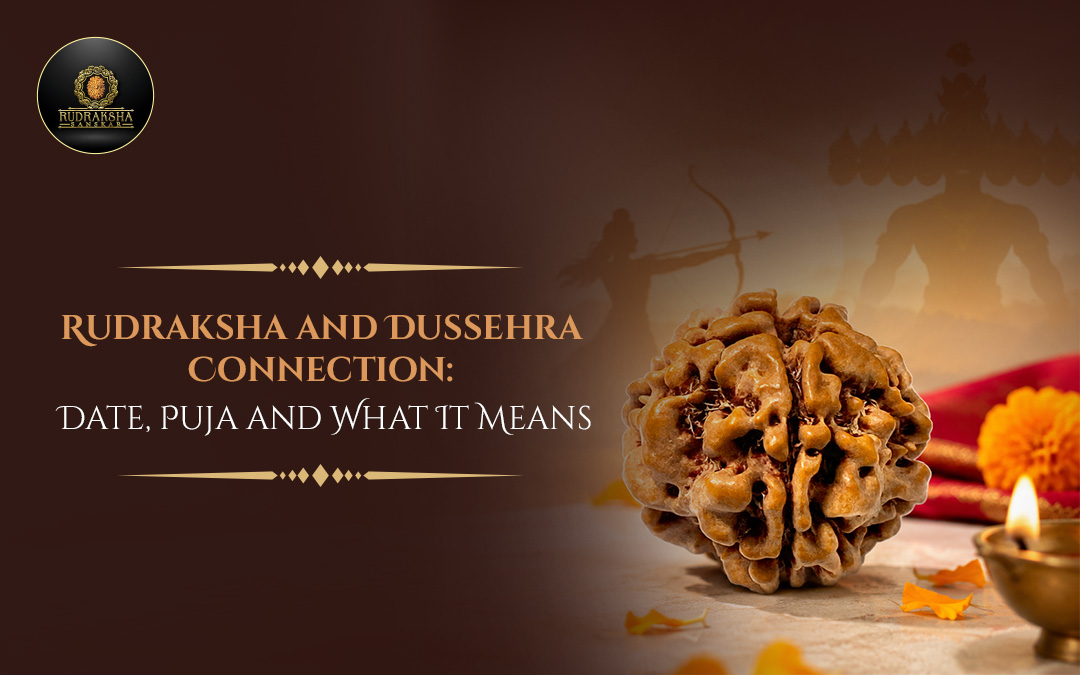
Dussehra 2026 falls on Tuesday, 20 October.
The festival is celebrated as Vijayadashami, marking the victory of Lord Rama over Ravana and also the triumph of Goddess Durga over Mahishasura. In Ahmedabad, the Vijay Muhurat falls between 2:20 PM and 3:06 PM, while the Aparahna Puja period runs from 1:34 PM to 3:52 PM.
For someone who wears Rudraksha, Dussehra can also carry a useful spiritual meaning.
The day is about victory, but not only victory over an external enemy.
It can also represent overcoming:
- fear
- confusion
- poor habits
- anger
- hesitation
- repeated mistakes
- patterns that keep pulling you backwards
That makes Dussehra a meaningful day to continue or begin a Rudraksha practice.
But there is no special rule saying everyone must buy or wear one particular Mukhi on Vijayadashami.
The better approach is to understand what the festival represents and then choose a Rudraksha only if its traditional symbolism genuinely matches what you are working on.
Why Is Dussehra Celebrated?
Dussehra brings together two major victory traditions.
In the Ramayana tradition, it commemorates Lord Rama’s victory over Ravana.
In the Shakti tradition, Vijayadashami marks Maa Durga’s victory over Mahishasura after the Navratri period.
Both stories revolve around a similar theme:
Dharma ultimately overcoming forces that create disorder.
That is why Dussehra is commonly associated with:
- victory
- courage
- righteous action
- overcoming obstacles
- beginning again with greater clarity
Traditional Vijayadashami observances also include Shami Puja, Aparajita Puja and Seema Avalanghan, which are generally performed during the Aparahna period.
Dussehra 2026 Date and Puja Time
For Ahmedabad:
- Vijayadashami: Tuesday, 20 October 2026
- Dashami Tithi Begins: 12:50 PM on 20 October
- Dashami Tithi Ends: 2:11 PM on 21 October
- Vijay Muhurat: 2:20 PM to 3:06 PM
- Aparahna Puja Time: 1:34 PM to 3:52 PM
Puja timings change by location, so anyone outside Ahmedabad should check the local Panchang rather than copy these timings directly.
What Is the Rudraksha Connection With Dussehra?
There is no single “Dussehra Rudraksha.”
That distinction is important.
Rudraksha belongs broadly to Hindu spiritual practice and is especially associated with Shiva. Dussehra, meanwhile, centres on Rama and Durga traditions.
The connection comes through what the festival asks a person to overcome.
For example:
Someone trying to face fear may connect with 9 Mukhi.
Someone struggling with repeated obstacles may consider 8 Mukhi.
Someone working on discipline and self-control may relate more naturally to 11 Mukhi.
Someone looking for steadiness during uncertainty may connect with 10 Mukhi.
The festival gives you the occasion for reflection.
The Mukhi gives you a traditional spiritual symbol connected with that intention.
Which Rudraksha Fits the Meaning of Vijayadashami?
There is no compulsory answer, but a few Mukhi align naturally with common Dussehra themes.
9 Mukhi Rudraksha: Courage and Maa Durga
9 Mukhi Rudraksha has perhaps the clearest festival connection because it is traditionally associated with Maa Durga and Navadurga.
Its themes include:
- courage
- fearlessness
- emotional resilience
- inner strength
That makes it particularly relevant for someone whose Dussehra intention is about facing something they have been avoiding.
8 Mukhi Rudraksha: Overcoming Obstacles
8 Mukhi Rudraksha is traditionally associated with Lord Ganesha.
It may suit someone treating Vijayadashami as a point to:
- begin a new project
- overcome repeated blocks
- make a difficult decision
- move forward after hesitation
10 Mukhi Rudraksha: Protection and Stability
10 Mukhi Rudraksha is traditionally associated with Lord Vishnu.
Its symbolism focuses more on:
- protection
- stability
- balance
- remaining steady during uncertainty
For someone trying to preserve calm while navigating a difficult phase, this may fit better than a courage-focused bead.
11 Mukhi Rudraksha: Discipline and Controlled Strength
11 Mukhi Rudraksha is traditionally associated with Hanuman and the Eleven Rudras.
Its themes include:
- self-control
- discipline
- courage
- consistency
That can be especially meaningful if the “Ravana” you are trying to defeat is actually one of your own repeated habits.
Dussehra Is a Good Day to Ask: What Are You Actually Trying to Defeat?
Festival symbolism becomes much more useful when it turns inward.
Instead of asking:
“Which Rudraksha is most powerful on Dussehra?”
ask:
“What pattern am I actually trying to overcome?”
Maybe it is:
- procrastination
- anger
- fear of speaking up
- poor financial discipline
- inability to make a decision
- constantly returning to an unhealthy pattern
Once the problem becomes clearer, the Rudraksha decision becomes clearer too.
This is far more useful than buying whichever Mukhi has the most dramatic product description.
A Simple Dussehra Puja at Home
Family traditions differ, so there is no need to turn one regional practice into a universal ritual.
A simple Vijayadashami observance may include:
1. Prepare the Puja Space
Clean the area and keep the deity or spiritual objects normally used in your home.
2. Offer Flowers and Diya
Begin with a simple diya and flowers according to availability.
3. Worship According to Your Family Tradition
This may centre on:
- Lord Rama
- Maa Durga
- Aparajita Devi
- Shami tree worship
Traditional Dussehra practices vary substantially across regions.
4. Offer a Prayer for Clarity and Right Action
Rather than only asking for external victory, use the day to identify one internal habit or obstacle you genuinely want to change.
5. Begin Something Constructive
Vijayadashami is traditionally regarded as an auspicious day for new beginnings.
That might mean:
- starting study
- beginning a new work project
- restarting spiritual practice
- committing to a healthier habit
The symbolic victory becomes meaningful when it leads to action.
Can You Start Wearing Rudraksha on Dussehra?
Yes, if you already have an authentic Rudraksha and understand why you are wearing it.
You do not need to wait specifically for Dussehra, but Vijayadashami can provide a meaningful beginning because of its association with victory and auspicious new starts.
A simple process is enough:
- Bathe and wear clean clothes.
- Keep the Rudraksha in your puja space.
- Perform your Dussehra prayer.
- Chant Om Namah Shivaya or the mantra followed in your own tradition.
- Wear the Rudraksha after puja.
If your guru or family tradition follows a different process, continue with that.
What Dussehra Does Not Mean for Rudraksha
A festival should not become a reason for exaggerated selling.
Be cautious with claims such as:
- “Wear this Mukhi before Vijay Muhurat or lose the opportunity.”
- “This Rudraksha destroys every enemy.”
- “Buy this combination for guaranteed victory.”
- “Dussehra makes rare Rudraksha more powerful.”
There is no need to rush a questionable purchase because a festival date is approaching.
If the bead is expensive or rare, verification matters more than catching a particular muhurat.
Victory Means More When Something Actually Changes
Dussehra is easy to celebrate externally.
Ravana burns.
Navratri ends.
Vijayadashami arrives.
The harder question is what the idea of victory means after the festival is over.
Maybe the real battle is with fear.
Or indecision.
Or anger.
Or a pattern you already know needs to change.
That is where the Rudraksha connection becomes meaningful.
Choose the bead according to the quality you are trying to develop, not because a festival advertisement tells you one Mukhi guarantees victory.
If you plan to buy rudraksha online, compare the available Rudraksha from Rudraksha Sanskar according to Mukhi, traditional purpose and authenticity rather than buying only because Dussehra is approaching.
FAQs
Dussehra or Vijayadashami falls on Tuesday, 20 October 2026.
There is no single compulsory Dussehra Rudraksha. 9 Mukhi may fit Durga and courage symbolism, while 8, 10 or 11 Mukhi may align with other intentions.
Yes. It can be a meaningful starting day, particularly if the festival symbolism aligns with the personal change you are trying to make.
9 Mukhi is traditionally associated with Maa Durga, giving it a natural connection with the Shakti side of Vijayadashami.
No. If you already wear a Rudraksha that suits your spiritual practice, continue with it.