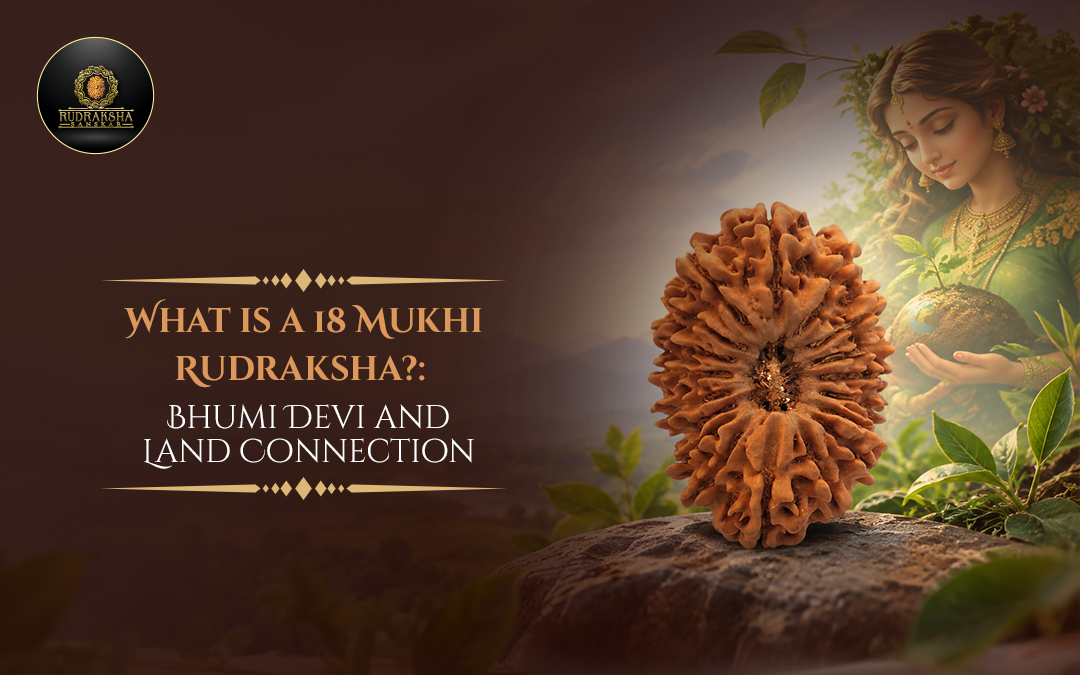
The 18 Mukhi Rudraksha belongs to the rare 15–21 Mukhi range and is widely associated in contemporary Rudraksha tradition with Bhumi Devi, or Mother Earth.
That association gives the bead its distinctive themes of land, stability, nourishment, grounding and material foundations.
This is also why 18 Mukhi is often discussed in connection with people involved in agriculture, property, construction or businesses dependent on land.
But there is an important distinction to make:
Bhumi Devi is a widely followed attribution for 18 Mukhi, but the classical textual evidence for higher Mukhi Rudraksha is less explicit than it is for 1–14 Mukhi.
For a bead at this price and rarity level, that distinction matters.
Who Is the Presiding Deity of 18 Mukhi Rudraksha?
The most commonly followed association for 18 Mukhi Rudraksha is Bhumi Devi, the personification of Earth.
This explains why its traditional symbolism centres around:
- stability
- land and property
- nourishment
- grounding
- patience
- material foundations
Some contemporary traditions also connect 18 Mukhi with forms of Shakti or Mother Goddess, which broadly fits its Earth and nurturing symbolism.
These should be understood as related traditions rather than forcing one attribution as universally settled.
What Do Classical Texts Say?
The Shiva Purana is one of the most important classical sources for Rudraksha tradition, but its commonly cited face-specific descriptions are clearest through 14 Mukhi.
The Padma Purana and Skanda Purana also contain important Rudraksha traditions. However, detailed modern charts assigning a specific deity, planet and benefit set to every Mukhi from 15 through 21 are harder to trace consistently to clear verses in these texts.
Therefore, the responsible description is:
Bhumi Devi is a widely followed later and contemporary attribution for 18 Mukhi rather than an attribution that should automatically be presented as directly stated in the Shiva Purana.
Buyers should be cautious when a seller invokes a Purana without providing the actual textual reference.
Which Planet Rules 18 Mukhi Rudraksha?
Planetary associations for higher Mukhi Rudraksha vary between modern traditions.
Some systems assign a particular graha to 18 Mukhi, while others focus primarily on Bhumi Devi and Earth symbolism rather than giving the bead one universally accepted planetary ruler.
If 18 Mukhi is being recommended specifically as an astrological remedy, ask which tradition the planetary attribution comes from.
At this tier, “this planet rules this bead” should not be accepted without context.
What Are the Traditional Benefits of 18 Mukhi?
The traditional interpretation of 18 Mukhi centres on stability and connection with the Earth principle.
It is commonly associated with:
- grounding
- patience
- stability
- material security
- land-related activities
- agriculture
- property
- long-term foundations
Because of this, it may traditionally appeal to:
- farmers and agricultural business owners
- builders and developers
- people involved in real estate
- landowners
- entrepreneurs managing physical assets
- experienced spiritual practitioners
- Rudraksha collectors
However, wearing an 18 Mukhi does not guarantee a profitable property deal, land appreciation or business success.
Its connection with land is traditional symbolism, not financial advice or a promise of results.
How Rare Is 18 Mukhi Rudraksha?
18 Mukhi sits deep within the premium 15–21 Mukhi range.
It is substantially less common than everyday Mukhi such as 5, 6 or 7 Mukhi and more difficult to source as a large, naturally developed specimen.
However, there is no credible universal table proving that 18 Mukhi is exactly the fourth-rarest bead among 1–21 Mukhi.
Natural availability varies by:
- origin
- harvest
- size
- development
- condition
So the accurate statement is that 18 Mukhi is a rare higher-Mukhi category with limited natural supply.
Rarity affects market price.
It does not automatically make the bead spiritually superior.
What Determines the Price of an 18 Mukhi?
At the premium level, buyers should stop thinking only in terms of:
“How much does an 18 Mukhi cost?”
The better question is:
“What exactly am I getting for this price?”
Two genuine 18 Mukhi specimens can have very different values depending on:
- Nepal or Indonesian origin
- dimensions
- weight
- shape
- clarity of natural Mukhi lines
- condition
- specimen scarcity
- certification
- X-ray documentation
A large, well-developed Nepal specimen may command a significant premium over a smaller example.
But larger does not mean spiritually stronger.
The price difference reflects the physical rarity of the specimen, not greater guaranteed benefits.
Authenticity: Why 18 Mukhi Needs Serious Verification
At 18 Mukhi, authenticity becomes one of the most important parts of the purchase.
The financial difference between an ordinary lower-Mukhi bead and a genuine 18 Mukhi can create an incentive to carve additional grooves into a cheaper bead.
A buyer should therefore demand more than a statement saying:
“100% original and certified.”
For an 18 Mukhi, ask for:
- clear photographs of the exact bead
- all 18 natural Mukhi lines
- exact dimensions
- exact weight
- stated origin
- specimen-specific certificate number
- X-ray where available
- confirmation of natural and artificial faces
Why Does X-Ray Matter?
Surface inspection determines whether the visible Mukhi lines appear natural.
X-ray provides another layer of evidence by examining the internal compartment structure.
This becomes increasingly useful as Mukhi count rises.
Neither method should be treated as sufficient by itself.
For premium Rudraksha, the stronger verification chain is:
physical specimen + surface analysis + dimensions and weight + X-ray + matching certificate.
If any of those records belong to a different bead, they do not authenticate the specimen being purchased.
How Do You Wear 18 Mukhi Rudraksha?
A rare and expensive Rudraksha does not require an extravagant ritual simply because it costs more.
A simple wearing vidhi can be:
- Bathe and wear clean clothes.
- Place the Rudraksha in your puja space.
- Gently rinse it with clean water if required.
- Offer prayer to Shiva and Bhumi Devi according to your tradition.
- Chant the prescribed mantra.
- Take a simple sankalp.
- Wear it respectfully.
Monday is suitable for a general Shiva-centred Rudraksha practice.
Some traditions may use another day for Bhumi Devi worship, so a family or guru tradition can take priority.
Beej Mantra
Higher-Mukhi mantra lists differ between traditions.
For a simple Shiva-centred practice:
Om Namah Shivaya
If your guru or sampradaya prescribes a specific 18 Mukhi Beej Mantra, follow that tradition rather than assuming one modern online mantra list is universal.
18 Mukhi Is About Foundations, Not Guaranteed Property Gains
The traditional identity of 18 Mukhi is unusually clear in theme:
Bhumi Devi. Earth. Stability. Land. Foundations.
But the claims surrounding it still require discipline.
Its classical face-specific attribution is not as clear as lower Mukhi Rudraksha.
Its rarity should not be confused with spiritual superiority.
And its connection with land should never become a promise of profitable real estate or agricultural returns.
For a premium buyer, the physical evidence matters just as much as the traditional story.
Explore the 18 Mukhi Rudraksha collection from Rudraksha Sanskar for the bead-specific details.
If you plan to buy rudraksha online, compare higher-Mukhi specimens using their origin, dimensions, weight, natural faces, certificate and X-ray evidence rather than rarity claims alone.
FAQs
Bhumi Devi is the most widely followed contemporary attribution. Some traditions also use broader Shakti or Mother Goddess associations.
The commonly cited Shiva Purana face-specific enumeration is clearer through 14 Mukhi. Bhumi Devi should therefore be described as a widely followed later attribution unless a precise classical verse is supplied.
It is traditionally associated with land, stability and the Earth principle. It does not guarantee successful property transactions or financial returns.
It may appeal to people involved with agriculture, property, construction and physical assets, as well as spiritual practitioners and collectors.
Yes. It belongs to the rare 15–21 Mukhi range, although there is no reliable universal numerical rarity ranking.
No. Price reflects physical rarity and specimen characteristics, not guaranteed spiritual effectiveness.
For a high-value specimen, X-ray documentation is strongly worth requesting alongside surface analysis and specimen-specific certification.