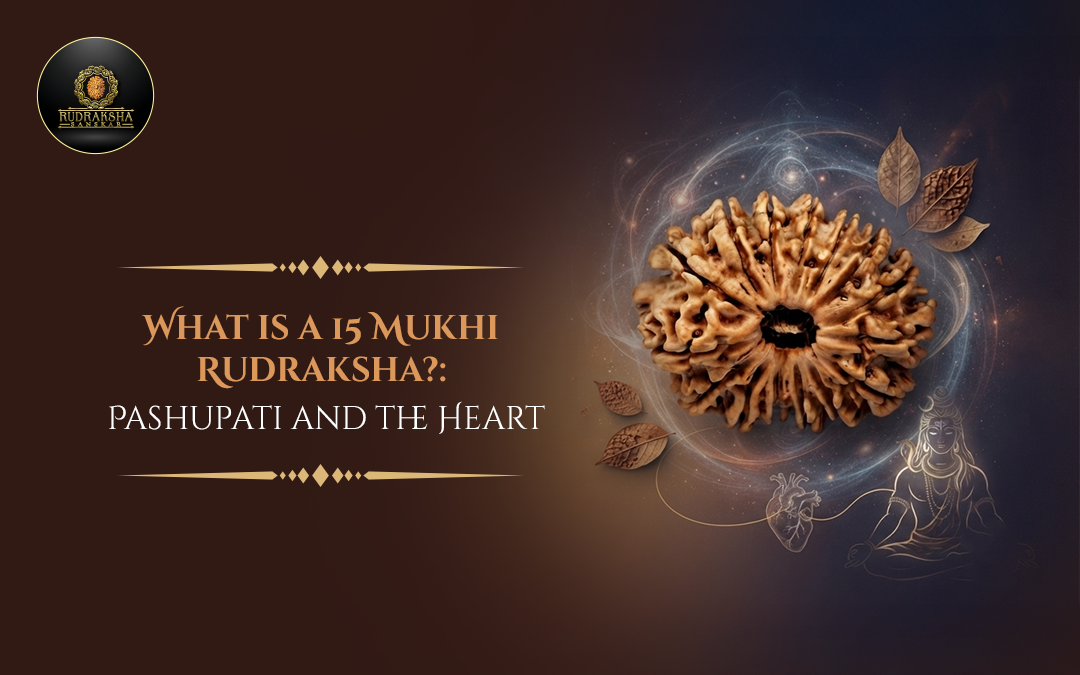
The 15 Mukhi Rudraksha marks a transition into the genuinely rare end of the Rudraksha market.
It has fifteen naturally formed Mukhi lines running from one pole of the bead to the other and is widely associated today with Lord Pashupatinath, the compassionate form of Shiva.
Its traditional themes are usually described around:
- detachment from emotional burdens
- compassion
- inner stability
- spiritual maturity
- freedom from excessive attachment
This is also why 15 Mukhi is sometimes described as a Rudraksha connected with the heart.
But buyers at this level should know something important before accepting every attribution they see online:
the textual record above 14 Mukhi is much less uniform than the record for the lower Mukhi.
Which Deity Is Associated With 15 Mukhi Rudraksha?
The most widely followed modern attribution is Lord Pashupatinath, a form of Shiva.
Rudraksha Sanskar follows this tradition and describes 15 Mukhi as connected with Pashupatinath, compassion, emotional balance and spiritual liberation.
However, this attribution requires a textual caveat.
What Do the Classical Texts Actually Say?
The Shiva Purana is one of the principal classical sources used for Rudraksha traditions, but its commonly cited face-by-face enumeration is strongest from 1 through 14 Mukhi.
That means I would not state that the Shiva Purana clearly names Pashupatinath as the presiding deity of 15 Mukhi unless a specific verse can be produced.
The same caution applies to broad online claims invoking the Padma Purana or Skanda Purana. Sellers frequently name these texts for 15 Mukhi, but clear verse-level attribution is difficult to establish consistently from reliable published sources.
Therefore, for publication, the most accurate wording is:
Pashupatinath is a widely followed later and modern traditional attribution for 15 Mukhi Rudraksha, while classical face-specific references become less uniform above 14 Mukhi.
That distinction makes the article stronger, not weaker.
Which Planet Rules 15 Mukhi Rudraksha?
Here too, traditions disagree.
Rudraksha Sanskar’s current catalogue assigns Jupiter or Guru to 15 Mukhi.
Other contemporary Rudraksha traditions variously connect 15 Mukhi with:
- Mercury
- Saturn
- Venus
- or no single graha at all
That disagreement is exactly why the planetary attribution should not be presented as settled scripture.
For Rudraksha Sanskar, it is reasonable to say:
Within our traditional framework, 15 Mukhi is associated with Jupiter, while other modern Rudraksha systems use different planetary assignments.
Why Is 15 Mukhi Called a Heart-Connected Rudraksha?
The heart connection is primarily symbolic and spiritual, not medical.
Modern Rudraksha traditions associate 15 Mukhi with:
- compassion
- forgiveness
- emotional release
- freedom from unhealthy attachment
- greater inner peace
This fits the Pashupatinath symbolism well.
Pashupati represents Shiva as lord and protector of living beings, which gives the bead a traditional association with compassion rather than dominance.
Rudraksha Sanskar also places 15 Mukhi in connection with the Anahata or heart chakra.
That does not mean 15 Mukhi should be claimed to treat heart disease, anxiety, trauma or clinical emotional disorders.
The “heart” here belongs to spiritual symbolism.
Who Traditionally Considers Wearing 15 Mukhi?
15 Mukhi is generally better suited to someone who already understands why they want a higher Mukhi Rudraksha.
It may traditionally appeal to:
Experienced Spiritual Practitioners
Someone working on detachment, compassion and deeper spiritual discipline may connect with the Pashupati symbolism.
People Moving Beyond a Difficult Personal Phase
The modern traditional interpretation often focuses on releasing excessive emotional attachment to:
- old relationships
- regret
- resentment
- past disappointments
The bead cannot erase those experiences.
Its role is symbolic: moving forward without remaining permanently defined by them.
People Seeking a Jupiter-Oriented Practice
Within Rudraksha Sanskar’s framework, 15 Mukhi is associated with Jupiter and may therefore be considered around wisdom, guidance and spiritual maturity.
If astrology is the main reason for choosing it, a complete chart reading is more useful than buying only from a generic Mukhi chart.
How Rare Is 15 Mukhi Rudraksha?
15 Mukhi sits at the beginning of the premium 15–21 Mukhi range.
It is substantially less common than everyday Mukhi such as 5, 6 or 7 Mukhi and generally less available than the familiar 1–14 range.
But it would be misleading to say something like:
“15 Mukhi is exactly the seventh-rarest Rudraksha.”
There is no universally accepted scientific 1-to-21 rarity ranking with reliable production percentages for every Mukhi.
The safer hierarchy is:
common lower Mukhi → increasingly uncommon higher Mukhi → rare 15–21 tier
Within the 15–21 range, individual supply can vary significantly by origin, size and season.
Rarity is about natural availability, not spiritual potency.
Why X-Ray Matters More at 15 Mukhi
As Mukhi count rises, visual verification becomes more demanding.
A counterfeit seller may attempt to convert a lower Mukhi into a higher one by carving extra lines.
At 15 Mukhi, that risk matters because the financial incentive is much greater than with an inexpensive 5 Mukhi.
Rudraksha Sanskar’s own 15 Mukhi authentication guidance highlights risks including:
- carved additional Mukhi
- heavy polishing
- chemically treated surfaces
- misleading visual presentation
For premium specimens, ask for:
- clear photographs of the exact bead
- all fifteen natural Mukhi lines
- exact dimensions and weight
- stated origin
- specimen-specific certificate number
- X-ray where available
Current Rudraksha Sanskar listings demonstrate this specimen-level approach. For example, a 23.8 mm, 2.32 g 15 Mukhi is listed with certificate DCL/2026/A/3388 and X-ray number 5212.
At this price level, “certified original” should not be the end of the conversation.
The documentation should match the exact bead.
How Should You Wear 15 Mukhi Rudraksha?
There is no need for an elaborate premium-bead ceremony.
A simple Shiva-centred vidhi can be:
- Bathe and wear clean clothes.
- Place the Rudraksha in your puja space.
- Rinse gently with clean water if required.
- Offer prayer to Lord Shiva or Pashupatinath.
- Chant the prescribed mantra.
- Wear it as a pendant or according to your tradition.
Monday is a natural choice because of the Shiva association.
Beej Mantra
For a general Shiva-centred practice:
Om Namah Shivaya
Some contemporary traditions also prescribe Mukhi-specific mantra forms for 15 Mukhi. Because these vary, use the form taught within your guru or sampradaya rather than presenting one modern formula as universally scriptural.
At 15 Mukhi, Evidence Matters as Much as Tradition
15 Mukhi Rudraksha is traditionally associated today with Pashupatinath, compassion and freedom from excessive emotional attachment.
But it also marks the point where buyers should become more demanding.
Classical textual attribution is thinner.
Modern planetary systems disagree.
Natural supply is lower.
Prices rise sharply.
And the incentive to modify lower Mukhi beads increases.
So evaluate both sides of the purchase:
the tradition behind the bead
and
the physical evidence in front of you.
If you plan to buy rudraksha online, compare the certified 15 Mukhi Rudraksha specimens from Rudraksha Sanskar by exact size, weight, origin, certificate and available X-ray rather than choosing only from spiritual claims.
FAQs
Pashupatinath Shiva is the most widely followed modern attribution. Classical face-specific textual evidence becomes less clear above 14 Mukhi, so this should not be presented as universally settled scripture.
Rudraksha Sanskar associates it with Jupiter. Other contemporary systems use different planetary assignments.
Modern tradition commonly associates it with compassion, emotional release, detachment, spiritual maturity and inner stability.
Yes. It belongs to the significantly rarer 15–21 Mukhi tier, although there is no reliable universal numerical rarity ranking for every Mukhi.
Size, weight, origin, specimen quality, rarity and certification all influence price.
For a high-value specimen, X-ray evidence is highly useful because it supports internal structural verification alongside visual inspection and certification.