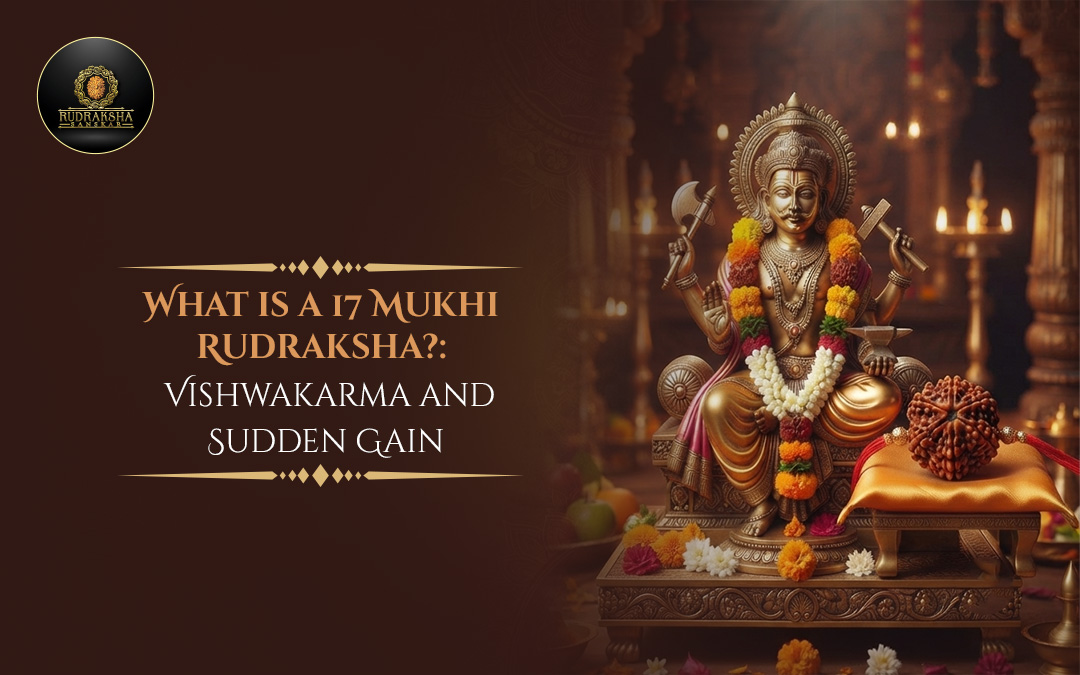
The 17 Mukhi Rudraksha belongs to the rare 15–21 Mukhi range and is traditionally associated in many contemporary Rudraksha systems with Lord Vishwakarma, the divine architect and craftsman.
Its traditional themes commonly centre on:
- creation and achievement
- prosperity
- material progress
- opportunities
- fulfilment
- unexpected or sudden gains
The phrase “sudden gain”, however, needs context.
17 Mukhi should not be interpreted as a bead that produces lottery wins, guaranteed investment returns or unexpected money simply by wearing it.
Its prosperity associations belong to traditional spiritual belief, while actual financial outcomes still depend on decisions, skills, circumstances and risk.
And like other Rudraksha above 14 Mukhi, its scriptural attribution deserves careful examination.
Which Deity Is Associated With 17 Mukhi Rudraksha?
A widely followed contemporary association connects 17 Mukhi Rudraksha with Lord Vishwakarma.
Vishwakarma is traditionally understood as the divine architect and master craftsman. This gives the bead a symbolic connection with:
- creation
- skill
- building
- accomplishment
- material development
- turning ideas into tangible results
This symbolism helps explain why 17 Mukhi has become particularly associated with people involved in business, enterprise, construction, manufacturing and other forms of creation.
However, the deity attribution is not completely uniform across all Rudraksha traditions.
Other contemporary sources use different deity associations for 17 Mukhi.
That disagreement should be acknowledged rather than presenting Vishwakarma as an uncontested scriptural fact.
What Do the Classical Texts Say About 17 Mukhi?
The Shiva Purana is one of the most important classical texts behind Rudraksha tradition.
But its commonly cited Mukhi-specific descriptions are clearest through 14 Mukhi.
Once we enter the 15–21 range, modern sellers frequently attribute detailed deity, planet and benefit charts to texts such as:
- Shiva Purana
- Padma Purana
- Skanda Purana
without providing an exact chapter and verse.
That is not sufficient for a premium-buyer article.
For 17 Mukhi specifically, the Vishwakarma attribution should therefore be described as a widely followed later or modern Rudraksha tradition unless a clear verse-level classical reference is supplied.
The Padma Purana and Skanda Purana remain important parts of the broader Rudraksha textual tradition, but that does not mean every modern 17 Mukhi attribution can automatically be traced to them.
This distinction becomes increasingly important as Mukhi count rises.
Which Planet Rules 17 Mukhi Rudraksha?
Planetary attribution for higher Mukhi Rudraksha is also less standardised.
Different modern systems connect 17 Mukhi with different grahas, while some traditions place greater emphasis on the presiding deity than on a specific planetary ruler.
Therefore, buyers should be cautious when a seller states one planetary association as universally accepted.
If 17 Mukhi is being recommended specifically as an astrological remedy, ask:
Which Rudraksha tradition or textual system is this planetary assignment based on?
For a premium bead, the explanation should be more substantial than a chart copied from another website.
Why Is 17 Mukhi Associated With Sudden Gain?
The traditional prosperity interpretation of 17 Mukhi is often connected with:
- new opportunities
- material fulfilment
- property
- business expansion
- wealth creation
- unexpected financial opportunities
The Vishwakarma association provides a useful way to understand this without exaggeration.
Vishwakarma represents creation.
In practical terms, prosperity usually has to be created through:
- skill
- planning
- execution
- useful work
- good judgment
- opportunity
So “sudden gain” is better understood as a traditional association with unexpected opportunities or favourable material developments, rather than money appearing without effort.
A 17 Mukhi should never be marketed as a guaranteed wealth-producing object.
Who Traditionally Considers Wearing 17 Mukhi?
Because of its price and rarity, 17 Mukhi is generally not an entry-level Rudraksha.
It may appeal particularly to:
Business Owners and Entrepreneurs
Its Vishwakarma symbolism naturally connects with people building businesses, products, systems or long-term assets.
Professionals Involved in Creation
Architects, engineers, manufacturers, designers, builders and other skilled professionals may find the Vishwakarma connection especially meaningful.
People Focused on Material Development
Traditional interpretations also connect 17 Mukhi with prosperity and fulfilment.
But this should complement financial planning and professional effort, not replace them.
Experienced Rudraksha Collectors
A well-developed natural 17 Mukhi, particularly from Nepal, is uncommon enough to have collector interest independent of its spiritual use.
How Rare Is 17 Mukhi Rudraksha?
17 Mukhi belongs firmly within the rare 15–21 Mukhi tier.
Naturally occurring specimens are substantially less available than common Mukhi such as 5, 6 or 7 Mukhi.
Supply becomes particularly limited when the buyer wants:
- Nepal origin
- larger dimensions
- good natural development
- clearly identifiable Mukhi lines
- strong condition
- specimen-specific certification
However, there is no reliable universal scientific ranking that proves 17 Mukhi is exactly the fifth-rarest Rudraksha among 1–21 Mukhi.
Natural supply varies.
So rather than inventing a numerical ranking, it is more accurate to say:
17 Mukhi sits deep within the premium high-Mukhi rarity range and is considerably less common than the standard 1–14 Mukhi market.
Rarity describes supply.
It does not prove that 17 Mukhi is spiritually “more powerful” than a 5 Mukhi or any other bead.
What Determines the Price of a 17 Mukhi Rudraksha?
At this tier, simply saying “17 Mukhi is rare” does not justify the price.
The exact specimen matters.
A premium listing should disclose:
- Mukhi count
- origin
- dimensions
- weight
- shape
- physical condition
- certificate number
- X-ray information where available
Current Rudraksha Sanskar inventory includes premium Nepal-origin 17 Mukhi specimens, showing how significantly size, weight and individual specimen characteristics can affect valuation.
For example, larger and heavier Nepal specimens with clearly documented natural faces can command substantially more than smaller examples of the same Mukhi.
That is because buyers at this level are not simply purchasing the words “17 Mukhi.”
They are purchasing a particular natural specimen.
Why Does Authentication Matter More at 17 Mukhi?
The price difference between a common Rudraksha and a genuine natural 17 Mukhi can be enormous.
That creates an obvious incentive for manipulation.
One risk is taking a lower-Mukhi bead and carving additional grooves into its surface.
At first glance, a heavily textured Rudraksha can make those modifications difficult for an inexperienced buyer to identify.
This is why high-value authentication should involve multiple forms of evidence.
1. Inspect All 17 Mukhi Lines
Each claimed natural Mukhi should run continuously between the poles according to the bead’s natural structure.
Look for:
- unnatural cuts
- sharp tool marks
- inconsistent groove texture
- suspiciously clean lines
- interrupted or artificially extended faces
2. Ask for the Exact Bead’s Certificate
The certificate should correspond to the specimen being sold.
It should ideally record information such as:
- weight
- dimensions
- number of natural faces
- artificial faces
- surface examination
- origin where assessed
- X-ray findings
3. Request X-Ray Evidence
As Mukhi count rises, X-ray becomes increasingly useful because the internal compartment structure can provide another layer of evidence supporting the claimed number of faces.
But X-ray should support surface analysis, not replace it.
A carved external groove cannot be validated simply because someone displays an unrelated X-ray.
4. Match Every Document to the Physical Bead
Compare the certificate with:
- exact dimensions
- exact weight
- specimen photographs
- X-ray number
- certificate number
At premium prices, traceability matters.
Wearing Vidhi for 17 Mukhi Rudraksha
A rare Rudraksha does not require an extravagant ritual because of its price.
A simple Shiva-centred vidhi is sufficient:
- Bathe and wear clean clothes.
- Place the Rudraksha in a clean puja space.
- Gently rinse it with clean water if necessary.
- Offer prayer to Shiva and, if following the Vishwakarma tradition, Lord Vishwakarma.
- Chant the prescribed mantra.
- Take a clear sankalp.
- Wear it respectfully.
Monday can be chosen for a general Shiva-centred practice.
Someone following a specific Vishwakarma, planetary or guru tradition may use the day prescribed within that practice.
Beej Mantra
Higher-Mukhi mantra lists are not completely uniform across traditions.
For a simple Shiva-centred practice, one can use:
Om Namah Shivaya
Where a specific 17 Mukhi Beej Mantra has been prescribed by a guru or established sampradaya, that lineage should take priority over generic online mantra lists.
At 17 Mukhi, “Sudden Gain” Should Never Replace Evidence
17 Mukhi Rudraksha has an interesting traditional identity.
Vishwakarma represents creation.
The bead is associated with achievement, prosperity and unexpected opportunities.
But those ideas should not be turned into promises of effortless wealth.
For premium buyers, there are two separate questions:
What does the tradition say?
and
Can the physical bead actually be verified?
The first requires honest discussion of where classical evidence ends and later tradition begins.
The second requires:
17 natural faces, exact dimensions, weight, origin, specimen-specific certification, surface examination and X-ray evidence where available.
That is the standard a high-value Rudraksha should be held to.
For deeper information on the bead itself, explore the 17 Mukhi Rudraksha collection and specimen details from Rudraksha Sanskar.
And if you plan to buy rudraksha online, compare premium specimens by their verifiable physical and certification data rather than choosing one because a seller promises “sudden wealth.”
FAQs
Lord Vishwakarma is a widely followed modern and later traditional attribution. Other higher-Mukhi systems may differ, and the attribution should not be presented as universally settled scripture.
The Shiva Purana is a foundational Rudraksha source, but its commonly cited face-specific enumeration is much clearer through 14 Mukhi. Claims about 17 Mukhi should therefore be supported by exact textual references where possible.
No. “Sudden gain” is a traditional prosperity association, not a financial guarantee.
It may traditionally appeal to entrepreneurs, creators, professionals, experienced spiritual practitioners and collectors.
Yes. It belongs to the premium 15–21 Mukhi range and is substantially less common than ordinary lower Mukhi Rudraksha.
No. Larger size and desirable specimen characteristics may increase rarity and market value, but that does not prove greater spiritual effectiveness.
At higher Mukhi counts, X-ray provides additional evidence about internal compartment structure and can support surface analysis and certification.