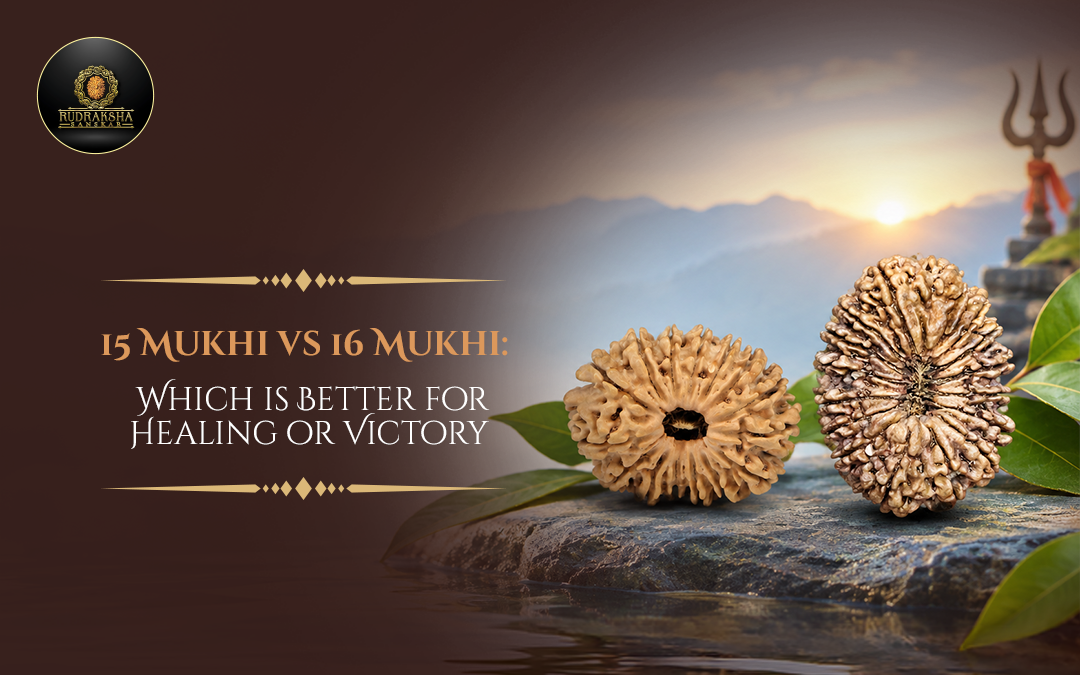
The 15 Mukhi and 16 Mukhi Rudraksha are both rare higher-Mukhi beads associated with forms of Lord Shiva. But traditionally, they are chosen for very different reasons.
The 15 Mukhi Rudraksha is associated with Pashupatinath and is primarily connected with emotional healing, compassion, letting go and inner freedom.
The 16 Mukhi Rudraksha is widely associated with Mahamrityunjaya Shiva and centres on courage, protection, resilience and overcoming fear.
Put simply:
15 Mukhi is about healing what you carry within.
16 Mukhi is about developing the strength to face what stands ahead.
Neither is universally better. The right comparison depends on whether your primary need is healing or victory over adversity.
15 Mukhi Rudraksha: The Healing Side
The 15 Mukhi Rudraksha is traditionally associated with Lord Pashupatinath, the compassionate form of Shiva as Lord of all beings.
Its traditional themes revolve around:
- emotional healing
- compassion
- forgiveness
- inner peace
- releasing attachment
- relationship harmony
- spiritual maturity
This makes 15 Mukhi particularly meaningful for someone who feels emotionally stuck rather than externally threatened.
A person may have moved forward in life while still carrying old grief, regret, resentment or attachment. The 15 Mukhi tradition approaches healing as gradually releasing that emotional burden.
Rudraksha Sanskar’s detailed guide to 15 Mukhi Rudraksha for emotional healing, peace and letting go explores this side more deeply.
But “healing” needs an important qualification.
A Rudraksha is not a medical or psychological treatment. Emotional healing here describes its traditional spiritual symbolism, not a cure for depression, anxiety, trauma or another health condition.
16 Mukhi Rudraksha: The Victory Side
The 16 Mukhi Rudraksha is approached differently.
One widely followed tradition connects it with Mahamrityunjaya Shiva, the form of Shiva associated with overcoming fear and suffering.
Other traditions use different Shiva-related or protective associations, so the deity attribution is not completely uniform.
Its core themes include:
- courage
- protection
- fearlessness
- resilience
- inner stability
- facing uncertainty
- strength during difficult periods
This is why 16 Mukhi is sometimes described as a victory bead.
But what does victory actually mean here?
It should not mean:
“Wear 16 Mukhi and you will win.”
A more grounded traditional interpretation is victory over fear, instability and the tendency to become overwhelmed by adversity.
The guide to 16 Mukhi Rudraksha for protection, fearlessness and stability explains this protective symbolism in greater detail.
15 Mukhi vs 16 Mukhi: Quick Comparison
| 15 Mukhi Rudraksha | 16 Mukhi Rudraksha | |
| Main purpose | Healing and release | Courage and protection |
| Common deity association | Pashupatinath | Mahamrityunjaya Shiva |
| Core theme | Inner freedom | Strength during adversity |
| Traditionally considered for | Emotional burden, attachment, inner peace | Fear, uncertainty, difficult periods |
| Healing focus | Emotional and spiritual | Stability and resilience |
| “Victory” focus | Letting go of inner burdens | Facing and overcoming fear |
| Market category | Rare, premium | Rare, premium |
The difference is less about which number is higher and more about where the struggle is happening.
Which Is Better for Emotional Healing?
Between these two, 15 Mukhi is the more directly aligned bead for emotional healing.
Someone may explore it after:
- emotional disappointment
- relationship difficulties
- grief or loss
- prolonged attachment
- regret
- difficulty forgiving
- a period of emotional exhaustion
Its Pashupatinath symbolism emphasizes compassion and liberation rather than fighting against circumstances.
That makes 15 Mukhi a very different spiritual tool from beads centred on authority, attraction or protection.
For more background on its deity connection, see 15 Mukhi Rudraksha meaning, benefits and Lord Pashupatinath.
Which Is Better for Victory?
If “victory” means developing the courage and stability to face a difficult situation, 16 Mukhi is the more relevant of the two.
It may traditionally appeal to someone facing:
- professional uncertainty
- high-pressure responsibilities
- fear of failure
- major life changes
- prolonged instability
- challenging circumstances
But it would be misleading to turn this into a guaranteed-results claim.
A 16 Mukhi cannot guarantee that you will win a lawsuit, defeat a competitor, receive a promotion, succeed in business or avoid every danger.
Its traditional victory symbolism is about fearlessness and resilience, not controlling external outcomes.
What If You Need Healing and Strength?
Sometimes the answer is not either-or.
Consider someone recovering from a difficult professional or personal experience.
They may need to release the emotional burden of what has already happened, which aligns with 15 Mukhi.
At the same time, they may need courage to enter the next phase without being controlled by fear, which aligns with 16 Mukhi.
Within traditions that permit Rudraksha combinations, the two can therefore be understood as complementary:
15 Mukhi → release
16 Mukhi → resilience
That does not mean everyone should automatically buy both. A combination should have a clear purpose rather than simply collecting increasingly rare beads.
Is 16 Mukhi Better Because It Has More Faces?
No.
A higher Mukhi number does not mean a spiritual upgrade.
15 Mukhi and 16 Mukhi have different traditional identities.
The same principle applies to price.
A current certified 15 Mukhi specimen may cost tens of thousands of rupees, while individual 16 Mukhi specimens can run into lakhs. That difference primarily reflects natural rarity, origin, dimensions, weight, specimen quality and market supply, not measurable spiritual strength.
For premium 15 Mukhi purchases, the guide to identifying an original 15 Mukhi Rudraksha, price and certification is worth reading before comparing specimens.
Authenticity Matters for Both
At this level, buying based only on the number of visible lines is risky.
Before purchasing either bead, check:
- all natural and continuous Mukhi lines
- exact specimen photographs
- dimensions
- weight
- origin
- surface condition
- specimen-specific certificate
- X-ray documentation where available
Artificially adding grooves to a lower-Mukhi bead becomes financially attractive when the claimed bead is worth lakhs.
X-ray can provide supporting evidence about internal compartments, while surface analysis helps examine whether the external Mukhi are naturally formed.
Use both forms of evidence where appropriate rather than treating one test as absolute proof.
Healing or Victory? Start With the Actual Need
The simplest way to choose between these two is not to ask which Rudraksha is stronger.
Ask what you are trying to work through.
Choose the 15 Mukhi tradition when the focus is emotional healing, compassion, letting go and inner freedom.
Explore the 16 Mukhi tradition when the focus is courage, protection, resilience and overcoming fear during difficult circumstances.
And when both healing and courage are relevant, they can be understood as two stages of the same journey:
15 Mukhi helps symbolize making peace with what is behind you.
16 Mukhi helps symbolize finding the courage to face what comes next.
If you plan to buy rudraksha online, decide on the purpose first. Then compare the exact bead’s origin, natural Mukhi, condition, certification and supporting documentation before comparing price.
FAQs
Neither is universally better. 15 Mukhi is more closely associated with emotional healing and release, while 16 Mukhi centres on courage, protection and resilience.
Between these two, 15 Mukhi has the clearer traditional association with emotional healing, compassion and letting go.
It is associated with courage and overcoming adversity in several traditions. “Victory” should be understood as spiritual resilience rather than guaranteed success over another person or situation.
They may be combined within traditions that allow multiple Rudraksha. Their themes can complement each other when someone seeks both emotional release and courage.
Both are premium higher-Mukhi beads. Prices vary substantially according to origin, size, weight, condition, natural formation, certification and availability.