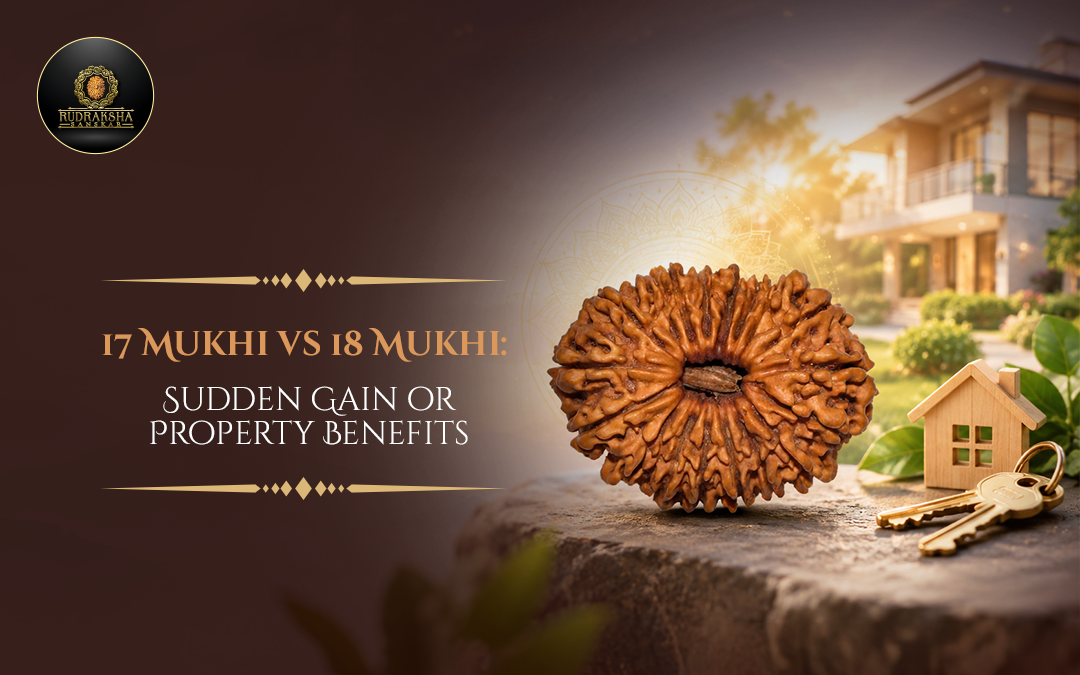
The 17 Mukhi and 18 Mukhi Rudraksha sit next to each other numerically, but traditionally they are chosen for very different material themes.
The 17 Mukhi Rudraksha is associated with Lord Vishwakarma, creation, prosperity, opportunity and what many traditions describe as “sudden gain.”
The 18 Mukhi Rudraksha is associated with Bhumi Devi, giving it a much stronger connection with land, property, agriculture, grounding and long-term material stability.
So the comparison is not:
Which one is more powerful?
It is:
Are you looking at opportunity and wealth creation, or land and property stability?
17 Mukhi Rudraksha: Opportunity and Sudden Gain
The 17 Mukhi Rudraksha is widely associated with Lord Vishwakarma, the divine architect and master craftsman.
That symbolism is important.
Vishwakarma represents:
- creation
- building
- skill
- execution
- development
- turning ideas into something tangible
This is why traditional 17 Mukhi interpretations often focus on:
- business opportunities
- prosperity
- material progress
- new ventures
- fulfilment
- unexpected gains
Rudraksha Sanskar’s detailed guide on 17 Mukhi Rudraksha, Vishwakarma and sudden gain follows this same framing.
But “sudden gain” needs to be understood carefully.
It should not mean:
lottery winnings
guaranteed profit
risk-free investment gains
or
money appearing without effort
A better interpretation is unexpected opportunity or favourable material development.
18 Mukhi Rudraksha: Land and Property
The 18 Mukhi Rudraksha has a different traditional identity.
It is widely associated with Bhumi Devi, or Mother Earth.
That creates a natural connection with:
- land
- agriculture
- property
- physical assets
- stability
- foundations
- long-term material security
For this reason, 18 Mukhi is often considered by people connected with:
- real estate
- construction
- farming
- land ownership
- infrastructure
- businesses based around physical assets
The detailed guide on 18 Mukhi Rudraksha, Bhumi Devi and land explains this Earth connection further.
Again, the property association should not be exaggerated.
Use up and down arrow keys to resize the meta box pane.
Use up and down arrow keys to resize the meta box pane.
Use up and down arrow keys to resize the meta box pane.
Use up and down arrow keys to resize the meta box pane.
18 Mukhi cannot guarantee:
- approval of a land deal
- rising property prices
- successful construction
- legal ownership
- agricultural profits
Its land connection is part of traditional symbolism, not a property-investment guarantee.
17 Mukhi vs 18 Mukhi: Quick Comparison
| 17 Mukhi Rudraksha | 18 Mukhi Rudraksha | |
| Main association | Opportunity and prosperity | Land and stability |
| Common deity | Vishwakarma | Bhumi Devi |
| Traditional focus | Creation, material progress, gain | Property, agriculture, grounding |
| Commonly considered by | Entrepreneurs, builders, creators | Landowners, developers, farmers |
| Key idea | Creating opportunity | Building a stable foundation |
| Premium category | Rare | Very rare |
| Typical buying reason | Growth and opportunity | Land/property-related symbolism |
The difference becomes easy to remember:
17 Mukhi = create and expand
18 Mukhi = establish and stabilize
Which Is Better for Sudden Gain?
Between these two, 17 Mukhi is the bead more traditionally associated with sudden gain and new opportunity.
That makes it more relevant for someone focused on:
- business expansion
- entrepreneurship
- creating new revenue streams
- professional opportunities
- building something new
Its Vishwakarma connection is especially useful here because it reframes prosperity around creation and skill, rather than passive luck.
In other words, 17 Mukhi is better understood as:
opportunity meeting preparation
rather than:
money appearing from nowhere
Which Is Better for Property?
For land, property and physical assets, 18 Mukhi is the more directly aligned bead.
The Bhumi Devi symbolism gives it a much clearer connection with:
- land acquisition
- real estate
- agriculture
- construction
- physical infrastructure
- stable material foundations
That is why 18 Mukhi is usually the more relevant choice when the primary intention specifically involves land or property.
But it should still be combined with:
- legal due diligence
- title verification
- financial planning
- valuation
- professional advice
A spiritual bead does not replace proper property decisions.
What If You Are a Real Estate Developer or Builder?
This is where the comparison becomes interesting.
A real estate developer may identify with both beads.
17 Mukhi fits the Vishwakarma side:
- creation
- construction
- enterprise
- business growth
18 Mukhi fits the Bhumi Devi side:
- land
- property
- physical foundations
- long-term assets
Within traditions that allow combinations, both may be considered together when there is a clear reason.
But that does not mean every builder or developer automatically needs both.
If the focus is primarily business opportunity and expansion, 17 Mukhi is the clearer choice.
If the focus is specifically land and property, 18 Mukhi is more directly aligned.
Is 18 Mukhi More Powerful Because It Is Rarer?
No.
18 Mukhi can be much more expensive, especially in larger Nepal-origin specimens, but that difference reflects natural scarcity and specimen quality, not spiritual superiority.
Current Rudraksha Sanskar examples make this clear.
A Nepal-origin 17 Mukhi measuring 30.5 mm and weighing 5.26 g is listed at ₹4,00,000.
A Nepal-origin 18 Mukhi measuring 34 mm and weighing 5.72 g is listed at ₹8,00,000, with certificate DCL/2026/A/0021 and X-ray number 1097.
The higher price of the 18 Mukhi reflects the specimen and market rarity.
It does not prove that it is “twice as powerful.”
Authentication Matters for Both
Both 17 and 18 Mukhi sit in the premium range.
Before buying either, ask for:
- photographs of the exact bead
- all natural Mukhi lines
- dimensions
- weight
- origin
- certificate number
- X-ray where available
- confirmation of natural versus artificial faces
At these price levels, the buyer should not accept a generic claim such as “100% original.”
Rudraksha Sanskar’s certificate guide also explains why the price of two beads with the same Mukhi can differ based on rarity, size, origin, condition and natural formation.
Can 17 and 18 Mukhi Be Worn Together?
Yes, in traditions that allow multi-Mukhi combinations.
The logic would be:
17 Mukhi → opportunity and creation
18 Mukhi → land and stability
This may make sense for someone whose work combines both, such as:
- real estate developers
- infrastructure businesses
- construction companies
- agricultural entrepreneurs
But a combination should have a real purpose.
Do not combine rare beads simply because more Mukhi sounds better.
Opportunity or Property? Start With the Main Goal
The easiest way to choose between these two is to identify the real intention.
Choose 17 Mukhi when the focus is creation, business opportunity, material growth and prosperity symbolism.
Choose 18 Mukhi when the focus is land, property, agriculture, grounding and stable material foundations.
And remember that neither bead guarantees financial results.
Rudraksha can support a traditional spiritual practice.
Business and property outcomes still depend on real-world decisions.
For deeper information, explore both the 17 Mukhi Rudraksha and 18 Mukhi Rudraksha collections from Rudraksha Sanskar.
If you plan to buy rudraksha online, compare the actual specimen, origin, dimensions, weight, certificate and X-ray rather than choosing from prosperity or property claims alone.
FAQs
Neither is universally better. 17 Mukhi is more closely associated with opportunity, prosperity and creation, while 18 Mukhi is more closely associated with land, property and stability.
17 Mukhi has the clearer traditional association with sudden or unexpected material opportunities.
18 Mukhi has the stronger Bhumi Devi and land-related association.
Yes. Its Vishwakarma symbolism makes it especially relevant to builders, creators and entrepreneurs.
They can be combined where a tradition permits it and where both opportunity and land-related symbolism are relevant.
Natural rarity, origin, size, weight, condition, certification and collector demand can all increase its price.