Everyone has something they wish they had handled differently.
A wrong decision. A failed relationship. A missed opportunity. Words that should not have been said. Or simply an older version of yourself that you no longer want to carry.
The 3 Mukhi Rudraksha is traditionally associated with Agni, the fire deity, which gives this bead its central symbolism: transformation.
It is often described as a Rudraksha for releasing guilt, past burdens and self-doubt. But that does not mean wearing one erases memories or removes the consequences of past actions.
Its traditional meaning is more practical:
learn from what happened without allowing it to define everything that happens next.
What Is a 3 Mukhi Rudraksha?
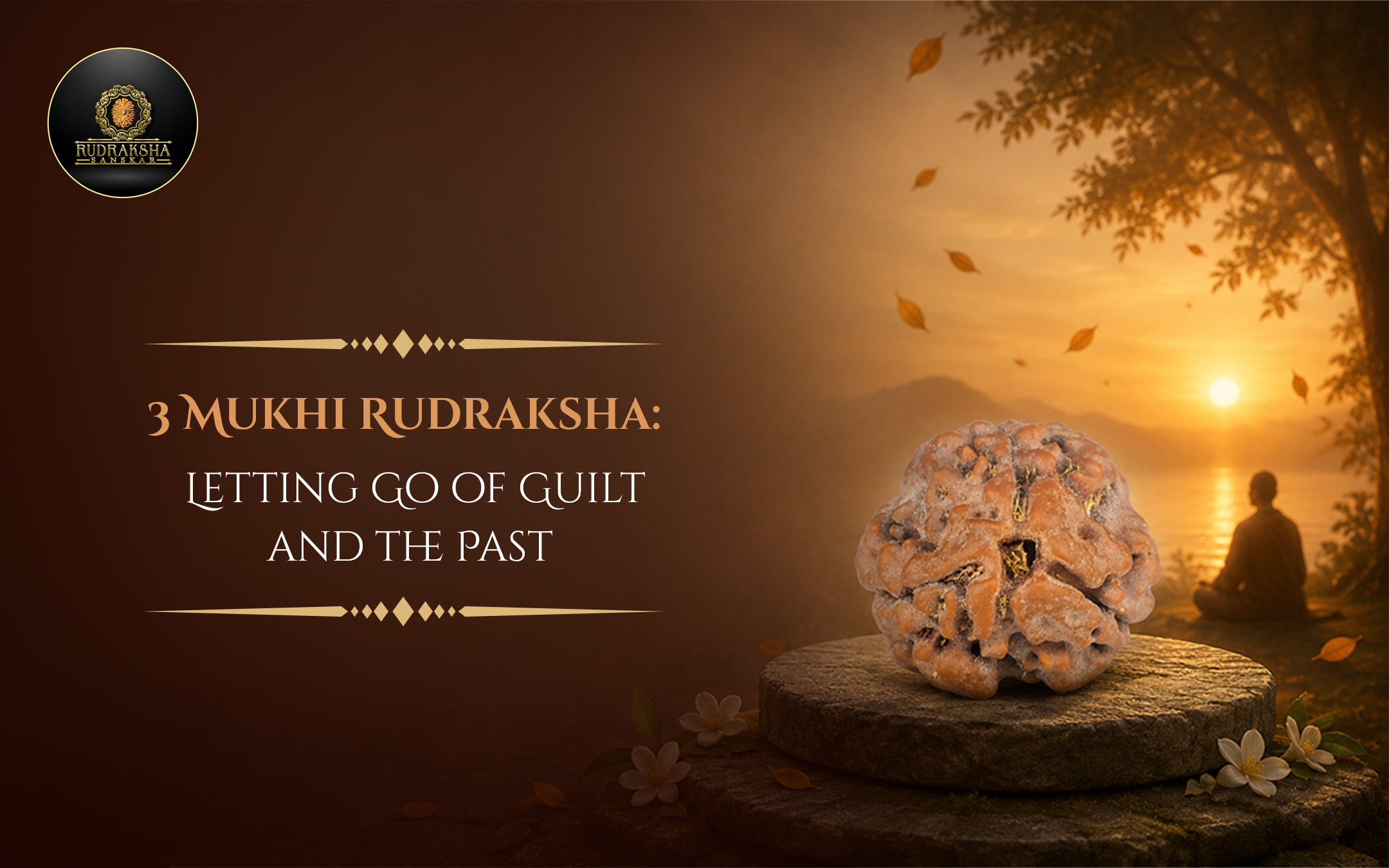
A genuine 3 Mukhi Rudraksha has three naturally formed Mukhi lines running across its surface.
Its traditional association with Agni connects it with:
- transformation
- releasing past burdens
- renewed confidence
- courage to begin again
- reducing excessive self-blame
- moving beyond old patterns
Fire is important to understanding this symbolism.
In Hindu tradition, Agni is associated with purification and transformation. What enters fire does not remain in its original state.
Similarly, the symbolism of 3 Mukhi is not about pretending the past never happened.
It is about allowing experience to change you without permanently trapping you.
Why Is 3 Mukhi Associated With Letting Go of the Past?
People often carry the past in two very different ways.
The first is useful:
“I made a mistake. What can I learn from it?”
The second becomes a burden:
“I made a mistake. Therefore, I am a failure.”
Those are not the same thing.
The traditional interpretation of 3 Mukhi fits the movement from the second mindset toward the first.
It represents the idea of acknowledging what happened, accepting responsibility where necessary and then allowing yourself to move forward.
That is why 3 Mukhi is frequently discussed around guilt and old emotional burdens.
What Does “Releasing Guilt” Actually Mean?
This phrase needs to be handled carefully.
Guilt can sometimes serve a useful purpose.
If you have hurt someone, guilt may encourage you to:
- acknowledge what happened
- apologise
- repair the damage where possible
- change your behaviour
- avoid repeating the same mistake
Simply trying to “remove” that guilt without taking responsibility misses the point.
The problem begins when useful reflection turns into constant self-punishment.
You may have already apologised.
You may have changed.
You may have learned from the experience.
Yet years later, you continue mentally replaying the same event.
The spiritual symbolism of 3 Mukhi is more relevant at this stage: not avoiding responsibility, but refusing to remain permanently imprisoned by something you can no longer change.
Traditional 3 Mukhi Rudraksha Benefits
Moving Beyond Past Mistakes
This is perhaps the clearest traditional association.
3 Mukhi may appeal to someone who understands a past mistake intellectually but continues carrying it emotionally.
The intention becomes:
remember the lesson, release the punishment.
Rebuilding Confidence
Failure can affect more than one situation.
A failed business may make someone afraid to start again.
A poor exam result may make a student question their ability.
A relationship ending may make someone doubt their judgment.
Traditional 3 Mukhi symbolism encourages renewal after such experiences.
It does not guarantee success on the next attempt.
It represents having the courage to make another attempt with greater awareness.
Breaking Repetitive Patterns
Sometimes the past is not one event.
It is a pattern.
You may repeatedly:
- avoid difficult conversations
- procrastinate
- react impulsively
- abandon goals after setbacks
- return to unhealthy habits
In this context, “letting go” means changing the behaviour rather than simply trying to forget previous consequences.
Beginning Again
Agni transforms.
That makes 3 Mukhi especially meaningful around a genuine fresh start.
This might include:
- returning to education
- changing careers
- rebuilding after business failure
- beginning a healthier routine
- restarting spiritual practice
- moving forward after a difficult personal period
The bead becomes a reminder of the intention behind the new beginning.
Who Should Consider Wearing 3 Mukhi Rudraksha?
People Who Keep Replaying Old Mistakes
If you repeatedly return to something that cannot now be changed, the traditional symbolism of release may resonate with you.
People Starting Again After Failure
Someone rebuilding after a professional, academic or personal setback may connect with its Agni symbolism of transformation.
People Struggling With Self-Doubt
Past experiences can create an internal assumption that future attempts will end the same way.
3 Mukhi is traditionally associated with confidence and moving beyond that mental burden.
Spiritual Practitioners Focused on Transformation
Not everyone needs to wear 3 Mukhi because something went wrong.
A devotee may choose it simply because Agni and transformation have significance within their spiritual practice.
What 3 Mukhi Rudraksha Cannot Do
This distinction matters especially with a topic involving guilt and the past.
A Rudraksha cannot:
- erase memories
- undo past actions
- make another person forgive you
- remove legal or financial consequences
- automatically resolve trauma
- replace therapy or mental-health treatment
If guilt, traumatic memories, depression or anxiety are significantly affecting everyday life, professional support is appropriate.
Spiritual practices and professional care do not have to compete with each other.
A Rudraksha can be part of someone’s personal spiritual routine without being presented as medical treatment.
3 Mukhi vs 9 Mukhi: Which Is More Relevant?
Both can appear in conversations about emotional strength, but their traditional emphasis differs.
3 Mukhi Rudraksha centres more on:
- the past
- guilt
- transformation
- starting again
- rebuilding confidence
9 Mukhi Rudraksha centres more on:
- Maa Durga
- courage
- fear
- emotional resilience
- facing present challenges
A simple way to distinguish them is:
3 Mukhi: “How do I stop allowing yesterday to control me?”
9 Mukhi: “How do I find the courage to face what is in front of me?”
These are traditional distinctions, not rigid rules.
How Should You Wear 3 Mukhi Rudraksha?
A simple spiritual practice is enough.
You can:
- Clean yourself and prepare your puja space.
- Keep the Rudraksha before Shiva or according to your family tradition.
- Set a clear intention around what you are trying to change.
- Chant Om Namah Shivaya or the mantra prescribed within your tradition.
- Wear the Rudraksha consistently rather than expecting an immediate change.
Some traditions associate Sunday with 3 Mukhi because of its Agni connection, while Shiva devotees may choose Monday.
If you have guidance from a guru or family tradition, follow that practice.
How Do You Identify an Original 3 Mukhi Rudraksha?
The bead should have three natural Mukhi lines rather than artificially carved grooves.
Before buying, examine:
- all three natural faces
- surface continuity
- signs of carving or modification
- dimensions
- weight
- origin
- photographs of the actual specimen
- certificate number
- X-ray information where available
Do not rely on unreliable home tests such as whether the bead floats or sinks.
For a more complete verification process, use the original Rudraksha identification guide.
FAQs
Traditionally, it is associated with transformation, releasing past burdens, renewed confidence and the courage to begin again.
3 Mukhi is traditionally associated with Agni, the fire deity.
Its traditional symbolism relates to releasing excessive self-blame and moving forward after learning from the past. It should not be treated as psychological treatment.
It may appeal to people rebuilding after setbacks, struggling with past mistakes or focusing spiritually on transformation and renewal.
Yes. A student rebuilding confidence after academic setbacks may connect with its traditional symbolism.
It can be meaningful as a spiritual reminder of renewal, but it does not replace planning, skill development or better decision-making.
Claims that simply wearing a bead automatically erases every past action should be treated cautiously. Traditional spiritual practice involves responsibility, reflection and transformation, not avoiding consequences.
 1MK(Underdeveloped) 23.4mm 3.9gm