Shravan creates an unusual problem for first-time Rudraksha buyers.
The month is closely associated with Lord Shiva, demand rises, and suddenly every rare Mukhi starts sounding essential. A person who has never worn Rudraksha before can go from looking for one simple bead to comparing 11 Mukhi, 14 Mukhi, 21 Mukhi and expensive combinations within an hour.
Most people do not need to start there.
If this is your first Rudraksha, a 5 Mukhi Rudraksha is usually the more sensible place to begin. It is widely worn, comparatively affordable, suitable for regular spiritual practice and does not require you to understand an entire system of rare Mukhi before getting started.
That does not make it a “basic” or lesser Rudraksha.
It makes it practical.
And during Shravan, when buying decisions are easily influenced by urgency, practical is exactly what a first-time wearer needs.
What Is a 5 Mukhi Rudraksha?
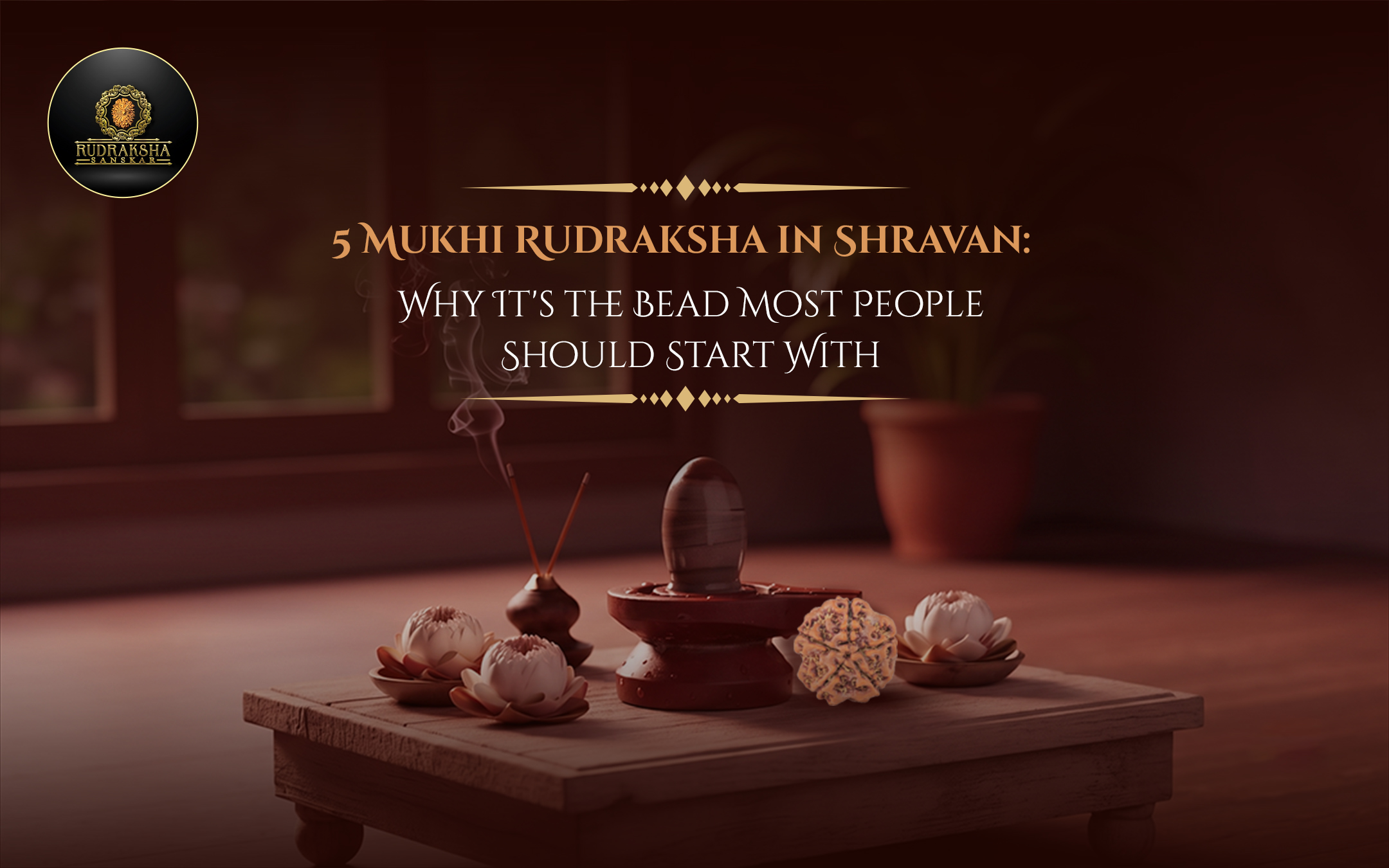
A 5 Mukhi Rudraksha is identified by five naturally formed lines or faces running along the bead.
In the Shiva Purana, the five-faced Rudraksha is identified with Rudra and referred to as Kalagni. This is one reason the bead has remained closely connected with Shiva worship rather than being treated only as an astrological object.
It is also one of the most widely available natural Mukhi varieties, which matters for a very practical reason: you do not have to pay rare-Rudraksha prices to begin wearing an authentic bead.
That combination explains much of its popularity:
- strong traditional association with Shiva
- suitable for regular japa and meditation
- widely available
- comparatively affordable
- simple for first-time wearers
- available as a single bead, bracelet, kantha or mala
- found in both Nepali and Indonesian varieties
The 5 Mukhi Rudraksha is therefore less about chasing a highly specific outcome and more about building a consistent spiritual practice.
For Shravan, that makes sense.
Why Do So Many People Start With 5 Mukhi Rudraksha?
Because a first Rudraksha should ideally help you build the habit before you build the collection.
A beginner usually does not yet know:
Which size feels comfortable for daily wear?
Do I prefer a single bead or mala?
Will I wear it throughout the day or mainly use it during japa?
How do I clean and care for it?
Do I actually want a more specialised Mukhi, or did I simply see one recommended online?
Starting with an expensive higher Mukhi does not answer any of those questions.
A 5 Mukhi gives you room to learn.
It does not depend on rarity
A common mistake is assuming that rarity and spiritual usefulness are the same thing.
They are not.
A 21 Mukhi is rarer than a 5 Mukhi. That explains part of the price difference. It does not automatically make 21 Mukhi the better first Rudraksha for every person.
The same principle applies throughout the Rudraksha system.
Higher Mukhi does not mean higher level.
Different Mukhi carry different traditional associations. The number should match the purpose rather than the size of your budget.
It is easy to include in daily practice
A single 5 Mukhi can be worn around the neck or used as part of a simple devotional routine.
A 5 Mukhi Rudraksha mala can also be used for mantra japa, including Om Namah Shivaya, making it particularly relevant for someone building a Shiva practice during Shravan.
There is no need to create an elaborate ritual around it every morning.
The entry cost is much lower
This point is often avoided in spiritual buying guides, but it matters.
5 Mukhi Rudraksha is naturally more abundant than many higher Mukhi varieties. Rudraksha Sanskar’s current 2026 pricing guide places typical individual 5 Mukhi beads at affordable rates, depending on origin, size and quality.
Compare that with rare Mukhi that can cost thousands, tens of thousands or substantially more.
A person exploring Rudraksha for the first time should not have to make a major financial commitment simply to begin a daily practice.
Who Is 5 Mukhi Rudraksha Actually For?
It is tempting to write “everyone.”
A more useful answer is that 5 Mukhi suits a particularly broad group of people.
First-time Rudraksha wearers
This is the clearest group.
If you have never worn Rudraksha before and do not have a specific recommendation from a guru or experienced consultant, 5 Mukhi keeps the starting decision simple.
Shiva devotees during Shravan
Shravan is traditionally centred around Shiva worship, Monday vrat, Abhishek, mantra and personal discipline.
A 5 Mukhi naturally fits that framework because its traditional association is directly connected with Rudra.
If you are planning to start wearing one on a Sawan Somvar, see our complete Sawan Somvar Rudraksha wearing guide before choosing your starting date.
People building a meditation or japa routine
If your actual goal is to become more regular with mantra chanting or meditation, a 5 Mukhi mala may make more practical sense than buying a rare single bead.
The object supports the routine.
The routine still has to be done.
Someone who does not yet know which specialised Mukhi they need
You do not have to solve the entire Rudraksha system before wearing your first bead.
Start simple. Learn. Then consider whether another Mukhi has a traditional association more specific to what you are working on.
That is a better sequence than buying three or four Mukhi together because an online chart told you to.
Who May Not Need to Start With 5 Mukhi?
An honest Rudraksha guide should answer this too.
5 Mukhi is broadly suitable, but that does not mean it is automatically the right purchasing decision for every person.
Someone given a specific spiritual practice by their guru
If an established teacher or tradition has specifically instructed you to use another Mukhi, there is little reason to replace that guidance with a generic internet recommendation.
Someone looking for a very specific traditional association
Suppose your interest is specifically around Ganesha, Surya, Hanuman, Gauri-Shankar or another recognised Rudraksha association.
In that case, researching the relevant Mukhi may be more appropriate than automatically choosing 5 Mukhi.
Someone buying Rudraksha to treat a medical condition
Do not buy a 5 Mukhi because someone told you it will cure hypertension, anxiety, insomnia, diabetes or another condition.
Those are medical matters.
You may wear Rudraksha as part of your spiritual practice, but it should not replace diagnosis, medication or professional medical care.
Someone expecting a result without a practice
Buying the bead is easy.
Maintaining the mantra, meditation, self-discipline or devotional routine around it is the part that takes effort.
If the expectation is “wear this and something external will automatically change,” the problem is not which Mukhi you selected.
It is the expectation.
5 Mukhi Rudraksha Benefits: Tradition vs What You Should Reasonably Expect
Search for 5 Mukhi Rudraksha benefits and you will find long lists.
Peace. Focus. better sleep. Health. Jupiter. Memory. Blood pressure. Spiritual awakening. Success.
The problem is that spiritual tradition, astrological interpretation and medical evidence often get mixed into one paragraph.
They should not.
Here is a cleaner way to understand it.
| Traditionally Associated With | A More Reasonable Way to Interpret It |
| Mental calmness | Use it as part of meditation, mantra and a more disciplined routine |
| Focus and awareness | The japa or mindfulness practice around the bead can become a consistent attention ritual |
| Spiritual growth | It can serve as a physical reminder of an ongoing Shiva or meditation practice |
| Discipline | Wearing it daily can reinforce a spiritual commitment you have chosen |
| Jupiter or Guru association | Relevant within certain astrological traditions, not a guaranteed planetary “fix” |
| Protection or purification | A traditional spiritual belief, not a measurable promise of immunity from problems |
The distinction matters.
A Rudraksha can have meaning without needing exaggerated claims attached to it.
That is especially true of 5 Mukhi. Its biggest advantage is not that it promises the most dramatic result.
It is that people can actually wear it regularly and build a practice around it.
Why Shravan Is a Good Time to Start Wearing 5 Mukhi
You can wear Rudraksha throughout the year.
Shravan is not the only valid window.
What the month gives you is context.
You already have repeated Mondays, Shiva worship, mantra chanting and a defined spiritual period in which to build consistency. Starting a Rudraksha practice during that routine can therefore feel more deliberate than beginning on a random day and forgetting about it a week later.
For exact regional dates, Somvar schedules and Shravan rituals, see our Shravan Month 2026 guide.
If you miss the first Monday, use the next.
The usefulness of Shravan is in the practice it helps you establish, not in creating a deadline that pressures you into buying.
How Much Does a 5 Mukhi Rudraksha Cost?
This is where 5 Mukhi becomes particularly attractive for a beginner.
It is one of the more abundant Mukhi varieties, so a genuine bead does not need to carry a rare-bead price tag.
The current catalogue also includes everything from small Indonesian beads used for malas to Nepali full-seed pieces around the 18 mm to 30 mm+ range.
Prices change with live inventory, bead quality, size, stringing and certification, so treat these as reference points rather than permanent rates.
For a wider explanation of how Mukhi, origin and size affect cost, see our Rudraksha price guide.
Why can two 5 Mukhi beads have different prices?
Because “5 Mukhi” tells you the facial structure, not the entire physical specification.
Price can change based on:
- origin
- diameter
- weight
- surface definition
- overall formation
- condition
- whether it is sold individually or in a mala
- certification or testing
- preparation, capping or jewellery work
A 30 mm Nepali bead and a small Indonesian bead can both be genuine 5 Mukhi Rudraksha and still sit at very different price points.
The mistake is assuming that the cheaper one must be fake or that the expensive one must be spiritually stronger.
Neither conclusion follows from price alone.
Nepali vs Indonesian 5 Mukhi: Which Should a Beginner Choose?
Both can be authentic Rudraksha.
The visible difference is usually much easier to understand than the marketing around it.
Nepali 5 Mukhi
Nepali Rudraksha are generally larger, with a stronger surface profile and more prominent natural lines.
This makes them popular for:
- individual wearing
- pendants
- larger malas and kanthas
- buyers who prefer a visibly pronounced bead
Their larger size can also increase the price.
Indonesian 5 Mukhi
Indonesian Rudraksha are generally smaller and have subtler surface lines.
Their compact size makes them useful for:
- 108-bead japa malas
- lighter everyday malas
- people who prefer smaller beads
- buyers looking for a more affordable entry point
Is Nepal automatically better?
Not in the simplistic way that question is usually presented.
A natural, correctly identified Indonesian 5 Mukhi is still a 5 Mukhi Rudraksha.
Origin affects physical appearance, availability and price. It should not be used as a shortcut for authenticity.
For a detailed origin comparison, our dedicated Nepali vs Indonesian Rudraksha guide will cover the differences separately rather than forcing that entire topic into this article.
Should You Buy One 5 Mukhi Bead or a 5 Mukhi Rudraksha Mala?
This depends on what you actually plan to do with it.
Choose a single bead if you want:
- simple everyday wearing
- a pendant-style Rudraksha
- your first experience wearing Rudraksha
- something easy to maintain
- the lowest-cost practical starting point
For most beginners, this is enough.
Choose a mala if you want:
- regular mantra japa
- a dedicated meditation tool
- 27, 54 or 108-bead practice
- to integrate Rudraksha directly into chanting
A mala is not automatically “more powerful” because it contains more beads.
It is a different format designed for a different type of practice.
If your main objective is mantra repetition, read our 5 Mukhi Rudraksha mala buying guide before choosing the bead count and size.
How to Wear 5 Mukhi Rudraksha During Shravan
You do not need an unnecessarily complicated ceremony.
If your family, guru or sampradaya follows a specific vidhi, continue with it.
For a simple Shiva-centred practice:
1. Choose a Monday if possible.
Sawan Somvar is a natural choice during Shravan, although missing one does not invalidate the next Monday.
2. Bathe and wear clean clothes.
3. Keep the Rudraksha near your Shiva puja space.
4. Perform a simple Jal Abhishek or your usual Shiva worship.
5. Chant Om Namah Shivaya.
If your tradition uses a specific count, follow it. Many devotees use 108 repetitions.
6. Wear the bead or begin your japa.
Then continue.
The consistency after the first morning matters more than making the first morning elaborate.
How Do You Check Whether a 5 Mukhi Rudraksha Is Original?
Because 5 Mukhi is affordable, some buyers assume verification does not matter.
It still does.
Look at the bead before you look at the claims around it.
Start with the five natural lines
A genuine 5 Mukhi should have five naturally formed Mukhi divisions.
The surface does not need to look perfectly symmetrical.
In fact, suspicious perfection deserves more attention than natural irregularity.
Do not rely on the water test
Floating or sinking is not a dependable authenticity test.
A bead’s density can vary, while tampered or treated material can also behave differently in water.
A test that gives you a dramatic yes-or-no answer is attractive. That does not make it scientifically reliable.
Know when certification matters
For an everyday low-cost 5 Mukhi, the cost of individual laboratory certification may sometimes approach or exceed the value of the bead itself.
That does not mean authenticity stops mattering.
It means verification should be proportionate.
For premium individual beads, unusual formation, expensive pieces or full malas marketed as certified, ask for documentation that actually corresponds to what you are buying.
Our Rudraksha authenticity guide explains what to check before relying on a certificate or seller claim.
Five Things a Beginner Does Not Need to Buy With Their First 5 Mukhi
Shravan buying can become unnecessarily complicated very quickly.
For your first bead, you usually do not need:
The rarest Mukhi available.
Rarity is not a requirement for beginning.
A complicated combination.
Learn to wear one Rudraksha consistently before assuming you need five.
Expensive metal capping.
It can improve presentation, but it is not what makes the Rudraksha genuine.
A fear-based astrological package.
No responsible seller should make you feel that something bad will happen if you do not purchase immediately.
A promise of guaranteed results.
No bead should be sold as a guaranteed cure, financial solution or substitute for professional guidance.
Start with the Rudraksha.
The accessories can wait.
What Should You Expect After You Start Wearing It?
Probably not a dramatic event on day one.
And that is fine.
Rudraksha is traditionally worn as part of a longer spiritual discipline. If you begin during Shravan, use the weeks that follow to establish something repeatable:
- a few minutes of mantra each morning
- regular Shiva worship
- meditation
- more deliberate conduct
- consistent care of the bead
- a routine that can continue after Shravan ends
You do not need to constantly ask, “Is it working?”
A better question after several weeks is:
Have I actually maintained the practice I started?
That is something you can answer.
FAQs
It is widely available, comparatively affordable, easy to wear and traditionally associated with general Shiva-centred spiritual practice rather than one narrow objective. This makes it a practical first Rudraksha for many people.
Traditionally, 5 Mukhi is associated with calmness, awareness, discipline, spiritual practice and Jupiter or Guru within certain astrological systems. These are traditional associations, not guaranteed medical or life outcomes.
Rudraksha Sanskar’s current 2026 price guidance places standard individual 5 Mukhi beads at approximately ₹200 to ₹1,000 depending on size and origin. Larger pieces, premium formation and malas can cost more.
Yes. Many Shiva devotees choose Shravan or a Sawan Somvar to begin wearing Rudraksha. You can also wear it at other times of the year.
Both can be authentic. Nepali beads are generally larger with more pronounced surface lines, while Indonesian beads are smaller and popular for malas. Choose according to intended use, budget and authenticity rather than origin alone.
5 Mukhi Rudraksha is widely worn by both men and women. If your family or spiritual tradition follows additional rules, those can be observed separately.
It is commonly regarded as one of the more broadly worn Rudraksha varieties. For children, practical considerations such as bead size, string safety and comfort also matter.
Choose a single bead if your priority is simple everyday wearing. Choose a mala if you specifically intend to use Rudraksha for regular mantra japa or meditation.
Common formats include 27, 54 and 108 beads, depending on how the mala will be used. A 108-bead mala is particularly common for mantra japa.
Certification can provide useful supporting evidence, especially for premium products and complete malas. For inexpensive single 5 Mukhi beads, also examine natural formation, seller transparency and provenance rather than assuming a printed certificate alone proves authenticity.
Shravan does not require you to begin your Rudraksha journey with the most expensive bead you can afford.
For most first-time wearers, that would miss the point.
A genuine 5 Mukhi Rudraksha, selected carefully and used consistently, gives you everything you need to understand how Rudraksha fits into your spiritual routine before you consider anything rarer.
Start with one bead if that is enough.
Use a mala if you genuinely plan to practise japa.
Choose Nepal or Indonesia according to your preference and budget.
Verify what you are buying.
Then give the practice enough time to become part of your life rather than another purchase made because Shravan created urgency.
If you plan to buy Rudraksha online, choose a trusted seller like Rudraksha Sanskar that provides clear information about the bead, its origin and available authenticity documentation.