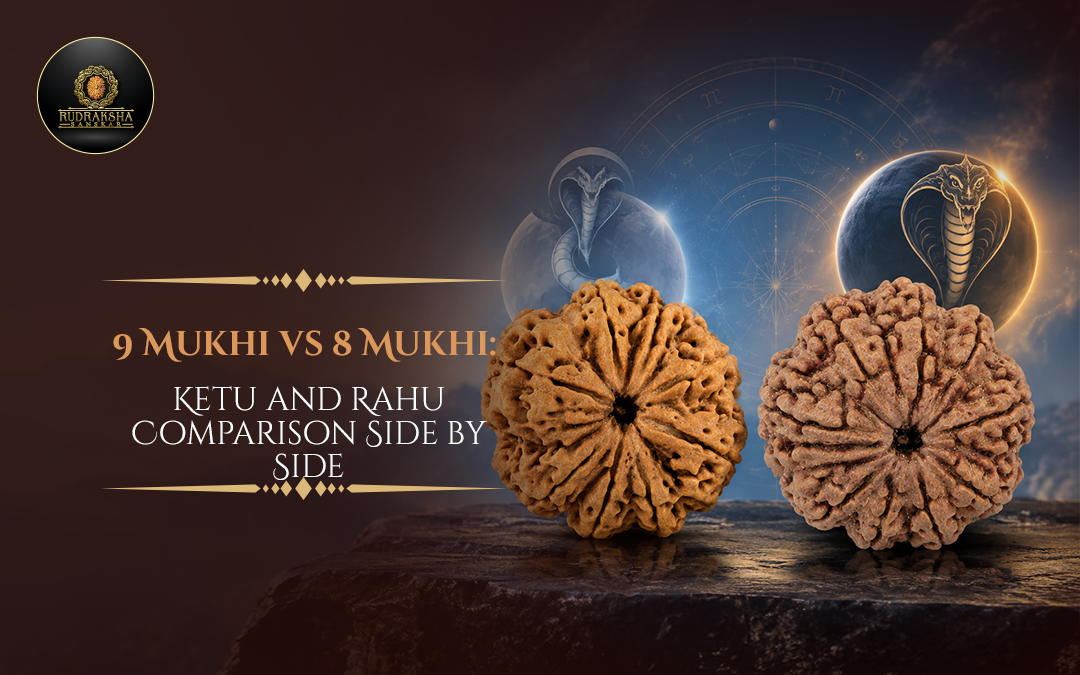
8 Mukhi and 9 Mukhi Rudraksha are often discussed together because of their associations with the two shadow planets of Vedic astrology:
8 Mukhi → Rahu
9 Mukhi → Ketu
But Rahu and Ketu represent very different challenges.
Rahu is commonly associated with ambition, desire, uncertainty, unconventional paths and worldly attachments.
Ketu is associated with detachment, introspection, spiritualization and separation from material identification.
That difference helps explain why 8 Mukhi and 9 Mukhi are not interchangeable remedies, even though Rahu and Ketu form the same nodal axis astrologically.
8 Mukhi Rudraksha: Ganesha and Rahu
The 8 Mukhi Rudraksha is widely associated with Lord Ganesha.
Ganesha is traditionally worshipped as the remover of obstacles and the deity invoked before important beginnings.
In contemporary Rudraksha astrology, 8 Mukhi is commonly connected with Rahu.
Its traditional themes therefore include:
- navigating obstacles
- clarity during confusion
- discipline
- adaptability
- dealing with uncertainty
- moving through unconventional circumstances
- overcoming repeated disruptions
This does not mean 8 Mukhi can simply “remove Rahu.”
Its symbolism is better understood around developing the steadiness and clarity needed when circumstances feel unpredictable.
For a deeper astrological explanation, the guide to 8 Mukhi Rudraksha during Rahu Mahadasha provides the individual bead options and traditional context.
9 Mukhi Rudraksha: Durga and Ketu
The 9 Mukhi Rudraksha is widely associated with Goddess Durga and her nine forms, Navadurga.
The Shiva Purana also connects the 9 Mukhi with Bhairava, while mentioning Durga-related divine feminine associations.
In contemporary Rudraksha astrology, 9 Mukhi is commonly associated with Ketu.
Its traditional themes include:
- courage
- spiritual strength
- fearlessness
- detachment
- inner discipline
- spiritual development
- moving beyond unnecessary attachment
Rudraksha Sanskar’s guide to 9 Mukhi Rudraksha and Maa Durga explores this bead and its available forms further.
The Ketu connection makes 9 Mukhi particularly different from 8 Mukhi.
Where Rahu tends to pull attention toward worldly experience, Ketu is traditionally associated with detachment from it.
8 Mukhi vs 9 Mukhi: Side-by-Side Comparison
| 8 Mukhi Rudraksha | 9 Mukhi Rudraksha | |
| Common deity | Lord Ganesha | Maa Durga / Navadurga; Bhairava in Shiva Purana |
| Planet | Rahu | Ketu |
| Main theme | Obstacles and uncertainty | Courage and detachment |
| Traditional focus | Clarity, adaptability, progress | Fearlessness, spiritual strength |
| Mahadasha | Rahu Mahadasha | Ketu Mahadasha |
| Often considered when | Life feels unpredictable or obstructed | Life feels detached, inward or spiritually transformative |
| Core symbolism | Navigate complexity | Develop inner strength |
A simple way to remember the distinction is:
8 Mukhi helps symbolize navigating what complicates your path.
9 Mukhi helps symbolize developing the strength to release what no longer belongs on it.
Which Is Better for Rahu?
Between the two, 8 Mukhi is the conventional Rahu-associated Rudraksha.
It is commonly considered during Rahu-related periods where themes might involve:
- uncertainty
- excessive ambition
- unconventional circumstances
- confusion
- repeated obstacles
- rapidly changing situations
Rahu Mahadasha itself should not automatically be treated as a curse or universally negative period.
Its effects in Jyotisha depend on the individual birth chart, Rahu’s placement, aspects, conjunctions and the Antardasha operating within the broader Mahadasha.
So 8 Mukhi should not be marketed as an automatic “Rahu Dosha remover.”
Which Is Better for Ketu?
For Ketu-related spiritual practice, 9 Mukhi is the more directly associated bead.
Ketu is traditionally connected with detachment, introspection, past karmic patterns and spiritual orientation.
That makes the Durga symbolism particularly meaningful.
Rather than promising that 9 Mukhi will eliminate every Ketu-related difficulty, its traditional themes centre on developing:
courage without attachment and spiritual strength during change.
Someone specifically navigating Ketu Mahadasha may therefore study 9 Mukhi more closely than 8 Mukhi.
Rahu vs Ketu: Why Would the Remedies Be Different?
Astronomically, Rahu and Ketu are the ascending and descending lunar nodes.
In Jyotisha, however, they carry different symbolic meanings.
Rahu is frequently connected with:
desire, expansion, ambition, fascination and worldly experience.
Ketu is frequently connected with:
detachment, separation, introspection and spiritualization.
Think of them as opposite directions along one axis.
This explains why choosing between 8 and 9 Mukhi should not simply depend on which bead looks more attractive or which Mukhi number is higher.
The underlying intention is different.
What If Rahu and Ketu Are Both Important in Your Chart?
This requires more nuance than automatically wearing both beads.
Every birth chart contains Rahu and Ketu because the two nodes always exist opposite one another.
That fact alone does not mean everyone needs both 8 and 9 Mukhi.
A proper astrological recommendation would consider:
- house placement
- zodiac signs
- conjunctions
- aspects
- current Mahadasha
- current Antardasha
- the wider birth chart
If a qualified tradition recommends both, 8 Mukhi and 9 Mukhi can be used together within practices that permit multiple Rudraksha.
Their symbolism can be complementary rather than contradictory.
Is 9 Mukhi Stronger Than 8 Mukhi?
No.
Nine is a larger number than eight, but Rudraksha does not work as a numerical power scale.
8 Mukhi has its own Ganesha and Rahu-related traditions.
9 Mukhi has its own Durga, Bhairava and Ketu-related traditions.
One does not replace the other.
Likewise, differences in price reflect factors such as:
- natural availability
- origin
- size
- weight
- condition
- specimen quality
- certification
They do not establish which bead is spiritually stronger.
Don’t Confuse 8 Mukhi With Ganesh Rudraksha
This distinction is especially important in an article about 8 Mukhi.
An 8 Mukhi Rudraksha is identified by having eight natural faces.
A Ganesh Rudraksha is identified by a natural trunk-like protrusion resembling Lord Ganesha.
A Ganesh formation can occur on Rudraksha with different Mukhi counts.
Therefore:
8 Mukhi ≠ automatically Ganesh Rudraksha
even though 8 Mukhi itself is traditionally associated with Lord Ganesha.
For buyers comparing unusual formations, the guide to Ganesh Rudraksha meaning, benefits and identifying carved fakes explains this distinction in more detail.
Authenticity: What Should You Check?
Whether buying 8 or 9 Mukhi, look for:
- naturally continuous Mukhi lines
- photographs of the exact bead
- dimensions and weight
- stated origin
- physical condition
- specimen-specific certification
- surface examination
- X-ray where appropriate
Do not rely solely on water tests, copper coins or appearance.
The bead should first be physically authentic before its astrological meaning becomes relevant.
FAQs
Yes. 8 Mukhi is commonly associated with Rahu in contemporary Rudraksha astrology and with Lord Ganesha in its deity tradition.
Yes. 9 Mukhi is commonly associated with Ketu and is widely connected with Maa Durga and Navadurga traditions.
They can be combined in traditions that permit multiple Rudraksha, but having Rahu and Ketu in a birth chart alone is not a reason to automatically wear both.
8 Mukhi is the more commonly followed Rahu-associated bead.
9 Mukhi is the more commonly followed Ketu-associated Rudraksha.
No. 8 Mukhi refers to the number of natural faces. Ganesh Rudraksha refers to a natural trunk-like formation and can occur with different Mukhi counts.