When you hold a finished Rudraksha, you see a dry, brown seed with natural grooves running across its surface.
But that is not how Rudraksha appears on the tree.
Every natural Rudraksha begins inside a fruit. It must mature, be harvested, separated from its outer pulp, cleaned, dried and sorted before its Mukhi can be properly examined.
And although Rudraksha is spiritually associated with Lord Shiva and the Himalayan tradition, its physical growing regions extend beyond the Himalayas.
So, where does Rudraksha actually originate, and how does it reach the person who eventually wears it?
Where Does Rudraksha Originate?
The sacred Rudraksha used for spiritual practice is commonly associated with Elaeocarpus ganitrus, also referred to botanically under the synonymous name Elaeocarpus sphaericus.
Rudraksha trees grow in suitable tropical and subtropical environments, particularly across parts of South and Southeast Asia.
The two origins most commonly encountered in today’s Rudraksha market are:
- Nepal
- Indonesia
Rudraksha trees are also associated with parts of India and other regions where suitable climatic conditions exist.
For buyers, however, Nepal and Indonesia are particularly important because their beads can have noticeably different physical characteristics.
Does Rudraksha Only Come From the Himalayas?
No.
The strong association between Rudraksha and the Himalayas comes partly from its importance within Shaiva traditions and the historical significance of Nepal and Himalayan regions.
But genuine Rudraksha is not restricted exclusively to one Himalayan location.
Commercial Rudraksha can originate from different growing regions.
That is why a genuine bead may legitimately be described as:
Nepal Rudraksha
or
Indonesian Rudraksha
Origin should describe where the specimen comes from, not be used as a synonym for whether it is genuine.
Nepal vs Indonesian Rudraksha
One of the easiest ways to understand origin is through physical characteristics.
Nepal Rudraksha
Nepal-origin specimens are generally known for being:
- larger
- heavier
- deeply textured
- prominently grooved
- easier to inspect visually
This is one reason large Nepal specimens, particularly rare higher Mukhi, can command significant collector premiums.
Indonesian Rudraksha
Indonesian specimens are typically:
- smaller
- lighter
- more compact
- less deeply textured
Their smaller size can make them convenient for malas and combinations containing multiple beads.
However, neither origin should automatically be described as spiritually superior.
Origin affects physical characteristics, availability and price. It does not prove spiritual potency.
How Does Rudraksha Grow?
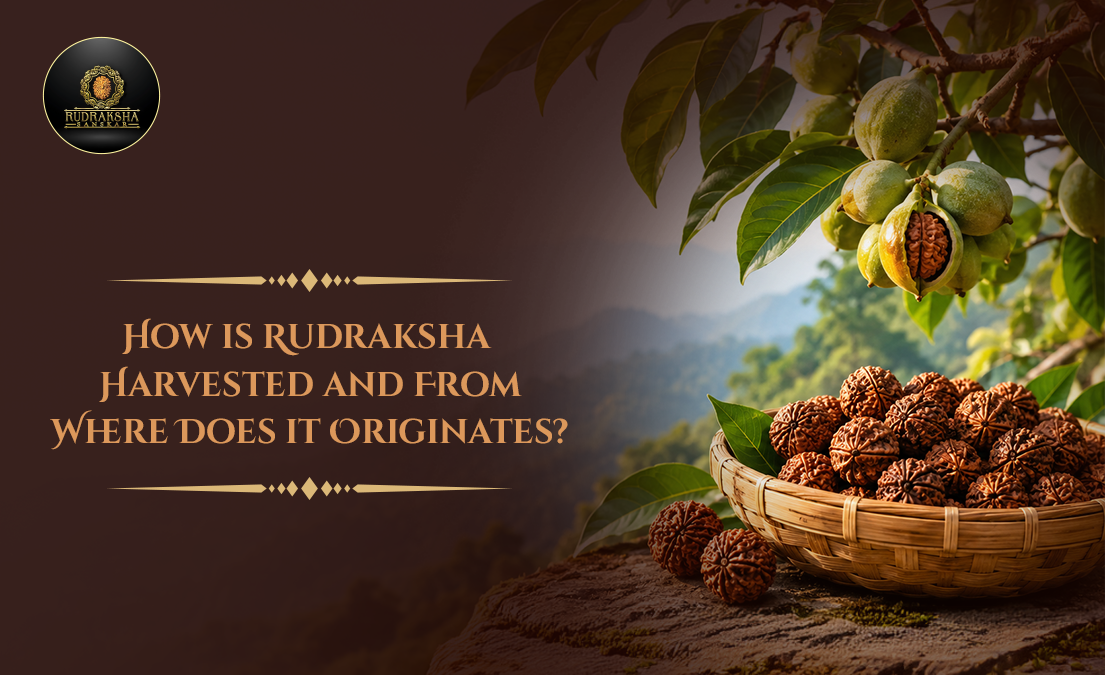
Before becoming the familiar bead, Rudraksha develops as the hard inner structure of a fruit growing on the tree.
As the fruit matures, its outer portion develops around the seed.
Once sufficiently ripe, the fruit can be harvested and processed.
The naturally formed Rudraksha is inside.
This distinction is important because the brown object eventually worn as Rudraksha is not the complete fruit. It is the cleaned and dried hard seed or stone from inside it.
How Is Rudraksha Harvested?
The journey from tree to wearable Rudraksha generally involves several stages.
1. Fruits Are Allowed to Mature
The first step is maturity.
Rudraksha fruits develop naturally on the tree and are allowed to ripen before collection.
Depending on regional harvesting practices, mature fruits may be collected directly or gathered after falling naturally.
2. The Fruits Are Collected
Once mature, the fruits are gathered for processing.
At this point, the Rudraksha is still covered by fruit material, so its complete surface and Mukhi are not yet presented in the form buyers recognise.
3. The Outer Pulp Is Removed
The fleshy portion surrounding the hard seed must be removed.
Fruits may be soaked or softened to make the pulp easier to separate.
The seed is then cleaned carefully until the natural textured surface becomes visible.
This is the stage where the familiar appearance of Rudraksha begins to emerge.
4. The Seeds Are Cleaned
Residual pulp, dirt and other material can remain trapped within the grooves.
The seeds therefore require additional cleaning.
Care matters here.
Excessive scraping, artificial carving or aggressive processing can damage the natural surface, which is particularly problematic because the surface lines are later used to determine the Mukhi.
5. Rudraksha Is Dried
After cleaning, the seeds need to dry properly.
A finished Rudraksha is a natural organic material, so improper moisture and storage can affect its condition.
Excessive heat should also be avoided because it can potentially contribute to drying damage or cracking.
What Happens After Harvesting?
Harvesting is only the beginning of the commercial process.
Once cleaned and dried, Rudraksha can be sorted according to its natural characteristics.
The most important is the number of Mukhi.
A harvest can therefore contain beads eventually classified as:
5 Mukhi, 6 Mukhi, 7 Mukhi, 8 Mukhi and other naturally occurring varieties.
Rare higher Mukhi occur much less frequently.
This natural variation is why a farmer cannot simply decide to produce thousands of 18, 20 or 21 Mukhi beads because market demand increases.
Who Creates the Mukhi?
Nobody.
The Mukhi are naturally formed characteristics of the Rudraksha.
They are not supposed to be carved after harvesting.
Natural lines run across the bead and divide its surface into identifiable faces.
For ordinary Rudraksha, visual examination may reveal these divisions clearly.
For expensive higher Mukhi, however, simply counting surface lines is not enough.
A carved groove could potentially make a lower-Mukhi bead appear to have additional faces.
This is why authentication becomes increasingly important as rarity and price rise.
From Harvesting to Certification
Premium Rudraksha may undergo further examination after sorting.
A serious verification process can include:
- Mukhi counting
- surface-line examination
- dimensions
- weight
- stated origin
- inspection for artificial faces
- specimen-specific certification
- X-ray examination where relevant
X-ray can provide additional evidence about the bead’s internal compartment structure.
It should support, rather than replace, careful surface analysis.
For a high-value specimen, the certificate should correspond to the exact bead being purchased, not simply state that the seller deals in authentic Rudraksha.
Does Harvesting Determine Rudraksha Quality?
Harvesting and post-harvest handling can affect the physical condition of the bead.
Poor handling can result in:
- cracks
- surface damage
- excessive scraping
- improper drilling
- moisture problems
- deterioration during storage
But harvesting does not determine whether a bead becomes 5 Mukhi or 15 Mukhi.
That natural structure has already developed within the seed.
Similarly, a carefully harvested common Mukhi does not transform into a rare collector-grade bead simply because it was processed well.
From a Fruit to a Sacred Bead
The journey of Rudraksha is surprisingly natural.
A tree produces fruit.
The fruit matures.
The seed is collected and cleaned.
Its natural Mukhi are identified.
The specimen is sorted and, where appropriate, authenticated.
Only after these stages does it become the Rudraksha that eventually reaches a devotee, practitioner or collector.
Its spiritual origin is traditionally connected with Shiva, while its physical origin begins with a living Elaeocarpus tree.
Understanding both helps buyers distinguish tradition from botany, origin from authenticity, and natural rarity from marketing claims.
You can explore different origins and Mukhi through the Rudraksha Sanskar shop.
If you plan to buy rudraksha online, ask where the specimen originated, but do not stop there. Its natural Mukhi, physical condition and specimen-specific authentication matter just as much as the country written beside its name.