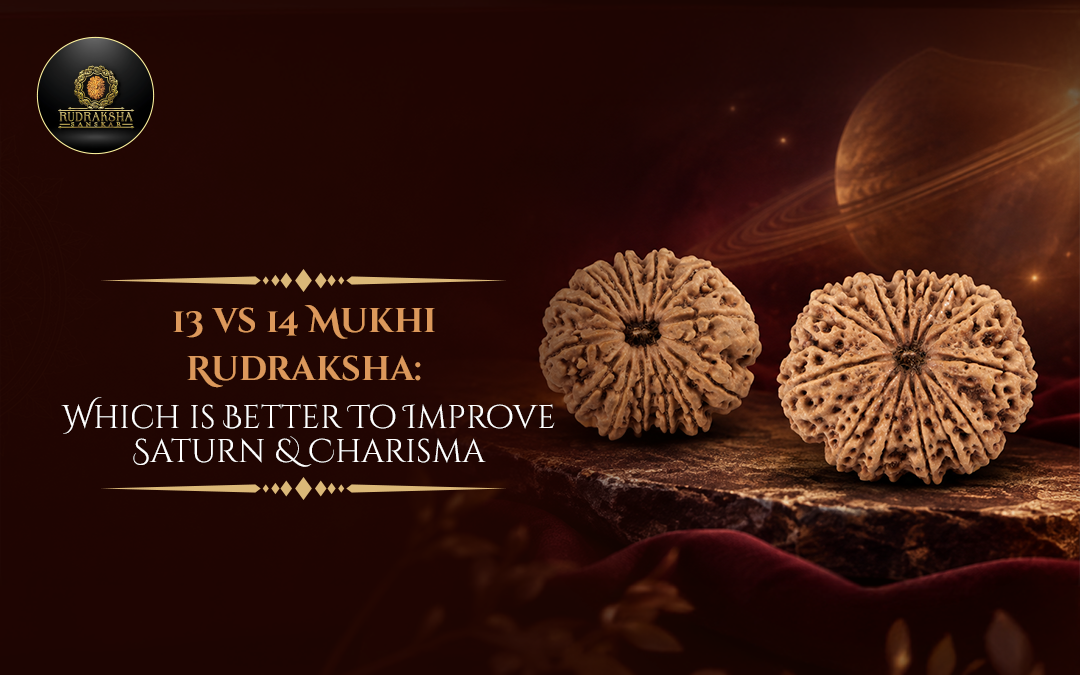
The 13 Mukhi and 14 Mukhi Rudraksha sit next to each other numerically, but traditionally they are chosen for quite different reasons.
The 13 Mukhi is strongly associated with charisma, attraction, confidence, fulfilment and Venus-related qualities.
The 14 Mukhi leans toward clarity, courage, intuition, judgment and stability during difficult phases. Some astrological traditions also connect it with Saturn.
So, if you are comparing 13 vs 14 Mukhi for Saturn and charisma, the question is not really which bead is more powerful.
It is: Which quality are you actually trying to strengthen?
13 Mukhi Rudraksha: The Charisma and Venus Side
The 13 Mukhi Rudraksha is traditionally associated with Lord Indra and Kamadeva in widely followed Rudraksha traditions.
It is also commonly connected with Venus or Shukra, the graha associated in Jyotisha with beauty, relationships, pleasure, creativity and refinement.
This is why traditional 13 Mukhi Rudraksha benefits tend to centre around:
- charisma and personal presence
- confidence
- attraction
- creativity
- self-expression
- relationships
- fulfilment and material enjoyment
The deeper idea behind charisma here is not magically controlling how other people respond to you.
It is better understood as developing the confidence and presence to express yourself well.
This makes 13 Mukhi particularly relevant for entrepreneurs, artists, speakers, sales professionals, marketers and people working in public-facing roles.
For a deeper explanation, see the guide to 13 Mukhi Rudraksha and its Kamadeva connection.
14 Mukhi Rudraksha: The Saturn and Stability Side
The 14 Mukhi Rudraksha has a very different traditional identity.
It is strongly connected with Lord Shiva, while other traditions also associate it with Hanuman.
Its major themes include:
- clarity
- courage
- judgment
- decision-making
- intuition
- responsibility
- inner stability
In astrological Rudraksha systems, 14 Mukhi is sometimes recommended in relation to Saturn or Shani, particularly where the desired qualities are discipline, steadiness and better judgment during difficult periods.
However, planetary assignments are not completely uniform across Rudraksha traditions. So it is better not to present “14 Mukhi = Saturn” as an uncontested scriptural equation.
Its broader identity remains awareness and strong decision-making.
The detailed guide on 14 Mukhi Rudraksha for intuition, decision-making and mental clarity explores this side in greater depth.
13 Mukhi vs 14 Mukhi: Quick Comparison
| 13 Mukhi Rudraksha | 14 Mukhi Rudraksha | |
| Main traditional focus | Charisma and fulfilment | Clarity and judgment |
| Common deity association | Indra and Kamadeva | Shiva / Hanuman traditions |
| Astrological association | Venus (Shukra) | Saturn association in some systems |
| Best known for | Attraction, confidence, creativity | Courage, intuition, decisions |
| Useful symbolism for | Public presence and expression | Responsibility and difficult choices |
| Typical wearer | Entrepreneurs, artists, speakers, sales professionals | Leaders, business owners, decision-makers, spiritual seekers |
The distinction becomes fairly simple:
13 Mukhi helps represent how you express yourself to the world.
14 Mukhi represents how steadily you navigate the world.
Which Is Better for Charisma?
For charisma, attraction, confidence and personal magnetism, 13 Mukhi is the more directly aligned choice within the traditional framework.
Its Venus and Kamadeva associations make it particularly relevant when the goal involves:
- stronger social confidence
- better self-expression
- creative presence
- professional visibility
- relationship confidence
- public-facing work
But “attraction” should not be misunderstood.
A Rudraksha cannot force another person to like, love or agree with you. The traditional symbolism is better understood around confidence, grace and expression rather than manipulation.
Which Is Better for Saturn?
If your concern specifically involves Saturn-related discipline, pressure, responsibility, fear or difficult decision-making, 14 Mukhi is the more relevant bead in the comparison.
Its traditional themes fit qualities often associated with challenging Saturn periods:
patience, judgment, courage, responsibility and stability.
But Saturn remedies should not be selected from one generic rule alone.
A difficult period does not automatically mean everyone needs the same Rudraksha.
For a broader understanding of choosing Rudraksha by purpose, the guide on Rudraksha for confidence, protection and personal growth provides useful context.
What If You Need Both Saturn Stability and Charisma?
This is where a comparison does not necessarily have to end with one winner.
Imagine someone running a business.
They may need the 13 Mukhi qualities of confidence, communication and presence when meeting clients or presenting ideas.
But they may also value the 14 Mukhi themes of judgment and stability when making expensive or high-pressure decisions.
Traditional Rudraksha practice allows different Mukhi to be used within combinations when appropriate.
For someone looking beyond two individual beads, a 1 to 14 Mukhi Siddha Mala brings different Mukhi associations together in one structured combination.
That does not mean everyone needs fourteen beads. It is simply a different approach from choosing one Mukhi for one specific purpose.
Is 14 Mukhi “More Powerful” Because It Is Higher?
No.
This is one of the easiest mistakes to make when comparing Rudraksha.
14 Mukhi is not automatically better than 13 Mukhi because fourteen is a larger number.
They represent different traditional purposes.
Likewise, a more expensive 14 Mukhi does not automatically deliver stronger spiritual results.
Higher market prices generally reflect factors such as:
- natural rarity
- origin
- size and weight
- condition
- specimen quality
- certification
- collector demand
Choose by purpose and tradition, not by assuming the highest Mukhi or highest price must be best.
What Should You Check Before Buying Either?
Both 13 and 14 Mukhi are uncommon enough that authenticity deserves attention.
Look for:
- naturally formed Mukhi lines
- photographs of the actual specimen
- dimensions and weight
- stated origin
- specimen-specific certification
- surface examination
- X-ray documentation where available
This becomes particularly important with premium Nepal specimens.
A certificate should describe the bead you are actually buying rather than simply making a general authenticity claim.
Different Beads, Different Purposes
The 13 vs 14 Mukhi comparison becomes easier once you stop asking which is universally better.
13 Mukhi: charisma, Venus, attraction, creativity and confident expression.
14 Mukhi: judgment, courage, clarity, responsibility and Saturn-related stability in traditions that make that association.
Someone focused primarily on personal magnetism will naturally study the 13 Mukhi more closely. Someone dealing with responsibility, difficult choices or Saturn-oriented spiritual practice may explore the 14 Mukhi.
And someone whose needs genuinely cross both areas may consider how the two fit within a broader Rudraksha practice rather than forcing an either-or decision.
If you plan to buy rudraksha online, choose according to purpose first. Then compare origin, physical characteristics, certification and the exact specimen before comparing price.
FAQs
They can be used together within some Rudraksha traditions and combinations. If you are following a specific astrological prescription or guru lineage, follow that system’s guidance.
13 Mukhi is commonly associated with Venus or Shukra in contemporary Rudraksha astrology and is traditionally linked with charisma, attraction, creativity and fulfilment.
Some astrological systems connect 14 Mukhi with Saturn-related balance and discipline. However, planetary assignments vary, while its broader traditional identity centres on clarity, courage and judgment.
It depends on the need. 13 Mukhi aligns more with confidence, influence and presentation, while 14 Mukhi aligns more with judgment, responsibility and major decisions.
Between these two, 13 Mukhi has the more direct traditional connection with charisma, attraction and personal presence.