Why is Rudraksha so closely associated with Lord Shiva?
Why do devotees wear these seeds around the neck, use them for mantra japa and keep them in the puja space?
The answer begins with one of the most important stories in Rudraksha tradition:
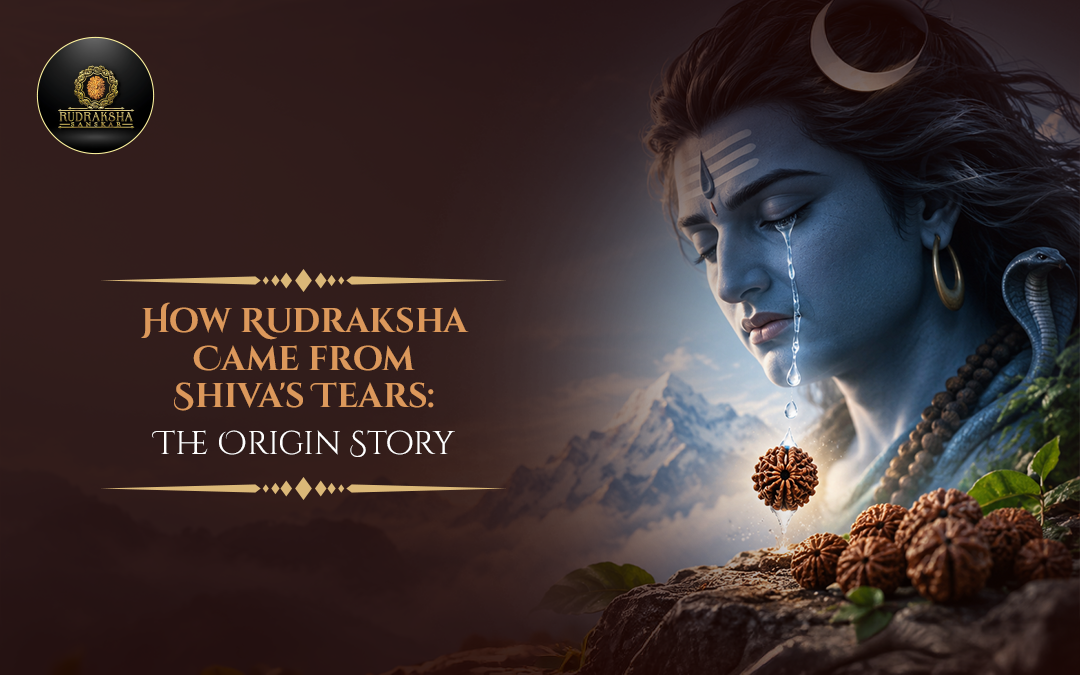
Rudraksha arose from the tears of Lord Shiva.
This is not simply a modern story created around the bead. An origin account appears in the Shiva Purana, where Shiva himself explains Rudraksha to Devi.
Understanding that story also explains why Rudraksha occupies such a distinctive place in Shaiva tradition.
Where Is the Rudraksha Origin Story Found?
One of the clearest accounts appears in the Shiva Purana, Vidyeshvara Samhita, Chapter 25, traditionally devoted to the greatness of Rudraksha.
The chapter begins with Suta explaining the importance of Rudraksha to the sage Shaunaka.
The narration then shifts to a conversation between Lord Shiva and Devi.
Shiva explains why Rudraksha came into existence and why it became sacred to his devotees.
This gives us a much more precise source than simply saying:
“Ancient scriptures say Rudraksha came from Shiva.”
We can identify the text, section and chapter.
The Story Begins With Shiva’s Tapas
According to the Shiva Purana account, Shiva had been engaged in intense tapas or penance for thousands of divine years.
The emphasis here is on an extraordinarily prolonged state of spiritual discipline and concentration.
Eventually, Shiva opened his eyes.
The text describes drops falling from his beautiful, partly closed eyes.
From those drops arose the Rudraksha trees.
That is the central origin story.
Rudraksha therefore does not merely become associated with Shiva later.
Within the sacred narrative, its very origin comes directly from him.
Were They Tears of Sadness?
This is where modern retellings often add details that are not necessary.
You may hear that Shiva cried because he saw humanity suffering.
Another version may say they were tears of compassion after meditation.
Other retellings connect the story with specific battles or events.
The Shiva Purana passage itself should be read more carefully.
Its emphasis is on Shiva’s prolonged tapas, the opening of his eyes and the drops that fell from them becoming Rudraksha trees.
It also frames Shiva’s teaching and actions around the welfare of the worlds and benefit of devotees.
So compassion is a reasonable theological interpretation.
But we should distinguish between what the verse directly narrates and how later devotees interpret its meaning.
The text does not need an invented dramatic reason for Shiva to cry in order for the story to be meaningful.
What Does the Word Rudraksha Mean?
The traditional explanation of the name itself reinforces the Shiva connection.
Rudra is a name associated with Shiva.
Aksha is commonly understood in this context in relation to the eye.
This gives Rudraksha its familiar interpretation as:
“the eye of Rudra”
or, in the context of the origin story,
that which arose from the tears of Rudra’s eyes.
The name therefore carries the same symbolism as the story.
Why Did Shiva’s Tears Become Rudraksha?
The Shiva Purana does not present the creation of Rudraksha as a meaningless accident.
The surrounding verses repeatedly connect the bead with benefiting devotees and the welfare of the world.
That changes how the origin story can be understood.
Rudraksha becomes a physical object through which a devotee remembers Shiva.
A seed can be:
- worn
- touched
- held during meditation
- used for mantra japa
- kept as part of spiritual practice
Something connected with Shiva’s tapas therefore becomes something devotees can physically carry with them.
That is one reason Rudraksha is much more than jewellery within the tradition.
Why Is Rudraksha Sacred to Shiva Devotees?
The same chapter describes Rudraksha as especially dear to Shiva.
It gives importance to seeing, touching, wearing and using Rudraksha for japa.
The chapter later discusses different sizes, wearing practices, Mukhi classifications and mantras.
This context is important.
The origin story is not isolated mythology followed by an unrelated bead-selling tradition.
Within the Shiva Purana itself, the story leads into a broader system of devotion, mantra and wearing Rudraksha.
That is the scriptural foundation behind much of its continuing importance in Shaiva practice.
Did Different Mukhi Also Come from Shiva’s Tears?
The origin story explains the Rudraksha tree itself as arising from Shiva’s tears.
The chapter then goes on to distinguish Rudraksha according to the number of natural faces or Mukhi.
Its well-known face-specific sequence covers 1 Mukhi through 14 Mukhi.
Different Mukhi receive different traditional associations and descriptions.
But they still belong to the same larger Rudraksha tradition rooted in Shiva.
For readers exploring these differences, Rudraksha Sanskar’s Rudraksha collection provides the individual Mukhi categories separately.
Is the Shiva’s Tears Story Scientifically Proven?
This question mixes two different ways of understanding the subject.
Botanically, Rudraksha is the seed of trees belonging to the Elaeocarpus genus, most famously Elaeocarpus ganitrus.
The story of Shiva’s tears belongs to Hindu sacred tradition.
It should be presented as such.
A spiritual origin narrative does not need to be described as a scientific botanical explanation, and science does not need to be used to “prove” a Puranic story.
For a devotee, the importance of the story lies in what Rudraksha represents within the Shiva tradition.
What Does the Origin Story Mean for Someone Wearing Rudraksha Today?
The story gives Rudraksha a much deeper identity than the modern idea of a “lucky bead.”
Its original context is Shiva’s:
tapas, devotion, mantra and spiritual discipline.
That is worth remembering because modern Rudraksha marketing often focuses almost entirely on outcomes:
“Wear this for money.”
“Wear this for success.”
“Wear this for relationships.”
“Wear this for protection.”
The Shiva Purana gives us a broader starting point.
Rudraksha is first connected with Shiva and spiritual practice.
Specific Mukhi traditions can then add their own meanings, deity associations and uses.
From Shiva’s Tapas to a Bead Worn Today
The Rudraksha origin story is powerful precisely because it is simple.
Shiva performs tapas.
His eyes open.
Drops fall.
Rudraksha trees arise.
From that sacred story developed a tradition of wearing Rudraksha, performing mantra japa with it and distinguishing beads according to their natural Mukhi.
Thousands of years of interpretation may have added more layers, but the central symbolism remains:
Rudraksha belongs first to the spiritual world of Shiva.
For readers exploring the different varieties, the Rudraksha Sanskar shop provides access to individual Mukhi and natural formations.
If you plan to buy rudraksha online, understanding where the tradition begins can be just as valuable as understanding which Mukhi you eventually choose.
FAQs
According to Hindu sacred tradition, yes. The Shiva Purana describes drops from Shiva’s eyes becoming Rudraksha trees. This is a religious origin narrative rather than a scientific explanation of the plant.
A clear account appears in the Vidyeshvara Samhita, Chapter 25, in the section discussing the greatness of Rudraksha.
The passage describes Shiva performing prolonged tapas, opening his eyes and drops falling from them. Modern retellings sometimes add specific emotional explanations that are not stated directly in the passage.
Rudra refers to Shiva, while Aksha is commonly interpreted in relation to the eye, giving the name its close connection with Shiva’s eyes.
Rudraksha is deeply rooted in Shaiva tradition, but the Shiva Purana account itself presents its availability more broadly. Today it is also worn by people from different spiritual backgrounds.