A finished Rudraksha bead looks very different from what first appears on the tree.
Before it becomes a brown, deeply textured seed used in a mala or worn as a pendant, Rudraksha develops inside a fleshy fruit growing on a living tree.
The species most commonly associated with sacred Rudraksha is Elaeocarpus ganitrus, an evergreen tree found across parts of South and Southeast Asia.
Understanding how this tree grows and how its seeds are harvested also helps explain differences in Rudraksha size, origin, appearance and rarity.
What Is the Rudraksha Tree?
Rudraksha belongs to the botanical genus Elaeocarpus, a group containing hundreds of species of trees and shrubs.
The species most closely associated with the traditional Rudraksha bead is commonly identified as:
Elaeocarpus ganitrus Roxb.
The tree is evergreen and can grow to a substantial height when mature.
It develops leaves, clusters of flowers and eventually round fruits containing the hard seed that becomes the Rudraksha used for spiritual purposes.
So the Rudraksha worn around someone’s neck is not the whole fruit.
It is the hardened seed found inside the fruit.
Where Do Rudraksha Trees Grow?
Rudraksha trees favour humid subtropical to tropical environments.
They are particularly associated with the Himalayan foothills and parts of South and Southeast Asia.
Commercial and traditional Rudraksha supplies commonly come from regions including:
- Nepal
- India
- Indonesia
Trees are also found across other suitable areas of South and Southeast Asia.
However, the origin of a bead can significantly affect how it looks.
Nepal Rudraksha
Nepal-origin Rudraksha are particularly valued in the premium market because they are often:
- larger
- heavier
- more prominently textured
- deeply grooved
- easier to examine visually
This becomes especially important with rare higher Mukhi, where a large, well-developed Nepal specimen can command a substantial collector premium.
Indonesian Rudraksha
Indonesian Rudraksha are generally known for being:
- smaller
- lighter
- more compact
- comparatively smoother in surface appearance
Their smaller size can make them particularly practical for malas containing many beads.
Neither origin is automatically spiritually superior.
Origin affects physical characteristics, availability and market value. It does not establish greater spiritual potency.
What Does Rudraksha Fruit Look Like?
The fruit does not initially resemble the brown Rudraksha most people recognise.
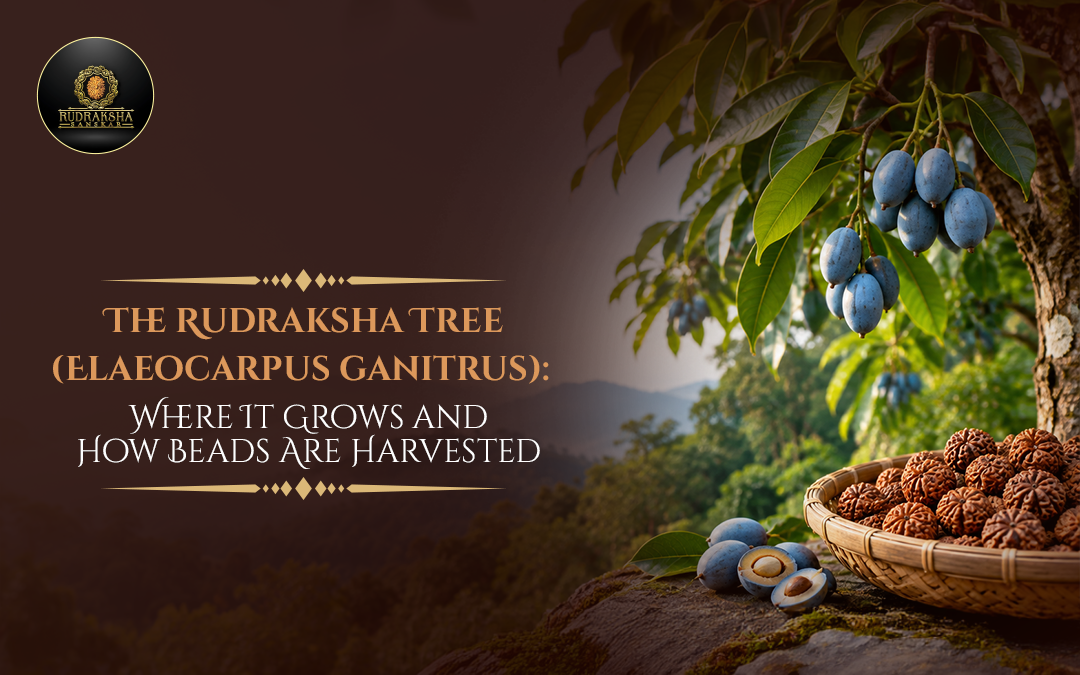
Rudraksha trees produce fleshy fruits that become blue to blue-purple when mature, which is why Elaeocarpus species are sometimes associated with the term “blue marble tree.”
Inside that outer fruit is a hard structure containing the naturally developed faces that become visible once the fruit material has been removed and the seed cleaned.
Those natural divisions are what buyers eventually recognise as Mukhi.
How Are Rudraksha Beads Harvested?
The process begins by allowing the fruit to mature.
1. The Fruit Ripens
Rudraksha fruits develop on the tree and gradually mature.
Responsible harvesting begins with sufficiently mature fruits rather than treating every developing fruit as ready for processing.
2. Mature Fruits Are Collected
Depending on local harvesting practices, ripe fruits may be collected from the tree or gathered after naturally falling.
The objective is to obtain a mature seed without unnecessarily damaging its natural surface.
3. The Outer Pulp Is Removed
The fleshy exterior must then be separated from the hard Rudraksha inside.
The fruit may be softened in water before the remaining pulp is carefully cleaned away.
At this stage, the familiar textured surface begins to appear.
4. The Seed Is Cleaned
Residual fruit material and dirt are removed from the natural grooves.
Cleaning must be careful because the surface itself contains important information used later when assessing the Mukhi.
Aggressive scraping, cutting or alteration can damage that evidence.
5. The Rudraksha Is Dried
After cleaning, the seed needs to dry properly.
Poor drying or prolonged moisture can affect its condition during storage.
Natural drying is preferable to extreme heat that may damage or crack the bead.
6. The Mukhi Are Counted and Sorted
Once cleaned, Rudraksha can be separated according to their naturally occurring number of faces.
This is where beads are identified as:
5 Mukhi, 6 Mukhi, 7 Mukhi, 14 Mukhi, 18 Mukhi, and so forth.
Common Mukhi make up much of the harvest.
Rare higher Mukhi occur in substantially smaller quantities, which is one reason their market value can increase dramatically.
Does the Farmer Decide How Many Mukhi a Rudraksha Has?
No.
This is one of the most important facts to understand.
The Mukhi are naturally formed characteristics of the seed.
A farmer does not grow a tree and decide to produce a 5 Mukhi this season and a 17 Mukhi next season.
Different natural Mukhi can occur among the harvested seeds.
That unpredictability is central to Rudraksha rarity.
A naturally occurring high-Mukhi specimen cannot simply be produced on demand because market demand increases.
Why Are Higher Mukhi So Rare?
The majority of commercially encountered Rudraksha fall into more commonly occurring Mukhi categories.
As the Mukhi count becomes unusual, natural availability generally becomes much thinner.
This becomes especially relevant in the 15–21 Mukhi premium range.
A buyer may not simply want a 20 Mukhi.
They may want:
- a natural 20 Mukhi
- Nepal origin
- larger dimensions
- good condition
- clearly developed faces
- strong surface characteristics
- certification
- X-ray documentation
Finding all of those characteristics in one specimen reduces available supply further.
That is why rarity is ultimately a supply issue, not proof that a higher Mukhi is spiritually more powerful.
Does Origin Prove a Rudraksha Is Genuine?
No.
A seller saying “Nepal Rudraksha” does not by itself authenticate the bead.
Origin and authenticity are separate questions.
A premium Rudraksha should still be evaluated through:
- natural Mukhi lines
- surface examination
- dimensions
- weight
- physical condition
- specimen-specific certification
- X-ray where relevant
This becomes increasingly important for rare Mukhi because additional grooves can potentially be carved into a lower-Mukhi bead.
Similarly, traditional tests involving water or coins should not replace proper physical examination and documentation.
Why Does Harvesting and Processing Quality Matter?
Rudraksha is a natural seed.
Even an authentic rare specimen can lose value if it has been poorly handled.
Problems can include:
- cracks
- excessive polishing
- damaged faces
- poorly drilled holes
- chemical treatment
- deep scraping
- improper storage
For a common bead, minor cosmetic differences may matter relatively little.
For a rare specimen costing lakhs, condition can become an important part of collector value.
This is why premium buyers should examine the actual specimen, not merely the Mukhi number.
FAQs
Sacred Rudraksha beads are most commonly associated with Elaeocarpus ganitrus, an evergreen tree belonging to the Elaeocarpus genus.
The bead used for wearing and japa is the hard seed found inside the Rudraksha fruit.
Rudraksha is associated with humid subtropical and tropical regions across parts of South and Southeast Asia, with Nepal, India and Indonesia being especially important in the commercial Rudraksha market.
Nepal specimens are often larger, heavier and more deeply textured. Rare, large Nepal-origin specimens can therefore command significant collector premiums.
Yes. Indonesian origin does not make a Rudraksha fake. They generally have different physical characteristics from Nepal specimens.
No. Mukhi formation occurs naturally within the seed.
Not necessarily. Larger size may increase rarity and market value, particularly for premium specimens, but it does not prove greater spiritual effectiveness.