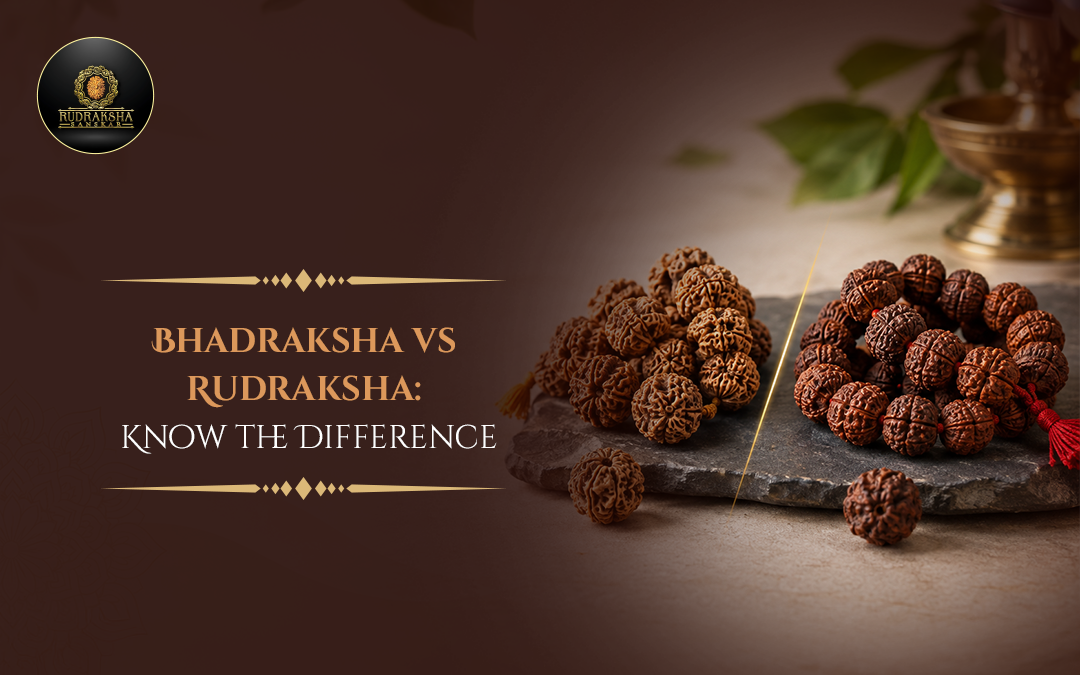
A bead has deep grooves, a rough surface and something that looks like Mukhi lines.
So it must be Rudraksha, right?
Not necessarily.
One of the lesser-known issues in the Rudraksha market is Bhadraksha, a term commonly used for seeds that can resemble Rudraksha closely enough to confuse an inexperienced buyer.
This becomes particularly important when someone is purchasing a rare Mukhi or paying a premium price.
The difference should therefore be understood through botany, physical structure and proper authentication, not appearance alone.
What Is a Genuine Rudraksha?
The sacred Rudraksha used in Hindu spiritual practice is most commonly identified botanically as Elaeocarpus sphaericus, with Elaeocarpus ganitrus widely used as a synonym.
It belongs to the Elaeocarpaceae family.
The tree produces fleshy fruits. Once the fruit matures and the pulp is removed, the hard inner structure becomes the Rudraksha bead used for:
- wearing
- mantra japa
- malas
- bracelets
- spiritual practice
The surface develops natural longitudinal divisions known as Mukhi or faces.
These natural structures are fundamental when identifying and classifying Rudraksha.
What Is Bhadraksha?
This is where terminology becomes less precise.
Bhadraksha is not used as consistently in botanical literature as Rudraksha.
In the Rudraksha trade, the term is commonly applied to look-alike seeds or fruit stones from other species that resemble genuine Rudraksha externally.
Different sellers may use “Bhadraksha” for different botanical varieties.
That means claims such as:
“Bhadraksha always comes from one specific species”
should be treated cautiously unless the botanical identification has actually been established.
The practical buyer’s definition is simpler:
Bhadraksha refers to Rudraksha-like beads that should not automatically be treated as the same botanical and traditional bead as genuine Rudraksha.
Rudraksha vs Bhadraksha: The Main Differences
Although appearance varies naturally, there are several useful characteristics to examine.
| Feature | Rudraksha | Bhadraksha / look-alike |
| Botanical identity | Primarily Elaeocarpus sphaericus / E. ganitrus | Term may cover other look-alike species |
| Mukhi | Natural longitudinal faces | Ridges may resemble Mukhi but structure can differ |
| Internal structure | Compartments correspond to natural development | Internal structure may not correspond to apparent external ridges |
| Surface | Naturally grooved and textured | Can appear similar, sometimes smoother or differently textured |
| Spiritual tradition | Established Rudraksha tradition | Should not automatically be treated as equivalent |
| Premium authentication | Surface analysis + certificate + X-ray where relevant | Botanical/structural differences can become apparent under examination |
These are general characteristics rather than a substitute for professional examination.
Can You Identify Bhadraksha Just by Looking?
Sometimes the difference may appear obvious.
Sometimes it does not.
Colour, shape and surface roughness alone are weak authentication methods because natural Rudraksha themselves vary considerably.
A Nepal Rudraksha may look very different from an Indonesian Rudraksha.
Similarly, two genuine beads from the same region can differ in:
- shape
- dimensions
- weight
- surface texture
- groove depth
So avoid rules such as:
“If it looks smooth, it is fake.”
or:
“If it is large and thorny, it must be Rudraksha.”
Neither is reliable enough for an expensive purchase.
What About the Natural Hole?
The internal structure is one characteristic frequently discussed when distinguishing Rudraksha from look-alikes.
Traditional Rudraksha examination considers the natural axial structure of the bead alongside its external Mukhi.
Some seeds marketed as Bhadraksha may lack the same natural central structure and require drilling directly through solid material.
However, the hole alone should not become another home-test shortcut.
Commercial Rudraksha may also be drilled for stringing and jewellery.
What matters is the overall anatomical structure of the specimen, not simply whether you can see a hole.
Why Mukhi Lines Matter
A genuine Rudraksha’s Mukhi are not supposed to be decorative scratches.
They are naturally formed divisions of the bead.
This distinction becomes extremely important with rare Mukhi.
Imagine a bead being sold as:
The buyer should not merely count visible lines and assume the claim is genuine.
Those lines need to be evaluated for natural formation.
This is one reason surface examination and, for premium specimens, X-ray documentation become valuable.
Why X-Ray Can Help
An X-ray can provide information about the bead’s internal compartment structure.
That gives the examiner another layer of evidence to compare with the claimed external Mukhi count.
It becomes particularly useful when dealing with:
- rare Mukhi
- expensive specimens
- suspicious surface lines
- potentially carved beads
- unusual natural formations
But an X-ray is not a magic authenticity certificate by itself.
A stronger verification process combines:
surface examination + dimensions + weight + internal structure + specimen-specific certificate + X-ray where appropriate.
The documentation should also belong to the exact bead being purchased.
Are Water and Copper Coin Tests Reliable?
They should not be your primary authentication method.
Popular home tests include:
- putting Rudraksha in water
- checking whether it sinks
- rotating it between copper coins
- judging authenticity from colour
These tests can produce misleading conclusions.
A genuine natural seed may behave differently depending on density, moisture and physical condition, while a manipulated bead may still pass a simplistic test.
For an inexpensive everyday Rudraksha, careful seller selection and physical inspection may be sufficient.
For a bead costing thousands or lakhs, demand better evidence.
Is Bhadraksha a “Fake Rudraksha”?
Not automatically.
This distinction matters.
A naturally occurring seed from another plant is not itself fake.
Misrepresentation is the problem.
If a seed is accurately identified and sold as Bhadraksha, there is no deception.
If it is represented as a rare genuine Rudraksha and priced accordingly, that becomes a serious authenticity issue.
The same principle applies to origin.
An Indonesian Rudraksha is not a “fake Nepal Rudraksha” unless someone falsely sells it as Nepal origin.
Accurate identification matters more than labels.
What Should You Ask Before Buying Rudraksha?
For a valuable specimen, ask the seller for:
- photographs of the exact bead
- claimed Mukhi count
- dimensions
- weight
- stated origin
- certificate number
- natural versus artificial face assessment
- X-ray where appropriate
The more expensive and unusual the bead becomes, the more detailed the documentation should become.
This is especially important when exploring rare specimens through the Rudraksha Sanskar shop.
Similar Appearance Does Not Mean the Same Bead
The most important lesson in the Bhadraksha vs Rudraksha discussion is simple:
do not authenticate a Rudraksha from appearance alone.
Natural seeds vary.
Origins vary.
Surface texture varies.
And look-alike seeds exist.
For a serious purchase, especially a rare Mukhi, physical structure and traceable documentation matter far more than traditional home tests.
If you plan to buy rudraksha online, look beyond the number of grooves on the surface. Ask what the bead actually is, how its Mukhi were verified and whether the certificate and X-ray genuinely belong to that specimen.
FAQs
No. Bhadraksha is commonly used in the trade for Rudraksha-like seeds or fruit stones that should not automatically be considered equivalent to genuine Rudraksha.
Rudraksha is commonly identified as Elaeocarpus sphaericus, with Elaeocarpus ganitrus widely treated as a synonym.
It can. That similarity is exactly why appearance alone is insufficient for valuable specimens.
A water test is not strong enough to establish authenticity reliably.
X-ray can provide valuable information about internal structure, but it should be combined with surface examination and specimen-specific documentation.