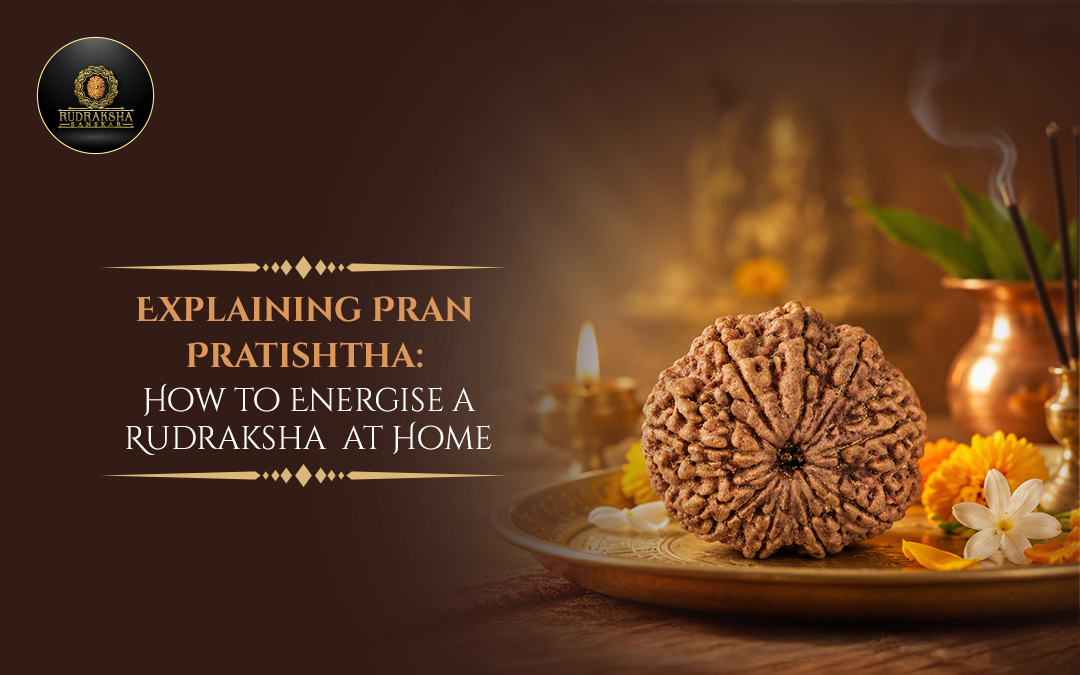
If you have just bought a Rudraksha, one question often comes next:
“Do I need to do Pran Pratishtha before wearing it?”
The short answer is:
For personal Rudraksha wearing, you usually do not need the same formal Pran Pratishtha used for temple murtis.
What most people actually need is a simple purification, mantra and sankalp ritual at home before beginning to wear the bead.
Rudraksha Sanskar’s current wearing guidance follows this practical approach: clean the bead, place it respectfully in the puja space, chant Om Namah Shivaya, set your intention and begin wearing it.
So the important distinction is:
formal Pran Pratishtha is one thing
and
home Rudraksha energisation is another.
What Does Pran Pratishtha Actually Mean?
The Sanskrit expression Pran Pratishtha broadly refers to establishing or invoking sacred presence into an object of worship.
In formal temple traditions, Pran Pratishtha is a highly structured ritual performed for a murti.
It may involve:
- Vedic mantras
- Nyasa
- Homa
- Abhishek
- specific deity invocation
- trained priests
- detailed ritual procedures
That is very different from what most people mean when they say:
“I want to energise my Rudraksha before wearing it.”
For personal Rudraksha use, the process is generally much simpler.
You are not trying to turn the bead into a temple deity.
You are beginning a spiritual practice with:
- cleanliness
- mantra
- intention
- respect
That is why calling every simple Rudraksha wearing ritual “Pran Pratishtha” can make the process sound more complicated than it really needs to be.
Does Rudraksha Need to Be Energised Before Wearing?
Traditional practice often recommends it.
Rudraksha Sanskar’s current guidance suggests simple steps such as:
- cleaning the bead with water
- placing it on a clean cloth or puja surface
- lighting a diya or incense
- chanting Om Namah Shivaya
- meditating on your intention
- wearing the Rudraksha afterward
The purpose is to begin wearing it consciously rather than casually.
It should not be understood like charging an electronic device.
A Rudraksha does not become “dead” because you have not completed a complicated ceremony.
The ritual gives structure to the beginning of your spiritual practice.
How to Energise a Rudraksha at Home
You do not need a large puja setup.
Keep it simple.
1. Clean Yourself and the Puja Space
Bathe and wear clean clothes.
Prepare a clean area where you normally pray.
You can place:
- a Shiva Lingam
- an image of Lord Shiva
- your regular family deity
according to your own practice.
2. Inspect the Rudraksha
Before the spiritual ritual, check the physical bead.
Make sure:
- the Mukhi are clearly visible
- there are no serious cracks
- the string or chain is secure
- the bead is clean
Do not perform harsh “authenticity tests” immediately before wearing it.
If you need verification, that should be handled separately.
3. Clean the Rudraksha Gently
Rinse the bead gently with clean water.
Some family traditions may use Ganga jal.
Rudraksha Sanskar’s current energisation guidance allows either clean water or Ganga jal as part of a simple home process.
There is no need to:
- boil it
- soak it for hours
- use detergent
- use chemical cleaners
After rinsing, wipe away excess water gently.
4. Place It in the Puja Space
Keep the Rudraksha:
- on a clean cloth
- on a copper plate
- near the Shiva Lingam
- beside your regular puja setup
Choose whichever method fits your household tradition.
The point is respectful placement.
5. Light a Diya or Incense
Light a diya or incense according to your normal puja practice.
You do not need to purchase a special “Rudraksha energisation kit.”
Simple worship is enough.
6. Chant Om Namah Shivaya
For general Rudraksha practice, the most straightforward mantra is:
Om Namah Shivaya
Rudraksha Sanskar repeatedly uses this mantra across its current wearing and energisation guidance.
If you wish, chant it 108 times.
A smaller number can also be used if 108 repetitions are not part of your practice.
What matters more is attention and consistency.
Do Different Mukhi Need Different Mantras?
Some traditional systems prescribe a specific mantra for each Mukhi.
That is valid within those systems.
For example, someone wearing a particular Rudraksha for:
- Ganesha worship
- Durga worship
- Surya practice
- a particular planetary tradition
may follow the mantra associated with that deity or Mukhi.
But this should not create anxiety for beginners.
Om Namah Shivaya remains a simple Shiva-centred mantra that can be used for general Rudraksha energisation.
If a guru has prescribed a specific mantra, follow that guidance instead.
7. Take a Sankalp
This is one of the most useful parts of the ritual.
A sankalp is simply a clear intention.
You may mentally state why you are beginning to wear Rudraksha.
For example:
- greater discipline
- regular meditation
- Shiva devotion
- courage
- better spiritual consistency
- greater self-awareness
Avoid turning the sankalp into a transactional demand such as:
“I will wear this bead so I must receive a promotion within 30 days.”
A spiritual intention works better than a deadline.
8. Wear the Rudraksha
After completing the prayer, wear the bead.
It may be worn as:
- a pendant
- bracelet
- mala
- Kantha
depending on its construction and your practice.
You do not need to leave it in the temple for several days unless your family or guru tradition specifically asks you to do so.
Once the puja is complete, you can begin wearing it.
Which Day Is Best for Energising Rudraksha?
Monday is one of the most commonly preferred days because of Rudraksha’s strong association with Lord Shiva.
Other meaningful occasions can include:
- Shravan Somvar
- Mahashivratri
- Pradosh
- another spiritually significant day followed in your tradition
Rudraksha Sanskar’s current wearing guidance also identifies Monday and Shiva-related observances as common starting points.
But do not wait months for a “perfect” date if you already have the bead and are ready to begin your practice.
Auspicious timing supports the intention.
It does not replace it.
Can You Energise Rudraksha Without a Priest?
For ordinary personal wearing, yes.
A simple home ritual does not require a priest.
This is different from a formal Pran Pratishtha ceremony for a temple murti.
You can begin your Rudraksha practice at home if you can:
- maintain cleanliness
- offer simple prayer
- chant respectfully
- set a clear intention
A priest or guru may still be helpful if:
- you are following a specialised mantra tradition
- you have a rare combination
- you are performing an elaborate ritual
- your sampradaya has specific requirements
But general Rudraksha wearing does not need to become inaccessible because a priest is unavailable.
Does an Already Energised Rudraksha Need Pran Pratishtha Again?
Usually, no.
If you received a Rudraksha that was already included in a puja or temple ritual, you can still begin wearing it with a simple personal prayer.
You do not need to repeatedly “reset” it.
Similarly, if you remove the Rudraksha temporarily, there is no need to perform full energisation every time you put it back on.
Rudraksha Sanskar’s current guidance focuses more on consistent daily practice than repeated ritual restarting.
Do You Need to Re-Energise Rudraksha Every Month?
There is no universal requirement.
Some devotees periodically include their Rudraksha in:
- Shiva Abhishek
- Monday puja
- Shravan worship
- Mahashivratri worship
- mantra practice
That can be spiritually meaningful.
But it does not mean the bead becomes useless if you forget to do this.
Think of periodic puja as renewing your own spiritual attention, not repairing an expired product.
Can You Energise a Mala or Bracelet the Same Way?
Yes.
The same basic process works for:
- a single bead
- Rudraksha bracelet
- 27-bead mala
- 54-bead mala
- 108-bead mala
- Kantha
The practical difference is simply handling.
For a full mala, make sure:
- it is physically clean
- the thread is secure
- the beads are dry before prolonged wearing
You do not need to chant separately over every individual bead unless that is part of your specific tradition.
What About Rare Rudraksha and Siddha Mala?
The same basic principle still applies.
Rare Rudraksha such as:
- 14 Mukhi
- higher Mukhi
- Gauri Shankar
- Ganesh
- Garbh Gauri
- Trijuti
do not automatically require a more dramatic home ritual simply because they cost more.
Price is a market characteristic.
It does not determine ritual complexity.
A rare bead may deserve more careful authentication, but that is different from requiring a more elaborate energisation ceremony.
Common Energisation Mistakes
Treating It Like a Product Activation
Rudraksha energisation is spiritual preparation.
It is not a technical switch from “inactive” to “active.”
Mixing Ten Different Rituals
One website says milk.
Another says Ganga jal.
Another says twelve mantras.
Another says a particular metal plate.
Do not combine everything out of fear.
Follow one clear tradition.
Ignoring Authenticity
A long puja cannot transform an artificially carved Rudraksha into a genuine Mukhi.
Verify the bead first.
Expecting Instant Results
The ritual marks the beginning of practice.
It does not guarantee:
- money
- marriage
- promotion
- healing
- business success
Consistency after the ritual matters more.
The Ritual Should Start the Practice, Not Complicate It
The phrase Pran Pratishtha can make a first-time Rudraksha wearer feel as though an elaborate temple ceremony is mandatory.
For ordinary personal wearing, that is usually unnecessary.
Keep the process clear:
clean the bead
place it respectfully
offer prayer
chant Om Namah Shivaya
set your sankalp
wear it
Then focus on what happens afterward.
Wear the Rudraksha consistently.
Keep it clean.
Maintain your spiritual discipline.
And allow the bead to become part of a practice rather than something you repeatedly “activate.”
If you plan to buy rudraksha online, choose an authentic Rudraksha from Rudraksha Sanskar first, then begin wearing it through a simple home ritual that you can genuinely maintain.
FAQs
For personal Rudraksha wearing, the term is often used loosely to describe purification, mantra and intention before wearing. Formal temple Pran Pratishtha is a much more elaborate ritual.
Yes. A simple process using clean water, prayer, diya or incense and Om Namah Shivaya can be followed at home.
Not for ordinary personal wearing. A priest or guru may be useful for specialised ritual traditions.
108 repetitions are commonly used, but the practice should follow your tradition and ability.
Yes. Once the simple puja is complete, you can begin wearing it.
Monday is commonly preferred because of Lord Shiva, though other auspicious Shiva-related days may also be chosen.
There is no universal fixed schedule. Periodic puja can be meaningful, but repeated re-energisation should not become a source of anxiety.