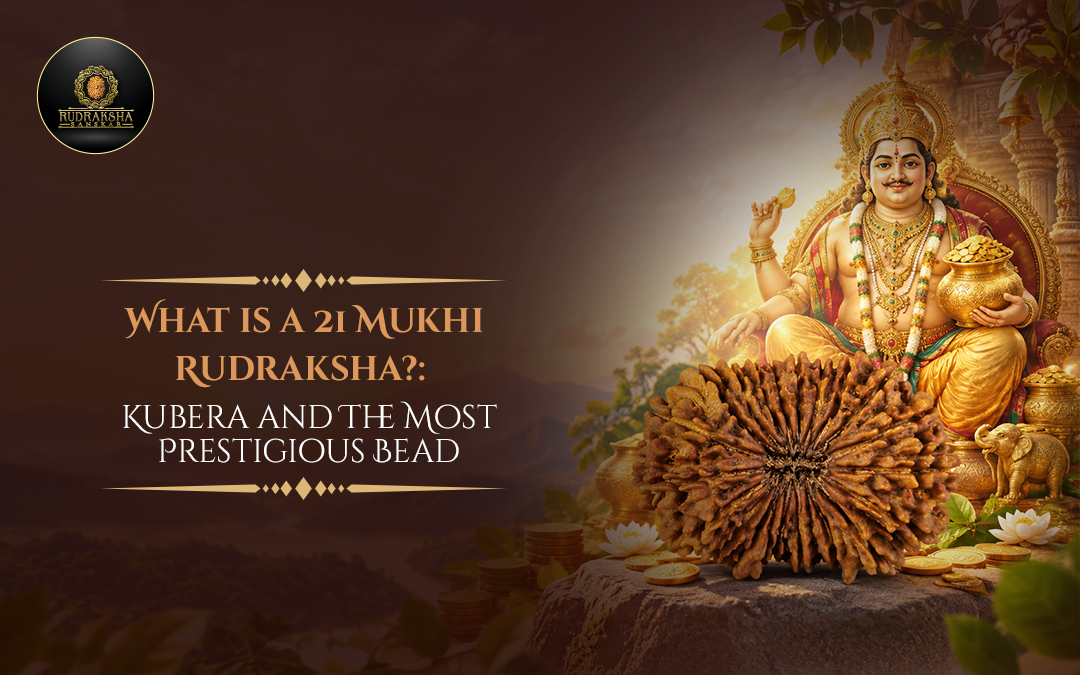
The 21 Mukhi Rudraksha sits at the extreme premium end of the commonly discussed 1–21 Mukhi range.
It is widely associated with Lord Kubera, the deity of wealth and guardianship of riches, giving the bead its traditional themes of prosperity, abundance, responsibility and preservation of wealth.
It is also one of the most prestigious Rudraksha from a collector’s perspective because genuine, well-developed specimens are difficult to source.
But prestige should not be confused with potency.
21 Mukhi is rare and expensive because of supply, specimen characteristics and collector demand. That does not make it universally “the most powerful Rudraksha.”
Who Is the Presiding Deity of 21 Mukhi Rudraksha?
A widely followed tradition associates 21 Mukhi Rudraksha with Lord Kubera.
Kubera is traditionally associated with wealth, treasures and responsible guardianship of material resources. This explains the bead’s modern associations with:
- prosperity
- abundance
- financial stability
- material responsibility
- preservation of wealth
However, the attribution is not uniform.
Some higher-Mukhi traditions associate 21 Mukhi with other divine forms. Rudraksha Sanskar’s own broader catalogue, for example, has also used an Indrakshi attribution.
That disagreement should be stated rather than hidden.
What Do the Classical Texts Say?
The Shiva Purana is fundamental to Rudraksha tradition, but its commonly cited face-specific descriptions are much clearer through 14 Mukhi.
The Padma Purana and Skanda Purana are also important in broader Rudraksha literature. However, the detailed deity-and-planet charts commonly used today for 15–21 Mukhi cannot always be cleanly traced to specific verses in these texts.
Therefore, Kubera is better described as a widely followed later and contemporary attribution for 21 Mukhi unless a specific classical passage is being cited.
This distinction matters particularly at 21 Mukhi because buyers may be spending lakhs on a single specimen.
Which Planet Rules 21 Mukhi?
There is no completely uniform planetary attribution.
Some contemporary systems connect 21 Mukhi with all planetary energies, while other traditions use different graha associations or primarily focus on Kubera rather than assigning a single planet.
So a seller should not present one planetary chart as universally established scripture.
If 21 Mukhi is being recommended specifically for astrology, ask which tradition that recommendation follows.
What Are the Traditional Benefits of 21 Mukhi?
Because of Kubera’s association, 21 Mukhi is traditionally linked with:
- prosperity
- abundance
- preservation of wealth
- material stability
- responsibility
- fulfilment
- spiritual and material balance
But this is also where marketing can become excessive.
21 Mukhi does not guarantee wealth, investment returns, business success or sudden financial gains.
A better way to understand its Kubera symbolism is not simply acquiring wealth, but developing the responsibility to create, manage and preserve resources.
How Rare Is 21 Mukhi Rudraksha?
Within the conventional 1–21 Mukhi range, 21 Mukhi occupies the extreme premium end of the market.
Large, naturally formed specimens with 21 clearly identifiable faces are particularly difficult to source.
However, even here, avoid statements such as:
“21 Mukhi is scientifically proven to be the rarest Rudraksha.”
There is no universal production database establishing an exact rarity percentage for every Mukhi.
What the market does clearly demonstrate is that desirable high-grade 21 Mukhi specimens can command extraordinary premiums because natural supply is extremely limited.
Again:
rarity explains market value, not spiritual superiority.
Why Can One 21 Mukhi Cost ₹2 Lakh and Another ₹65 Lakh?
This is where the actual specimens become important.
A current Rudraksha Sanskar Indonesian 21 Mukhi measures:
19.5 × 11.7 × 11.6 mm
Weight: 1.07 g
Origin: Indonesia
Certificate: DCL/2026/A/1546
Listed price: ₹2,00,000
The current category also includes smaller Indonesian specimens around ₹1–1.7 lakh.
Now compare that with Nepal-origin inventory.
Current Nepal 21 Mukhi listings include specimens such as:
- 26.7 mm, 3.38 g – ₹15,00,000
- 30.3 mm, 4.11 g – ₹55,00,000
- 30.8 mm, 4.1 g – ₹55,00,000
- 32.1 mm, 4 g – ₹65,00,000
That difference cannot be explained by the words “21 Mukhi” alone.
At this tier, price is influenced by:
- origin
- size
- weight
- natural development
- condition
- clarity of the 21 faces
- scarcity of comparable specimens
- certification
- X-ray documentation
- collector demand
Nepal specimens are generally larger and more deeply textured than Indonesian examples, and exceptional high-Mukhi Nepal specimens can therefore command a major collector premium.
A ₹65 lakh bead is not automatically spiritually stronger than a ₹2 lakh bead.
The premium reflects the rarity and characteristics of that physical specimen.
Who Actually Buys 21 Mukhi at This Price?
This is important because 21 Mukhi should not be marketed as something every spiritual seeker needs.
At the highest price levels, realistic buyers may include:
Serious Rudraksha Collectors
Collectors may value an exceptional specimen for rarity, origin, size and documentation.
Temples and Spiritual Institutions
Rare Rudraksha may be acquired for worship, preservation or institutional collections rather than everyday personal wear.
Experienced Practitioners
Someone with an established Rudraksha practice may specifically seek 21 Mukhi according to their tradition or guru’s guidance.
High-End Devotional Buyers
Some buyers simply value owning a rare sacred natural object and have the means to acquire one.
For most people beginning with Rudraksha, a 21 Mukhi is not necessary.
Higher price does not mean a beginner receives greater spiritual benefit.
Authenticity: What Should You Demand?
At 21 Mukhi prices, verbal assurance is not enough.
The financial incentive to carve extra grooves into a lower-Mukhi bead is substantial.
Demand:
- photographs of the exact specimen
- all 21 natural Mukhi lines
- exact dimensions
- exact weight
- stated origin
- specimen-specific certificate
- X-ray documentation where available
- surface analysis for artificial faces
For example, the ₹65 lakh, 32.1 mm Nepal specimen is listed with certificate DCL/2026/A/0947 and X-ray number 5016.
That is the level of specimen-specific information a premium buyer should expect.
X-ray helps examine internal compartment structure, while surface analysis helps identify potentially carved lines.
Neither replaces the other.
How Do You Wear 21 Mukhi Rudraksha?
Price does not determine ritual complexity.
A simple vidhi is sufficient:
- Bathe and wear clean clothes.
- Place the bead in a clean puja space.
- Offer prayer according to your Shiva or Kubera tradition.
- Chant the prescribed mantra.
- Take a clear sankalp.
- Wear it or keep it respectfully in the puja space.
For a general Shiva-centred practice:
Om Namah Shivaya
For Kubera worship, mantra traditions vary. If a guru or established sampradaya has prescribed a specific mantra, follow that tradition rather than assuming one online Beej Mantra is universally scriptural.
FAQs
Kubera is one of its most widely followed contemporary associations. Other traditions, including Indrakshi-oriented interpretations, also exist.
No. Its prosperity association is traditional symbolism, not a financial guarantee.
Natural scarcity, origin, size, weight, condition, certification and collector demand can all influence its price.
Not necessarily. The price difference reflects specimen rarity and market characteristics, not measurable spiritual potency.
It is most relevant to serious collectors, institutions, temples and experienced practitioners specifically seeking the bead. It is not necessary for the average beginner.
At this value, X-ray documentation alongside surface examination and specimen-specific certification is strongly worth demanding.