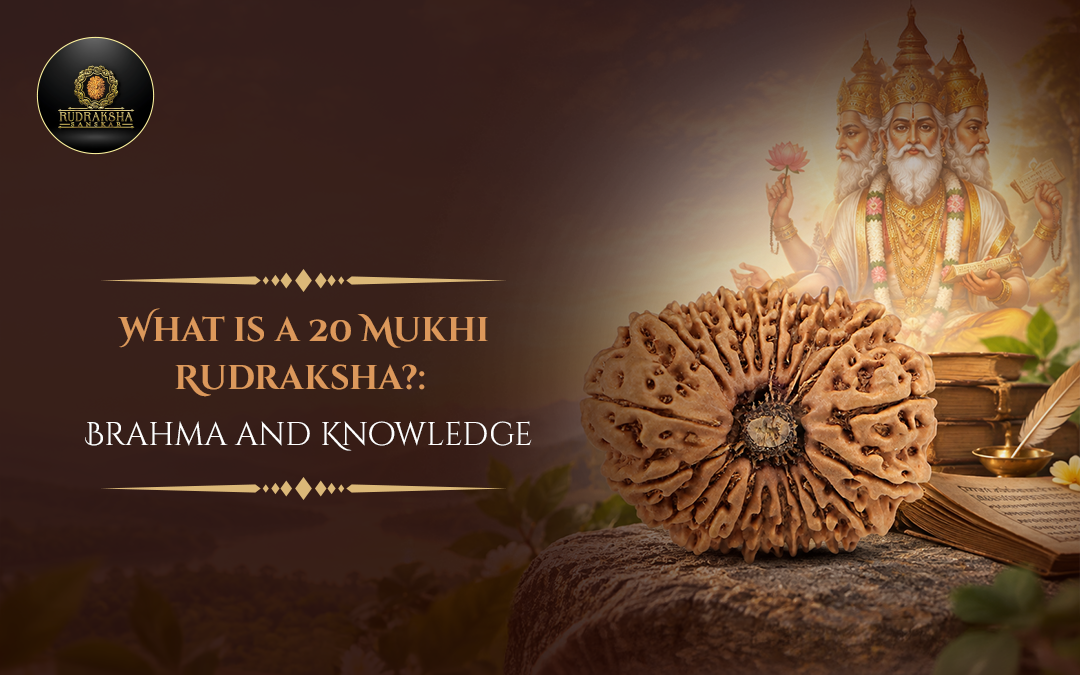
The 20 Mukhi Rudraksha sits near the extreme end of the rare 15–21 Mukhi spectrum and is widely associated in contemporary Rudraksha tradition with Lord Brahma, the creator within the Hindu Trimurti.
Its traditional themes naturally follow that association:
- knowledge
- creativity
- intellectual clarity
- learning
- creation
- broader understanding
- applying knowledge constructively
This makes 20 Mukhi particularly interesting for experienced spiritual practitioners, researchers, teachers, creators and collectors.
But with a Rudraksha this rare, both the spiritual claims and the physical bead deserve scrutiny.
The Brahma attribution is widely followed today, but higher-Mukhi textual traditions are less uniform than those for the familiar 1–14 Mukhi range.
Who Is the Presiding Deity of 20 Mukhi Rudraksha?
The most widely followed attribution for 20 Mukhi Rudraksha is Lord Brahma.
Brahma represents creation and knowledge. This gives 20 Mukhi its traditional connection with the ability to:
- learn
- understand
- create
- think deeply
- apply knowledge
- develop new ideas
Some later traditions expand this association toward broader divine knowledge or other deity interpretations.
Therefore, Brahma can reasonably be described as the widely followed modern and later traditional attribution, but not as an uncontested face-specific attribution across every Rudraksha tradition.
What Do the Classical Texts Say?
The Shiva Purana is among the most important classical sources used when discussing Rudraksha.
However, its commonly cited face-by-face descriptions are much clearer through 14 Mukhi.
The Padma Purana and Skanda Purana are also important within broader Rudraksha tradition. But detailed contemporary charts assigning one specific deity, planet and benefit set to every higher Mukhi from 15 to 21 cannot always be cleanly traced to specific verses in these texts.
For 20 Mukhi, that means it is safer to say:
Brahma is a widely followed later attribution rather than claiming that a clearly identifiable Shiva Purana verse universally establishes Brahma as the deity of 20 Mukhi.
For premium Rudraksha, naming a scripture is not enough.
A seller making a specific scriptural claim should be able to provide the relevant passage.
Which Planet Rules 20 Mukhi Rudraksha?
There is also disagreement around planetary attribution.
Different contemporary Rudraksha systems assign different planetary influences to higher Mukhi beads, while some treat 20 Mukhi primarily through its Brahma and knowledge symbolism rather than a single ruling graha.
Therefore, a planetary association should not be presented as settled scripture unless its tradition is identified.
If someone recommends 20 Mukhi specifically as a graha remedy, ask what system that recommendation follows.
What Are the Traditional Benefits of 20 Mukhi?
The central theme of 20 Mukhi is not simply “becoming intelligent.”
It is better understood as the traditional symbolism of knowledge being used for creation.
The bead is commonly associated with:
- intellectual clarity
- learning
- creativity
- deeper understanding
- decision-making
- applying knowledge productively
- spiritual study
This may make it traditionally relevant for:
Researchers and Academics
People whose work requires sustained learning, investigation and intellectual depth may connect naturally with its Brahma symbolism.
Teachers and Knowledge Professionals
Educators, consultants, strategists and other professionals whose work depends on transferring or applying knowledge may also find the association meaningful.
Creators and Innovators
Brahma represents creation, making 20 Mukhi relevant in traditions connecting knowledge with invention and original thinking.
Experienced Practitioners and Collectors
At this rarity level, many buyers already understand Rudraksha and are looking for a particular higher-Mukhi specimen rather than their first spiritual bead.
However, wearing 20 Mukhi does not guarantee better examination results, superior intelligence, successful inventions or business decisions.
Those remain dependent on study, skill and judgment.
How Rare Is 20 Mukhi Rudraksha?
20 Mukhi is an exceptionally rare higher-Mukhi Rudraksha.
Naturally formed specimens are far less available than ordinary lower Mukhi, particularly when buyers seek:
- Nepal origin
- larger size
- good condition
- clearly developed natural faces
- specimen-specific certification
- supporting X-ray documentation
It sits at the extreme end of the 1–21 spectrum, immediately before 21 Mukhi.
But that does not justify claiming an exact universal rarity position such as “second-rarest” unless reliable supply data supports it.
The safer conclusion is:
20 Mukhi is among the least commonly encountered Mukhi in the regular 1–21 market.
And rarity is about natural supply, not spiritual superiority.
What Determines the Price of a 20 Mukhi?
At this level, the phrase “rare Rudraksha” is not enough to justify a premium price.
Buyers should evaluate the exact specimen.
Price can be influenced by:
- origin
- dimensions
- weight
- natural development
- shape
- condition
- clarity of the 20 faces
- availability of comparable specimens
- certification
- X-ray documentation
- collector demand
Large, well-developed Nepal-origin specimens can command substantial premiums because naturally occurring examples are difficult to source.
But a heavier or more expensive 20 Mukhi is not automatically spiritually stronger.
The premium reflects the physical specimen and its scarcity.
Authenticity: Why 20 Mukhi Needs Strong Documentation
Twenty natural Mukhi lines make surface verification considerably more demanding.
At the same time, the high market value creates greater incentive for a lower-Mukhi bead to be modified by carving additional grooves.
A premium buyer should therefore demand:
- photographs of the exact specimen
- clear views of all 20 natural faces
- exact dimensions
- exact weight
- stated origin
- specimen-specific certificate
- X-ray evidence where available
- assessment of natural versus artificial faces
Why Does X-Ray Matter?
Surface analysis examines whether the visible Mukhi lines appear naturally formed.
X-ray adds another layer by showing the bead’s internal compartment structure.
Neither should replace the other.
At 20 Mukhi, the stronger verification chain is:
exact bead + surface analysis + weight and dimensions + certificate + matching X-ray.
Do not rely on water tests, copper-coin tests or vague statements such as “100% divine original” as authentication.
How Do You Wear 20 Mukhi Rudraksha?
Its rarity does not require an unnecessarily elaborate ritual.
A simple vidhi can be:
- Bathe and wear clean clothes.
- Place the bead in a clean puja space.
- Gently rinse it with clean water if required.
- Offer prayer to Shiva and Brahma according to your tradition.
- Chant the prescribed mantra.
- Take a clear sankalp.
- Wear or keep the bead according to your practice.
For a general Shiva-centred Rudraksha practice:
Om Namah Shivaya
If a guru or established tradition provides a specific 20 Mukhi Beej Mantra, that should take priority. Higher-Mukhi mantra lists vary, so one modern mantra should not be presented as universally scriptural.
20 Mukhi Is About What You Do With Knowledge
The most useful way to understand 20 Mukhi is through the symbolism of Brahma.
Knowledge becomes meaningful when something is created from it.
That may be an idea, a body of research, a business, a solution or a deeper spiritual understanding.
This is the traditional identity of 20 Mukhi.
Its rarity makes it valuable in the collector market, but rarity does not make it “more powerful.”
For deeper bead-specific information, explore the dedicated 20 Mukhi Rudraksha collection from Rudraksha Sanskar.
If you plan to buy rudraksha online, evaluate a premium 20 Mukhi through its exact origin, dimensions, weight, natural faces, certificate and available X-ray evidence rather than spiritual adjectives alone.
FAQs
Lord Brahma is its widely followed later and contemporary attribution, although higher-Mukhi traditions are not completely uniform.
The commonly cited face-specific Shiva Purana descriptions are clearer through 14 Mukhi. A specific claim for 20 Mukhi should therefore be supported with an exact textual reference.
It is associated with knowledge, creativity, understanding, learning and constructive application of intelligence.
Yes. It is among the least commonly encountered Mukhi in the 1–21 range, although precise numerical rarity rankings should be treated cautiously.
No such outcome can be guaranteed. Its knowledge association is spiritual and traditional, not a substitute for study or experience.
It provides additional evidence about internal structure and supports surface examination and specimen-specific certification.