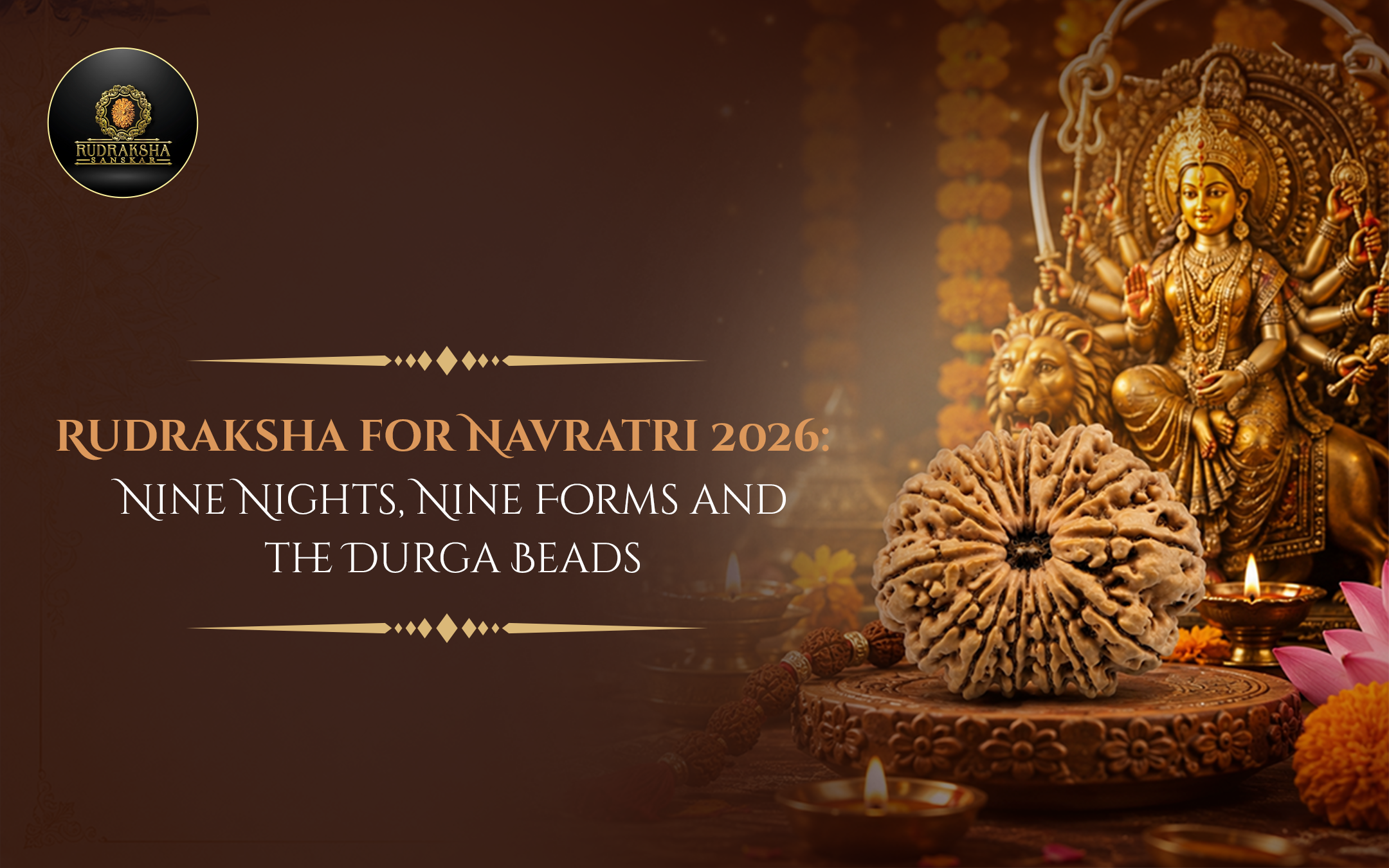
Shardiya Navratri 2026 begins on Sunday, 11 October, with Ghatasthapana and the worship of Maa Shailaputri. The festival continues through the worship of the nine forms of Durga, with Vijayadashami falling on 20 October 2026.
For devotees of Shakti, these days are about much more than fasting, colours and Garba.
Each form of Navadurga represents a different aspect of strength, discipline, wisdom, courage and spiritual growth.
That is also why Rudraksha enters the conversation naturally.
Among the different Mukhi, 9 Mukhi Rudraksha has the clearest traditional connection with Maa Durga and Navadurga. But that does not mean you need nine different Rudraksha for nine nights.
The better approach is to understand what each night represents and choose a Rudraksha only when its traditional meaning actually fits your practice.
Navratri 2026 Dates at a Glance
Shardiya Navratri begins on 11 October 2026.
The nine nights are dedicated to the Navadurga, while Vijayadashami concludes the festival on 20 October. Drik Panchang confirms the 11 October start for Gujarat as well as the wider Indian calendar.
The Navadurga are traditionally worshipped in this order:
- Shailaputri
- Brahmacharini
- Chandraghanta
- Kushmanda
- Skandamata
- Katyayani
- Kalaratri
- Mahagauri
- Siddhidatri
Because lunar tithis do not always align neatly with one civil date each, local Panchang listings can compress or overlap some observances. Follow your local calendar for exact puja timing rather than assuming every Navadurga must correspond to one fixed midnight-to-midnight date.
What Do the Nine Forms of Durga Represent?
Each form of Navadurga highlights a different quality of Shakti.
Shailaputri: Grounding
The first form represents steadiness and beginning from a strong foundation.
This is a useful reminder that spiritual practice does not always start with something dramatic.
Sometimes it starts with becoming stable.
Brahmacharini: Discipline
Brahmacharini represents devotion, austerity and persistence.
Her symbolism fits the ability to continue a practice even when motivation changes.
Chandraghanta: Courage
Chandraghanta is associated with courage and readiness to face difficulty.
This is where the idea of fearlessness becomes more prominent.
Kushmanda: Creative Energy
Kushmanda represents creative force and life-giving energy.
Her symbolism centres around bringing something new into existence.
Skandamata: Nurturing Strength
Skandamata represents motherhood, protection and care.
Strength here is not force.
It is the responsibility to nurture.
Katyayani: Determination
Katyayani represents decisive strength and the willingness to confront what needs to change.
Kalaratri: Facing Fear
Kalaratri is one of the fiercest forms of Durga.
Her symbolism is especially connected with confronting darkness, fear and uncertainty rather than running from them.
Mahagauri: Purity and Renewal
Mahagauri represents purification, peace and renewal.
Siddhidatri: Completion
Siddhidatri represents spiritual fulfilment and the completion of the Navadurga cycle.
Taken together, the nine nights tell a larger story:
become grounded, develop discipline, find courage, create, nurture, act decisively, face fear, renew yourself and move toward fulfilment.
Which Rudraksha Is Most Closely Connected With Maa Durga?
The clearest answer is 9 Mukhi Rudraksha.
It is traditionally associated with Maa Durga and Navadurga and is commonly discussed around:
- courage
- fearlessness
- inner strength
- emotional resilience
- protection
- confidence during difficult phases
This makes 9 Mukhi particularly relevant during Navratri.
The connection is also easy to understand symbolically:
nine Mukhi, nine forms of Durga.
That does not mean wearing the bead guarantees divine protection or removes every fear.
Its traditional meaning fits a spiritual practice centred around the qualities represented by Durga.
Is 9 Mukhi the Only Rudraksha You Can Wear During Navratri?
No.
Navratri does not create a rule that everyone must wear 9 Mukhi.
Different Rudraksha may still fit different intentions.
3 Mukhi for Transformation
3 Mukhi Rudraksha is traditionally associated with Agni and transformation.
It can resonate with the Navratri theme of releasing old patterns and beginning again.
5 Mukhi for Daily Spiritual Practice
For someone completely new to Rudraksha, 5 Mukhi Rudraksha remains the simplest starting point.
You do not need to buy 9 Mukhi simply because Navratri has arrived.
Garbh Gauri for the Maternal Aspect of Shakti
Garbh Gauri Rudraksha carries traditional symbolism around motherhood, nurturing and the maternal aspect of Parvati.
That can connect naturally with forms such as Skandamata.
Gauri Shankar for Shiva-Shakti Balance
Gauri Shankar Rudraksha represents Shiva and Shakti in union.
For someone whose Navratri practice centres on balance between these two principles, its symbolism can be meaningful.
But again, none of this creates a requirement to wear several Rudraksha during the festival.
Do You Need a Different Rudraksha for Each of the Nine Nights?
No.
There is no need to create a purchasing chart such as:
Night 1 = one Mukhi
Night 2 = another Mukhi
Night 3 = another Mukhi
That may look convenient for marketing, but it should not be presented as an established Navratri rule without a genuine traditional basis.
If your purpose is specifically Durga worship, one authentic 9 Mukhi is a much clearer choice than buying nine unrelated beads simply to match nine nights.
If you already wear another Rudraksha as part of your regular practice, you can continue wearing it during Navratri.
The festival does not require you to replace it.
Who Should Consider 9 Mukhi During Navratri?
Durga Devotees
This is the most direct group.
Someone already connected with Maa Durga, Shakti worship or Navadurga may find 9 Mukhi naturally aligned with that practice.
People Working on Courage
If fear or hesitation repeatedly stops you from acting, the traditional courage symbolism may be particularly relevant.
People Going Through a Difficult Phase
Navratri itself tells a story of strength developing through challenge.
Someone moving through:
- career uncertainty
- personal setbacks
- emotional pressure
- major changes
may connect with the 9 Mukhi themes of resilience and inner strength.
Women Drawn to Shakti Worship
9 Mukhi is often associated strongly with feminine divine energy, but it is not restricted to women.
Men and women can both wear it.
The connection is spiritual, not gender-exclusive.
How Can You Start Wearing 9 Mukhi During Navratri?
If you already have an authentic 9 Mukhi, Navratri can be a meaningful time to begin.
A simple method is enough:
- Bathe and prepare a clean puja space.
- Keep the Rudraksha near your Durga worship setup.
- Perform your usual Navratri puja.
- Offer flowers or other items according to your family tradition.
- Chant your Durga mantra or established spiritual mantra.
- Wear the Rudraksha after prayer.
You do not need an elaborate “Navratri activation” ritual.
If your guru or family follows a specific procedure, use that instead.
How Do You Check an Original 9 Mukhi Rudraksha?
A genuine 9 Mukhi should show nine naturally formed Mukhi lines.
Check:
- all nine natural faces
- surface continuity
- no artificially carved grooves
- dimensions
- weight
- stated origin
- photographs of the exact bead
- certificate number
- X-ray where available
This is especially important if the bead carries a significant price.
For a broader verification process, use the original Rudraksha identification guide.
Navratri works because each night adds another layer to the idea of Shakti.
Grounding.
Discipline.
Courage.
Creation.
Nurturing.
Determination.
Facing fear.
Renewal.
Fulfilment.
That is a far more meaningful way to approach the festival than trying to assign a product to every night.
If Maa Durga is central to your spiritual practice, 9 Mukhi Rudraksha has the clearest traditional connection.
If another Rudraksha already fits your practice, continue with it.
The goal is not to collect nine beads before Navratri ends.
It is to understand the qualities the nine forms of Durga represent and build them into the way you live after the festival is over.
If you plan to buy rudraksha online, compare the certified 9 Mukhi Rudraksha options from Rudraksha Sanskar and review the exact Mukhi, origin and certification before choosing.
FAQs
Shardiya Navratri begins on 11 October 2026.
Vijayadashami falls on 20 October 2026.
9 Mukhi Rudraksha is the clearest traditional Durga-linked Mukhi.
It is traditionally connected with Maa Durga and her nine forms, making its symbolism especially relevant during Navratri.
No. There is no need to buy nine different Mukhi simply because Navratri has nine nights.
Yes. Its association with Shakti and Durga does not restrict it to women.
Yes, when there is a clear reason for choosing it. For general Rudraksha practice, 5 Mukhi remains a simpler first option.