At some point, Rudraksha pricing stops looking like ordinary spiritual buying.
A common bead may cost a few hundred or a few thousand rupees.
Then you see one at:
₹2 lakh.
Another at ₹5 lakh.
Another at ₹31 lakh.
The obvious question is:
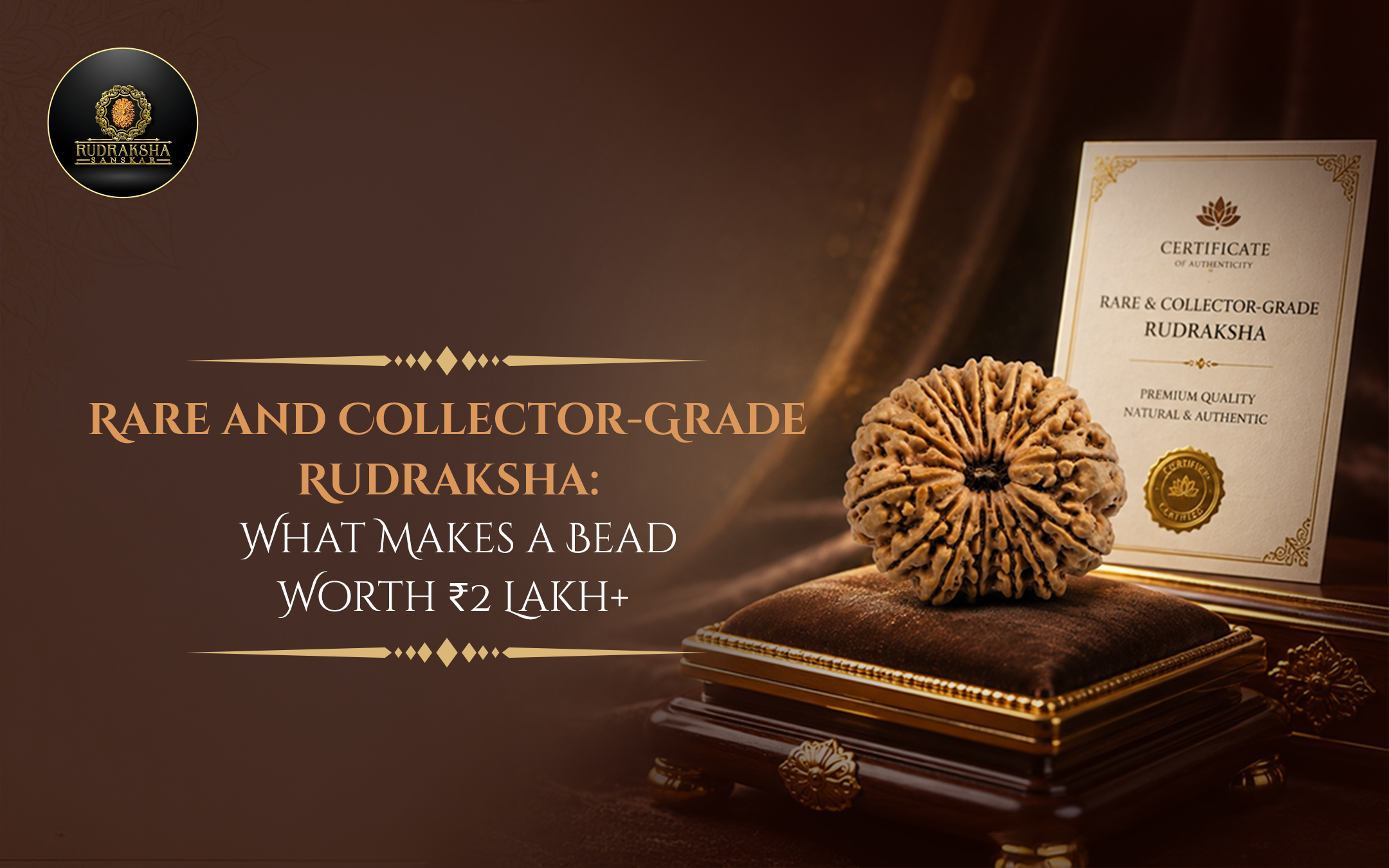
What makes one Rudraksha worth that much?
The answer should never be simply:
“because it is powerful.”
For a collector-grade Rudraksha, the premium should come from characteristics you can actually examine:
rarity, Mukhi, origin, size, natural formation, condition and specimen-level verification.
If a ₹2 lakh+ bead cannot be explained through those factors, the price deserves more questions.
What Does “Collector-Grade Rudraksha” Actually Mean?
There is no universal laboratory grade called “collector-grade.”
It is a market term generally used for specimens that stand out because they are unusually:
- rare
- large
- well formed
- naturally distinctive
- difficult to source
- desirable to experienced collectors
A collector may value a bead because only a small number of comparable natural specimens appear in the market.
That is different from saying the bead is spiritually “better.”
Collector value and spiritual suitability are not the same thing.
A genuine 5 Mukhi may be exactly right for one person’s daily practice even though it has almost no collector premium.
Mukhi Rarity Is Usually the Starting Point
Some Mukhi are naturally much easier to find than others.
5 Mukhi is abundant.
14 Mukhi is much rarer.
By 16, 18, 20 or 21 Mukhi, genuine availability becomes significantly more limited.
That is why Mukhi count strongly affects collector pricing.
Current Rudraksha Sanskar listings illustrate this clearly:
- 14 Mukhi Nepal, 34.8 mm: ₹2,00,000
- 21 Mukhi Indonesia, 19.5 mm: ₹2,00,000
- 21 Mukhi Gauri Shankar Nepal, 41.1 mm: ₹31,00,000
All three are premium specimens, but for different reasons.
The 14 Mukhi combines rarity with substantial Nepal size.
The Indonesian 21 Mukhi is physically smaller but carries a much rarer Mukhi count.
The 21 Mukhi Gauri Shankar combines a rare Mukhi with an exceptional natural joined formation.
That is how collector pricing begins to make sense.
Size Matters, but Only Within Context
Large Rudraksha can command premiums, particularly from Nepal.
But size alone does not explain everything.
For example, Rudraksha Sanskar currently lists several 14 Mukhi specimens around 35–36 mm between roughly ₹2 lakh and ₹5 lakh.
They are similar in Mukhi.
Their sizes are relatively close.
Yet prices still vary.
That tells you something important:
millimetres are not the entire valuation system.
Other characteristics can include:
- weight
- surface structure
- clarity of Mukhi lines
- overall formation
- condition
- individual scarcity
So “this one is bigger” may explain part of a premium.
It should not be the only explanation.
Natural Formations Can Push a Bead Into Another Price Category
Some collector-grade Rudraksha are valuable because nature created an unusual structure.
Examples include:
These formations add another layer of rarity on top of Mukhi count.
A Gauri Shankar requires two Rudraksha to grow naturally joined.
Trijuti requires three.
Sawar develops an additional attached formation.
Ganesh shows a natural trunk-like projection.
Now combine a rare formation with an already rare Mukhi.
That is where very high collector prices can begin to appear.
The current 21 Mukhi Gauri Shankar at ₹31 lakh is a good example: the price is not based on “21 Mukhi” alone. It combines high Mukhi rarity, Nepal origin, a 41.1 mm specimen, natural Gauri Shankar formation, an individual certificate and X-ray reference.
Origin Can Add a Premium
Nepal-origin Rudraksha are generally known for:
- larger size
- greater weight
- deeper texture
- more prominent Mukhi lines
This often gives Nepal specimens stronger collector appeal.
But origin alone cannot justify any price.
A genuine Indonesian 21 Mukhi can still be extremely valuable because Mukhi rarity may outweigh physical size. Rudraksha Sanskar currently lists a 19.5 mm Indonesian 21 Mukhi at ₹2 lakh with certificate DCL/2026/A/1546.
So the hierarchy is not:
Nepal = expensive
Indonesia = cheap
The real interaction is:
Mukhi + origin + size + formation + availability.
Condition Matters More at Collector Prices
A common everyday Rudraksha can still be spiritually meaningful even if its appearance is not exceptional.
Collector-grade pricing is different.
At ₹2 lakh+, buyers should look more closely at:
- cracks
- damage
- artificial repair
- drilling quality
- excessive polishing
- chipped sections
- unclear or altered Mukhi lines
Rudraksha Sanskar’s existing price guidance likewise lists condition, natural formation and Mukhi clarity among the factors that influence value.
If two equally rare beads are available, the cleaner natural specimen may attract the stronger collector premium.
Certification Becomes Non-Negotiable at This Level
A ₹2 lakh bead should not be sold on:
“Trust us, it is original.”
Expect specimen-level information such as:
- exact photographs
- certificate number
- dimensions
- weight
- stated origin
- natural Mukhi count
- laboratory observations
- X-ray where useful
For example, Rudraksha Sanskar’s ₹2 lakh 21 Mukhi listing gives:
Certificate: DCL/2026/A/1546
Dimensions: 19.5 × 11.7 × 11.6 mm
Weight: 1.07 g
Origin: Indonesia
and shows both regular and X-ray imagery.
That is the kind of traceability worth expecting.
The larger the price, the less acceptable generic documentation becomes.
When Is ₹2 Lakh+ Reasonable?
A premium begins to make sense when several strong factors appear together.
For example:
rare Mukhi + genuine Nepal origin + unusually large size + excellent natural formation + strong condition + specimen-level certification
or
extremely rare Mukhi + unusual natural formation + clear X-ray + traceable certificate
What should not justify ₹2 lakh by itself:
- “very powerful”
- “VIP bead”
- “limited stock”
- “rare energy”
- “special vibration”
- “festival offer ends tonight”
Those are sales phrases.
They are not valuation factors.
Does a ₹5 Lakh Rudraksha Work Better Than a ₹50,000 One?
There is no responsible basis for saying that spiritual effectiveness rises in direct proportion to price.
Price measures market rarity and specimen characteristics.
It does not measure devotion.
A ₹5 lakh rare 14 Mukhi may be valuable because it is difficult to source at that size and formation.
A much cheaper 5 Mukhi may still be entirely appropriate for someone practising daily Shiva japa.
Do not confuse collector desirability with personal suitability.
Six Questions Before Buying Collector-Grade Rudraksha
Ask:
1. What exactly makes this specimen rare?
Mukhi, size, origin or formation?
2. Is this the exact bead I will receive?
You should see specimen-specific photographs.
3. What does the certificate identify?
It should correspond with the bead.
4. Is an X-ray available?
Especially for high Mukhi or unusual natural formations.
5. How does this compare with other beads of the same Mukhi?
Compare size, origin and formation.
6. Am I buying it to wear or to collect?
Those can lead to very different buying decisions.
At ₹2 Lakh+, Buy the Specimen, Not the Story
Collector-grade Rudraksha should become more transparent as the price rises.
Not more mysterious.
You should be able to understand:
why the Mukhi is rare,
why the size matters,
what the origin is,
whether the formation is unusual,
what condition the bead is in,
and which certificate belongs to it.
If the entire reason for the premium is a spiritual story that cannot be connected to the physical bead, keep looking.
At this level, rarity should be visible and verification should be specific.
If you plan to buy rudraksha online, compare individual certified specimens from Rudraksha Sanskar and judge collector-grade value from the exact Mukhi, size, origin, natural formation and authentication rather than the price tag alone.
FAQs
Usually a combination of rarity, Mukhi, unusual size, origin, natural formation, condition and specimen-level verification.
No. Current prices vary substantially even within 14 Mukhi depending on the individual specimen.
Yes. An extremely rare Mukhi can have high value even when the bead is smaller. A current certified Indonesian 21 Mukhi is listed at ₹2 lakh.
Because the naturally joined formation adds rarity on top of the underlying Mukhi.
For collector-grade buying, specimen-specific certification and supporting evidence should be considered essential.