Buying Rudraksha becomes confusing surprisingly quickly.
You may know which Mukhi you want, but then another question appears:
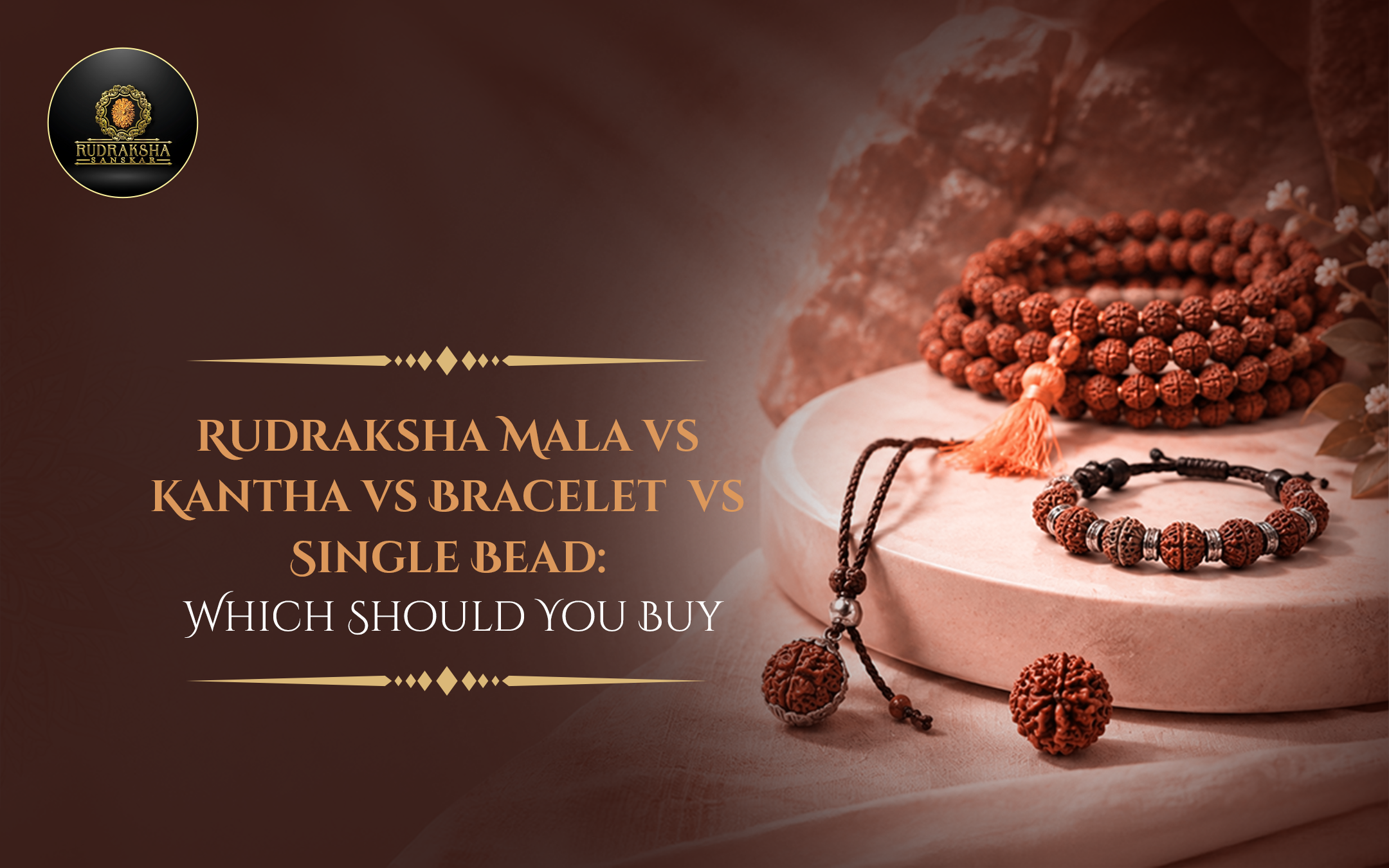
Should you buy one bead, a bracelet, a mala or a full Kantha?
There is no format that is automatically better.
A single bead may be perfect for someone who wants one specific Mukhi.
A bracelet may suit daily professional wear.
A mala may make sense for mantra japa.
A Kantha may suit someone who wants a more traditional full-neck Rudraksha practice.
The right choice depends on how you actually intend to use the Rudraksha, not which format contains the most beads.
The Quick Comparison
| Format | Best For | Typical Structure | Main Advantage |
| Single Bead | Specific Mukhi purpose | One Rudraksha | Simple, targeted and easy to verify |
| Bracelet | Everyday wear | Multiple beads around wrist | Compact and practical |
| Mala | Japa, meditation and neck wear | Often 27, 54 or 108 beads | Designed for mantra practice |
| Kantha | Traditional neck wear | Usually larger/full neck arrangement | Strong traditional wearing format |
The differences are mostly practical.
More Rudraksha does not automatically mean more spiritual benefit.
When Should You Buy a Single Rudraksha Bead?
A single bead is usually the easiest choice when you already know which Mukhi fits your purpose.
For example:
- 4 Mukhi for traditional learning and communication associations
- 5 Mukhi for general Shiva practice and japa
- 7 Mukhi for traditional stability and Saturn-related guidance
- 9 Mukhi for Maa Durga, courage and resilience
- 12 Mukhi for Surya, confidence and leadership
A single bead is best if:
- you want one clearly selected Mukhi
- you are buying your first Rudraksha
- you prefer minimal daily wear
- the Mukhi itself is rare or expensive
- you want specimen-level certification
This last point is especially important.
If you are buying an expensive 13 or 14 Mukhi, it is generally much easier to inspect and verify one individual bead than a complex jewellery arrangement.
The Main Limitation
A single bead is not designed as a counting tool for mantra japa.
You can certainly wear it during prayer or meditation, but someone practising 108 mantra repetitions regularly may find a mala more practical.
When Should You Choose a Rudraksha Bracelet?
A Rudraksha bracelet works particularly well for someone who wants Rudraksha to remain part of everyday life without wearing a necklace.
It can fit naturally into:
- office wear
- casual clothing
- travel
- everyday spiritual practice
A bracelet is best if:
- you prefer wrist wear
- you want something compact
- a neck mala feels too prominent
- you are comfortable wearing multiple beads
- you want Rudraksha with a jewellery-style presentation
A simple 5 Mukhi bracelet can be a practical first option.
More specialised bracelets may combine multiple Mukhi around a specific traditional intention.
The mistake is assuming more Mukhi means a better bracelet.
If a bracelet contains 4, 6, 8, 11 and 12 Mukhi, you should understand why each one was included rather than accepting a product name such as “complete success bracelet.”
Consider Comfort
Large Nepal Rudraksha can be beautiful but bulky around the wrist.
Someone typing for eight hours a day may prefer smaller beads rather than having several 25–30 mm Rudraksha constantly hitting a desk.
For the detailed sizing and wearing considerations, see our guide on choosing a Rudraksha bracelet.
When Does a Rudraksha Mala Make More Sense?
A Rudraksha mala becomes particularly useful when mantra japa or meditation is part of your practice.
Common counts include:
- 27 beads
- 54 beads
- 108 beads
A traditional full japa mala generally uses 108 beads plus one Guru bead.
Choose a mala if:
- you regularly chant mantras
- you meditate with Rudraksha
- you prefer wearing Rudraksha around the neck
- you want a traditional 108-count tool
- you want multiple same-Mukhi beads rather than one rare specimen
A 5 Mukhi Rudraksha mala is one of the most familiar choices because 5 Mukhi is widely associated with general Shiva practice and japa.
Mala Does Not Mean Rare Mukhi
This is worth clarifying.
A 108-bead mala does not need 108 expensive Rudraksha.
In fact, using very rare Mukhi throughout an entire full mala would make the product extraordinarily expensive and often impractical.
Most traditional malas use a common Mukhi consistently.
If someone wants several rare Mukhi together, that moves closer to a Siddha Mala or combination mala, which is a different type of purchase.
What Is a Rudraksha Kantha?
The word Kantha is often used for a substantial Rudraksha neck arrangement, especially versions made from larger Nepali beads.
Rudraksha Sanskar’s current Kantha collection includes structures such as:
- 54+1 beads
- 108+1 beads
- different Mukhi
- different bead-size ranges
A Kantha may therefore technically share similarities with a mala, but the term is commonly used in the market for a more prominent traditional neck-wearing format.
Choose a Kantha if:
- you specifically want traditional neck wear
- you prefer larger visible Rudraksha
- you are comfortable with additional weight
- Rudraksha is already part of your regular spiritual practice
- you value the appearance and structure of a full neck mala
Think About Weight
This is where Kantha buying gets practical.
Fifty-four small beads and fifty-four large Nepali Rudraksha can feel completely different.
A large Kantha may look impressive but become heavy during extended wear.
Before buying, check:
- bead count
- average bead diameter
- total weight where available
- finished length
- whether the mala sits comfortably on your neck
The largest option is not automatically the best.
Mala vs Kantha: Aren’t They Basically the Same?
They can overlap.
The terminology is not always perfectly standardised across every Rudraksha seller.
Generally:
Mala is the broader term for a string of beads used for japa, meditation or wearing.
Kantha usually describes a more substantial neck-worn Rudraksha mala, often made using visible traditional beads.
So every Kantha can broadly be understood as a neck mala, but not every small japa mala would necessarily be marketed as a Kantha.
The practical specifications matter more than the label.
Ask:
- How many beads?
- What Mukhi?
- What size?
- Which origin?
- How long?
- How heavy?
Those answers tell you what you are actually buying.
Which Format Is Best for a Beginner?
For most beginners, keep it simple.
Option 1: Single 5 Mukhi
Probably the easiest introduction.
You can learn how it feels to wear Rudraksha and how to care for it without making a large purchase.
Option 2: Simple 5 Mukhi Bracelet
Useful if you strongly prefer wrist wear.
Option 3: 5 Mukhi Mala
Better if you already intend to practise mantra japa.
A large Kantha or expensive multi-Mukhi combination generally does not need to be your first Rudraksha purchase.
Start with the practice.
You can expand the format later.
Which Format Is Best for Japa?
Mala wins here.
If you regularly perform mantra repetitions, the traditional 27, 54 or 108 count gives you a practical counting system.
A bracelet generally contains too few beads for convenient full mantra cycles.
A single bead does not provide counting functionality.
A Kantha may work depending on its construction, although some large neck-wear versions are better suited to wearing than repeatedly moving through the fingers during japa.
If japa is the main reason for buying, choose the mala based on bead count and handling comfort, not only appearance.
Which Format Is Easiest to Verify?
Usually, the single bead.
You can easily inspect:
- every Mukhi line
- dimensions
- weight
- natural formation
- certificate number
- X-ray where available
Bracelets and malas contain multiple Rudraksha, so the verification question changes.
Ask:
Is every bead certified?
Was the complete mala certified as one set?
Are only rare Mukhi individually certified?
Do not assume a single certificate image automatically proves every bead in a 108-bead mala was individually tested.
For premium products, the seller should be able to explain what the certification actually covers.
Use the original Rudraksha identification guide before comparing higher-value options.
Which Format Costs More?
There is no fixed answer because Mukhi can outweigh format.
A simple 5 Mukhi mala containing dozens of common beads may cost far less than one certified rare 14 Mukhi Rudraksha.
Likewise, a bracelet containing several rare Mukhi may cost substantially more than an ordinary Kantha.
Price depends on:
- Mukhi
- number of beads
- origin
- bead size
- rarity
- natural formations
- certification
- silver or gold work
- craftsmanship
Do not use bead count as the only measure of value.
Which One Should You Buy?
Use this shortcut.
Buy a Single Bead If:
You know which Mukhi you want and prefer the simplest, most targeted option.
Buy a Bracelet If:
You want compact daily wear and prefer Rudraksha on the wrist.
Buy a Mala If:
Mantra japa or meditation is one of your main reasons for buying.
Buy a Kantha If:
You specifically want a substantial traditional Rudraksha necklace and are comfortable with the size and weight.
And if none of those answers feels obvious, start with one genuine 5 Mukhi rather than buying the most complex option. You can shop more of our authentic rudraksha collection from our official online rudraksha store.
A Rudraksha does not become better because it is turned into a larger piece of jewellery.
The format should serve the practice.
Single bead: simple and specific.
Bracelet: compact and practical.
Mala: ideal for japa and meditation.
Kantha: traditional, substantial neck wear.
Once you know which format suits you, then compare Mukhi, origin, bead size, construction and certification.
That order prevents a common mistake: buying an impressive-looking Rudraksha product first and only later wondering what you are supposed to do with it.
If you plan to buy rudraksha online, compare the available individual beads, malas, Kanthas and ready-to-wear Rudraksha options from Rudraksha Sanskar according to how you actually intend to wear and use them.
FAQs
Neither is universally better. A single bead is useful for one specific Mukhi, while a mala is particularly practical for japa and meditation.
Mala is the broader term for a string of Rudraksha beads. Kantha commonly refers to a larger traditional neck-worn Rudraksha arrangement.
The format itself should not be treated as a measure of spiritual effectiveness. Choose based on purpose, Mukhi and how you plan to use it.
A single 5 Mukhi bead or simple 5 Mukhi bracelet is usually easiest. A mala also makes sense for beginners already committed to japa.
A 27-, 54- or 108-bead mala is the most practical option for mantra counting.
It can be, particularly when made using large Nepali Rudraksha. Check bead size, count and total weight before buying.
Not automatically. More beads change the format and may support different practices, but quantity should not be treated as spiritual strength.