A traditional Rudraksha neck mala is more than a string of beads worn around the neck.
Depending on how it is made, it can serve as:
- a daily spiritual accessory
- a meditation aid
- a mantra-japa mala
- a personal Rudraksha combination
- a traditional kantha worn for longer periods
The most familiar versions use 5 Mukhi Rudraksha, especially for daily wear and japa, but traditional neck malas can also be made using 7 Mukhi, 8 Mukhi or carefully selected combinations.
The right mala depends on three things:
what you want to use it for, how many beads you need, and what bead size you can comfortably wear.
What Is a Traditional Rudraksha Neck Mala?
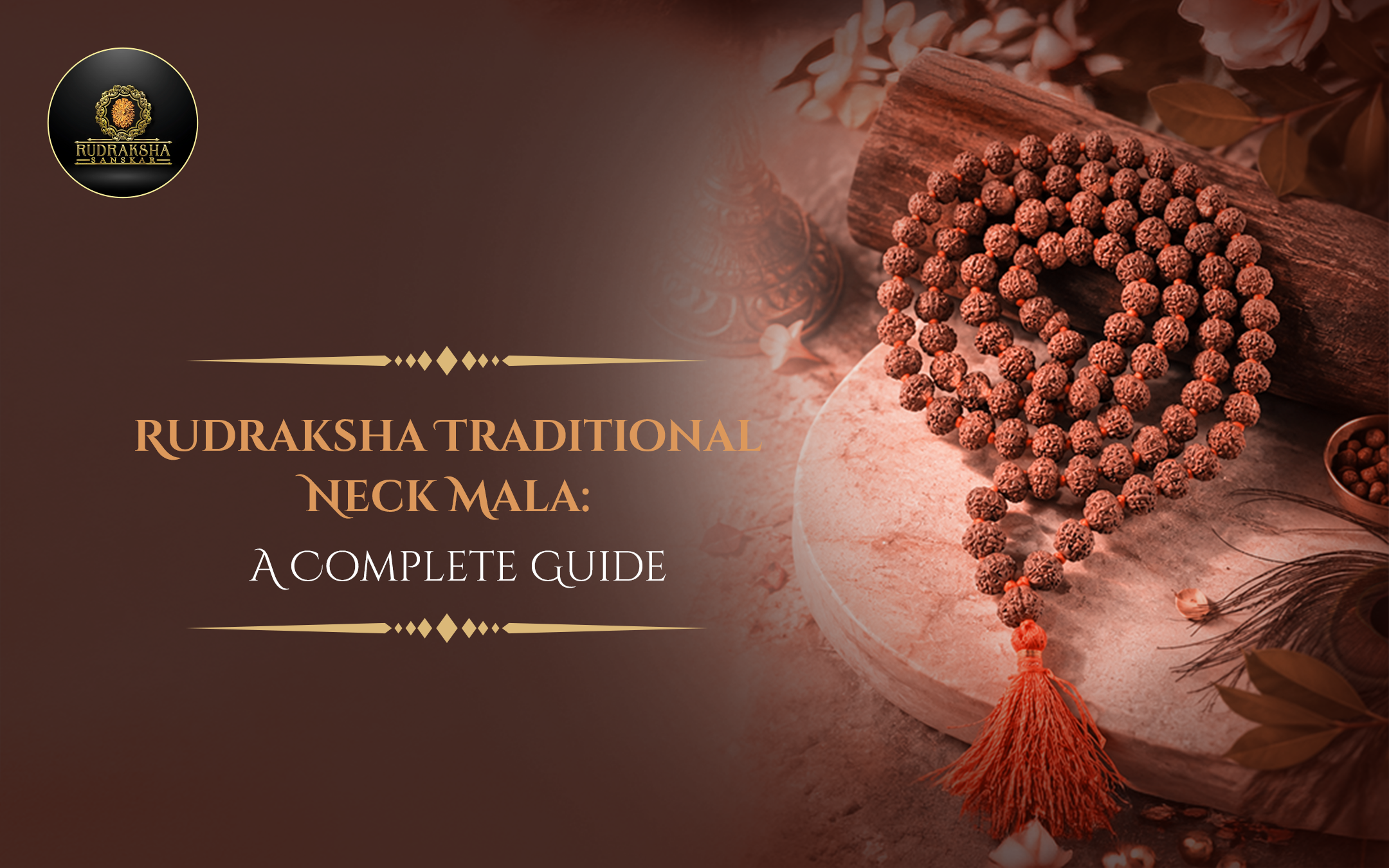
A Rudraksha neck mala is a series of Rudraksha beads strung together for wearing around the neck or using during spiritual practice.
Traditional bead counts commonly include:
- 27 beads
- 54 beads
- 108 beads
A full japa mala traditionally uses 108 beads plus one Guru bead, while shorter 27- and 54-bead versions are also used for chanting and daily wearing. Rudraksha Sanskar’s current 5 Mukhi mala guidance follows these same common counts.
You may also see the word Kantha used for larger Rudraksha neck malas.
Current Rudraksha Sanskar inventory, for example, includes 54+1 and 108+1 Nepali Kanthas in different bead sizes. You can shop our authentic 1 to 14 mukhi rudraksha mala from our online store.
Which Rudraksha Is Best for a Neck Mala?
For most people, 5 Mukhi Rudraksha is the easiest place to start.
It is widely used for:
- daily wearing
- Shiva devotion
- meditation
- mantra japa
- general spiritual practice
Rudraksha Sanskar’s current 5 Mukhi category specifically describes it as the common choice for both beginners and traditional japa malas.
5 Mukhi Mala
A 5 Mukhi Rudraksha mala works well if you want:
- your first Rudraksha neck mala
- a regular meditation mala
- a simple daily-wear option
- 27, 54 or 108-bead japa practice
7 Mukhi Mala
A 7 Mukhi mala may be chosen where the traditional intention is more specific around stability and Saturn-related practice.
Current Rudraksha Sanskar inventory includes 7 Mukhi Nepali Kanthas in several bead sizes, including approximately 14–16 mm, 16–18 mm and larger versions.
Higher Mukhi Neck Malas
Higher Mukhi malas also exist, but they can become significantly more expensive.
For example, the current catalogue includes an 8 Mukhi Nepali Kantha and a 9 Mukhi Gauri Shankar Nepali Kantha at substantially higher price points than common 5 Mukhi malas.
For a first mala, there is usually no reason to start with the most expensive Mukhi available.
27, 54 or 108 Beads: Which Mala Should You Choose?
The bead count should match how you actually intend to use the mala.
27 Beads
A compact option.
Good for:
- short mantra sessions
- lighter everyday wear
- people who find a full mala too long
Four rounds of 27 beads equal a traditional 108-count japa cycle.
54 Beads
A useful middle ground.
Good for:
- regular chanting
- neck wear
- people who want more beads without the length and weight of 108
Two rounds complete 108 repetitions.
108 Beads
The traditional full japa count.
Good for:
- established mantra practice
- meditation
- people who want one complete mantra cycle without repeating sections
Rudraksha Sanskar’s current catalogue includes both 54+1 and 108+1 Nepali 5 Mukhi Kanthas.
More beads do not automatically mean “more benefits.”
The count primarily changes how the mala is used.
What Is the Guru Bead?
Many traditional malas include one additional bead beyond the main count.
This is commonly referred to as the Guru bead.
So you may see descriptions such as:
54+1
or
108+1
The extra bead marks the starting and finishing point of the mala during japa.
Traditionally, when chanting with a mala, you do not cross over the Guru bead and continue in the same direction.
Instead, the mala is turned and the next round begins in reverse.
If you are wearing the mala mainly as a neck mala rather than performing japa, this detail matters less practically, but it remains part of the traditional construction.
What Bead Size Is Best for a Neck Mala?
This is one of the most overlooked buying decisions.
Large Rudraksha may look impressive in photographs but can become heavy once 54 or 108 of them are worn together.
10–14 mm
Generally:
- lighter
- easier for 108-bead malas
- less bulky
- comfortable for longer wear
14–18 mm
A balanced size for many traditional neck malas.
The Rudraksha remains clearly visible without becoming excessively large.
18 mm and Above
More prominent and heavier.
Better suited to:
- shorter malas
- 27- or 54-bead constructions
- people who specifically prefer larger Nepali beads
Rudraksha Sanskar’s live Kantha collection shows this range clearly, with current 5 Mukhi and 7 Mukhi necklaces available across several size bands.
Before buying, ask yourself:
Will I actually wear this for several hours?
Comfort matters more than choosing the largest bead available.
Nepal vs Indonesian Rudraksha Mala
Origin can make a major practical difference in neck malas.
Nepali Rudraksha
Typically:
- larger
- heavier
- deeply textured
- more visually prominent
- stronger visible Mukhi lines
A Nepali mala may appeal to someone who wants the Rudraksha itself to be visually prominent.
Indonesian Rudraksha
Typically:
- smaller
- lighter
- more compact
- easier to use for 108-bead malas
This can make Indonesian beads especially practical for japa or all-day neck wear.
Rudraksha Sanskar’s current guidance makes the same distinction, noting that Nepali beads are larger while Indonesian beads can keep a full 108-bead mala lighter.
Neither origin is automatically spiritually superior.
Choose according to comfort, appearance, budget and verification.
Neck Mala vs Siddha Mala: What Is the Difference?
A traditional neck mala usually contains multiple beads of the same Mukhi, such as a 5 Mukhi Kantha.
A Siddha Mala is different.
It combines several different Mukhi, often including:
- 1 to 14 Mukhi
- Gauri Shankar
- Ganesh Rudraksha
Rudraksha Sanskar’s current ready-to-wear collection includes several such certified Siddha Mala combinations with mixed Nepali, Indonesian, South Indian and North Indian beads.
Choose a traditional same-Mukhi neck mala if you want:
- simplicity
- regular japa
- daily wear
- one clear traditional association
Choose a Siddha Mala only if you understand why a broad multi-Mukhi combination suits your practice.
Thread, Knots and Construction Matter Too
A mala can contain genuine Rudraksha and still be poorly made.
Check the stringing.
Thread
Cotton, silk or other durable traditional threads are commonly used.
The thread should be:
- strong
- comfortable
- securely finished
- resistant to unnecessary fraying
Knots
Better malas may use individual knots between beads.
This helps:
- keep spacing consistent
- reduce bead-to-bead friction
- prevent every bead from falling if the thread breaks
Silver or Gold
Silver, gold or panchdhatu can also be used for:
- capping
- spacers
- chains
These increase the jewellery value.
They do not determine whether the Rudraksha itself is genuine.
If you are paying substantially more for precious metal, understand how much of the final price comes from the beads and how much comes from the metalwork.
Can You Wear a Rudraksha Neck Mala Every Day?
Yes, many people wear Rudraksha malas regularly.
A practical daily routine is more important than constantly taking the mala on and off because of conflicting online rules.
Protect it from:
- swimming-pool chemicals
- harsh soap
- hair-treatment chemicals
- heavy impact
- prolonged unnecessary soaking
Rudraksha Sanskar’s current care guidance similarly recommends keeping beads away from chemical exposure and situations where they may be struck or damaged.
If your family or spiritual tradition has specific rules about sleeping, bathing or particular environments, follow that established practice.
How Should You Start Wearing a Rudraksha Mala?
There is no need for an unnecessarily complicated ceremony.
A simple Shiva-centred method can be:
- Bathe and wear clean clothes.
- Keep the mala in your puja space.
- Offer your normal Shiva prayer.
- Chant Om Namah Shivaya.
- Wear the mala around your neck or begin your japa practice.
Monday is commonly chosen for beginning Rudraksha wearing, although different Mukhi may also have traditionally associated days.
If your guru or family tradition gives another method, follow that instead.
How Do You Check Whether a Rudraksha Mala Is Original?
With a mala, authenticity requires more attention because you are checking multiple beads, not just one.
Check the Mukhi Consistency
If the product is sold as a 5 Mukhi mala, the beads should genuinely show five natural Mukhi lines.
Ask What Is Certified
This is especially important.
Does the certificate cover:
- one sample bead?
- every bead?
- the completed mala as a set?
Do not assume the word “certified” means every bead was individually tested.
Current Rudraksha Sanskar Kantha listings provide specific certificate numbers for completed malas. For example, a 54+1 Nepali 5 Mukhi Kantha is currently listed with certificate DCL/2026/B/0027, while other Kanthas have their own individual certification references.
Check Bead Size Uniformity
The mala should sit naturally.
Large inconsistencies in size can make it uncomfortable and may indicate a poorly assembled product.
Inspect the Stringing
Authentic Rudraksha on weak thread still results in a poor mala.
Check the durability of the entire product, not just the beads.
Choose the Mala Around the Practice
A traditional Rudraksha neck mala works best when you choose it from the inside out.
First decide why you want it.
Then choose the Mukhi.
Choose the bead count.
Choose the size.
Decide whether you prefer Nepal or Indonesian Rudraksha.
Check the stringing.
And finally, understand what exactly has been certified.
A 108-bead mala may be ideal for one person and unnecessarily heavy for another.
A simple 54+1 5 Mukhi Kantha may serve someone for years without needing any rare Mukhi at all.
The right mala is the one you can wear comfortably and actually use in the spiritual practice you intended.
If you plan to buy rudraksha online, compare the current Rudraksha Sanskar Kantha collection and choose the bead count, Mukhi, size and certification that fit your practice.
FAQs
Common counts are 27, 54 and 108 beads. Traditional full japa malas generally use 108 beads plus one Guru bead.
5 Mukhi is the most common and practical choice for general daily wear, meditation and japa.
Yes. Many people use Rudraksha malas for regular wear, provided the beads and thread are cared for properly.
Yes. A 54-bead mala is commonly used, and two rounds can complete a 108-count mantra cycle.
That depends largely on bead size and origin. Smaller Indonesian beads can make 108-bead malas much lighter than large Nepali Rudraksha.
They should generally be reasonably consistent for comfort and even stringing, though natural beads will never be perfectly identical.
Yes. Rudraksha wearing is not inherently restricted to men.