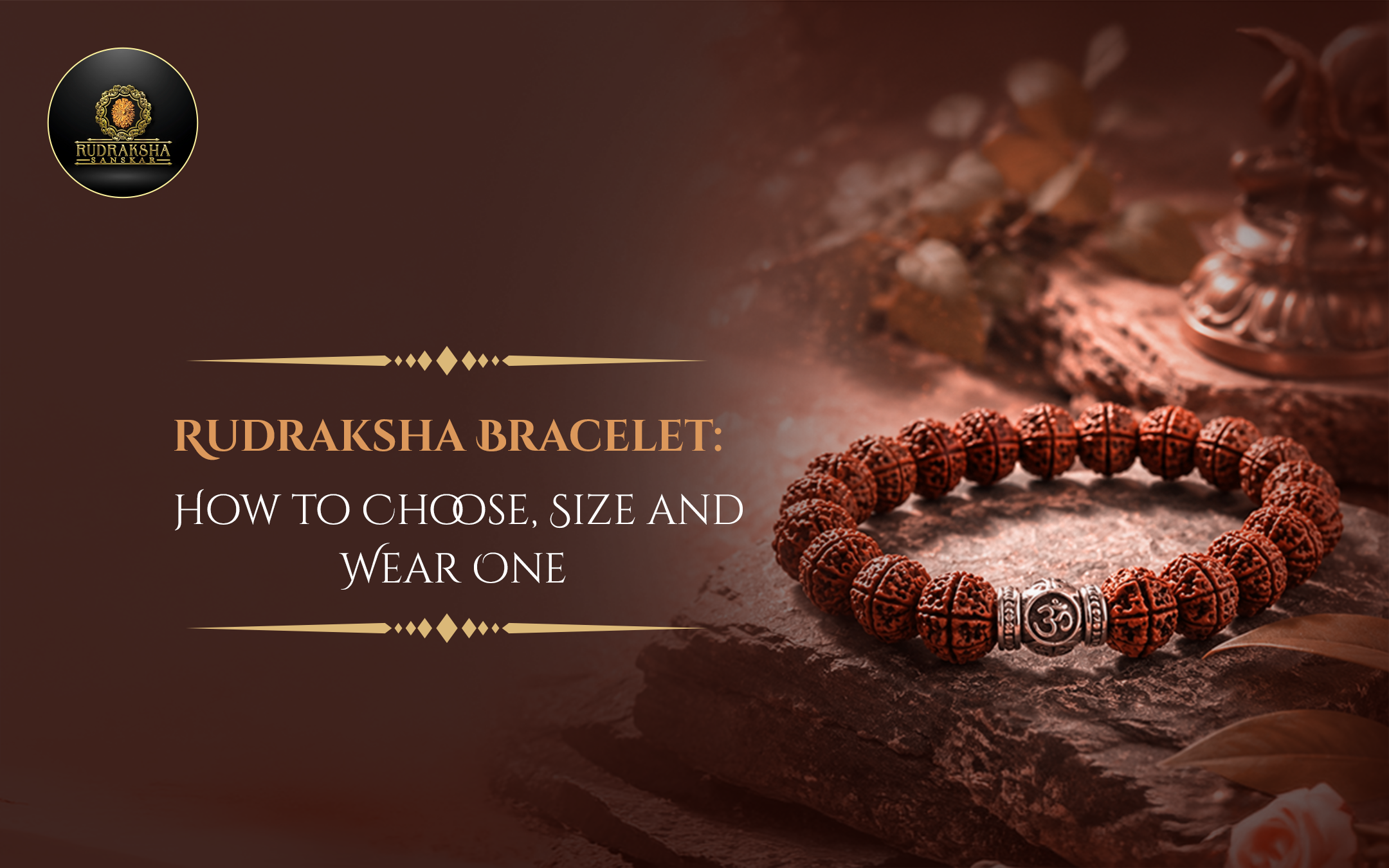
A Rudraksha bracelet is one of the easiest ways to include Rudraksha in everyday wear.
It is compact, practical and usually easier to manage than a full mala around the neck. But buying one should involve more than choosing whichever bracelet looks best in a product photograph.
The Mukhi matters.
The bead size matters.
Your wrist size matters.
And if the bracelet is being sold as genuine Rudraksha, the authenticity of the beads matters more than the metal spacers or decorative design around them. You can shop our other authentic rudraksha wearables from our official online Rudraksha store.
Here is what to check before choosing a Rudraksha bracelet for daily wear.
Why Choose a Rudraksha Bracelet Instead of a Mala?
A bracelet and a mala serve slightly different purposes.
A traditional Rudraksha mala is often chosen for:
- mantra japa
- meditation
- longer spiritual practice
- wearing around the neck
A bracelet is generally better suited to:
- everyday wear
- people who prefer something compact
- professionals who want a less prominent format
- first-time Rudraksha wearers
- combining a few specifically chosen beads
Neither format is spiritually “stronger” simply because it contains more Rudraksha.
Choose according to how you actually intend to use it.
If you know you will regularly chant with 108 beads, a mala makes more sense.
If you want Rudraksha to remain comfortably part of your normal day, a bracelet may be more practical.
Which Mukhi Should You Choose for a Rudraksha Bracelet?
Do not begin with the bracelet design.
Begin with why you want to wear Rudraksha.
5 Mukhi for Everyday Wearing
For most beginners, 5 Mukhi Rudraksha remains the simplest option.
It is traditionally associated with:
- Shiva worship
- meditation
- spiritual discipline
- everyday japa
- general Rudraksha practice
Its wider availability also makes a 5 Mukhi bracelet more accessible than combinations using several rare Mukhi.
4 Mukhi for Learning and Communication
Someone whose main focus is study, knowledge or communication may consider 4 Mukhi.
It is traditionally associated with learning, expression and intellectual clarity.
6 Mukhi for Confidence and Expression
6 Mukhi may be more relevant where the intention centres around:
- confidence
- communication
- self-expression
- professional interaction
7 Mukhi for Stability
7 Mukhi is traditionally associated with stability, material discipline and Saturn-related guidance.
Higher Mukhi Bracelets
Bracelets can also incorporate rarer Mukhi such as:
But this changes the buying decision significantly.
A bracelet containing expensive individual Mukhi should be evaluated as a Rudraksha combination, not merely as jewellery.
You should know which bead is which and why each one has been included.
Single-Mukhi Bracelet or Combination Bracelet?
Both formats can make sense.
Single-Mukhi Bracelet
This uses the same Mukhi throughout.
A 5 Mukhi bracelet is the simplest example.
Choose this if:
- you are new to Rudraksha
- you want one clear traditional purpose
- you prefer a straightforward design
- you do not need an elaborate combination
Combination Bracelet
A combination bracelet contains different Mukhi selected around several traditional intentions.
For example, someone may see combinations built around:
- career
- communication
- confidence
- relationships
- business
- spiritual practice
Do not assume that adding more Mukhi makes a bracelet better.
Every additional bead should have a reason for being there.
A bracelet containing five different Rudraksha you understand is a better purchase than one containing ten beads chosen because the product title says “complete success bracelet.”
What Rudraksha Bead Size Is Best for a Bracelet?
This is partly a comfort decision.
Larger Rudraksha are visually prominent, but several large Nepali beads together can make a bracelet bulky.
Smaller beads generally sit more comfortably around the wrist.
Smaller Beads
Better for:
- lighter bracelets
- slimmer wrists
- everyday office wear
- people who prefer a subtle appearance
- bracelets with more beads
Indonesian Rudraksha are naturally smaller and are therefore commonly suited to compact malas and bracelets.
Medium Beads
These offer a balance between:
- visible Rudraksha texture
- comfort
- weight
- everyday practicality
Large Nepali Beads
Large Nepali Rudraksha can look impressive because of their deeper texture and prominent Mukhi lines.
But imagine placing seven or eight large 25–30 mm beads around your wrist.
The bracelet may technically fit, yet be uncomfortable for typing, driving or everyday movement.
Larger is not automatically better for bracelet use.
Rudraksha Sanskar’s current guidance similarly notes that bead size affects comfort and that larger beads can become heavy during extended wear.
How Do You Measure Your Wrist for a Rudraksha Bracelet?
Do not choose only by labels such as:
Small, Medium or Large.
Measure your wrist.
Step 1: Measure the Wrist
Use a flexible measuring tape around the point where you normally wear a bracelet.
Do not pull it excessively tight.
If you do not have a measuring tape, use a thread and then measure that thread against a ruler.
Step 2: Decide the Fit You Prefer
For a close fit, only a small amount of additional room is needed.
For a more relaxed bracelet, allow slightly more space.
The finished size must also account for the thickness of the Rudraksha beads, particularly when the beads are large.
A string with a 17 cm circumference does not necessarily fit like a 17 cm bracelet once thick Rudraksha are placed around it.
Step 3: Consider Whether It Is Adjustable
Adjustable thread bracelets give more flexibility.
Fixed silver, gold or metal designs require more accurate wrist sizing before purchase.
When ordering a fixed bracelet, ask for the finished internal circumference, not just the overall length of the thread or chain.
Thread, Elastic, Silver or Gold: Which Is Better?
The material holding the Rudraksha does not determine whether the beads are genuine.
It mainly affects:
- comfort
- appearance
- durability
- price
- maintenance
Thread
Traditional and lightweight.
Good for someone prioritising simplicity.
Check that:
- the thread is durable
- knots are secure
- beads do not rub excessively against one another
Elastic
Convenient for wearing and removing.
But elastic naturally loses tension over time and may eventually require restringing.
Silver
Silver capping or spacers can make the bracelet more structured and jewellery-like.
It can be useful when someone wants something suitable for both spiritual and professional everyday wear.
Gold
Gold substantially increases the jewellery cost.
Remember that you are then paying for two different things:
- the Rudraksha
- the precious metal
Do not mistake a high gold value for evidence that the Rudraksha itself is rare or authentic.
Which Wrist Should You Wear a Rudraksha Bracelet On?
There is no need to turn this into an unnecessarily rigid rule.
Different traditions may recommend a particular hand depending on:
- gender
- spiritual practice
- the Mukhi
- the purpose of wearing it
For ordinary daily Rudraksha wearing, comfort and consistency matter.
If your guru or established family tradition prescribes a specific wrist, follow that practice.
Otherwise, choose the wrist on which the bracelet:
- sits comfortably
- does not interfere with work
- is less likely to be struck
- can remain clean
Someone working at a computer all day may find that a large bracelet on the dominant hand constantly hits the desk.
Practicality matters too.
How Tight Should a Rudraksha Bracelet Be?
It should not restrict circulation.
A good bracelet should:
- sit securely
- move slightly
- not leave deep pressure marks
- not slide continuously over the hand
- not pull excessively on the Rudraksha holes
Too tight and it becomes uncomfortable.
Too loose and repeated movement can strain the stringing and cause the beads to hit surfaces.
If the bracelet leaves significant marks or causes tingling, it is too tight.
How Should You Start Wearing a Rudraksha Bracelet?
If you follow an existing family or guru-led practice, use that.
Otherwise, a simple Shiva-centred initiation is enough.
You can:
- Bathe and wear clean clothes.
- Keep the bracelet in your puja space.
- Offer your normal prayer to Lord Shiva.
- Chant Om Namah Shivaya.
- Wear the bracelet.
Monday is commonly chosen for Rudraksha initiation, although different Mukhi may also have traditionally associated days.
You do not need an elaborate “activation package” for a bracelet.
Can You Wear a Rudraksha Bracelet All Day?
Generally, Rudraksha is intended for regular use, but practical care is important.
Remove or protect the bracelet where it may be exposed to:
- swimming-pool chemicals
- salon chemicals
- heavy soap exposure
- oil massage
- strenuous work where the beads may be struck
- activities likely to damage the stringing
Rudraksha Sanskar’s current care guidance similarly recommends protecting beads from chemical exposure and physical impact.
After wearing it regularly, inspect the thread or elastic occasionally.
The Rudraksha may last for years, but the string holding it may not.
How Do You Check Whether a Rudraksha Bracelet Is Original?
Do not let the finished jewellery hide the beads.
Check the Mukhi Lines
The faces should form naturally.
Be cautious with:
- sharp artificial grooves
- suspiciously perfect lines
- excessive polish
- filled or repaired areas
Ask What Exactly Is Certified
This question is especially important for bracelets.
Does the certificate cover:
every individual bead?
the selected rare Mukhi?
or
the bracelet as one product?
A generic certificate photograph does not automatically authenticate every Rudraksha in a multi-bead bracelet.
Rudraksha Sanskar’s existing buying guidance also recommends checking whether certification applies to individual beads or to the finished mala/product as a whole.
Higher Mukhi Need More Scrutiny
If the bracelet includes a rare 11, 12, 13 or 14 Mukhi, ask for specimen-level identification where applicable.
For a general authenticity checklist, use the original Rudraksha identification guide.
Choose the Bracelet You Will Actually Wear
The best Rudraksha bracelet is not necessarily the one with the most Mukhi, the largest beads or the most expensive silver work.
It is the one that makes sense for your purpose and fits comfortably enough to become part of your normal routine.
Start with the Mukhi.
Then choose the bead size.
Measure your wrist.
Check the stringing.
Understand exactly what is certified.
And if rare Rudraksha are included, verify those beads individually before paying the premium.
A bracelet can make Rudraksha easier to wear every day.
It should not make the buying decision less careful.
If you plan to buy rudraksha online, compare the available Rudraksha options from Rudraksha Sanskar and choose the Mukhi, bead size and wearing format that best fit your daily practice.
FAQs
For most beginners, 5 Mukhi is the simplest everyday option. More specialised Mukhi can be chosen where there is a clear traditional purpose.
Yes. Rudraksha can be worn in different forms, including bracelets, pendants and malas.
It should sit securely but comfortably without restricting circulation or constantly sliding across the wrist.
Practices differ. If you do not follow a specific spiritual instruction, choose the wrist that allows comfortable and respectful daily wear.
Yes. Rudraksha wearing is not inherently restricted to men.
Some people wear Rudraksha continuously while others remove it during sleep according to family custom. If the bracelet is large or uncomfortable, removing and keeping it in a clean place may also be more practical.
Regular exposure to soaps, shampoos and chemicals is best avoided to protect both the beads and the stringing.
No. Price can rise because of rare Mukhi, bead size, origin, certification and precious-metal work. Higher cost does not guarantee greater spiritual effect.
 1MK(Underdeveloped) 24.2mm 4.29gm