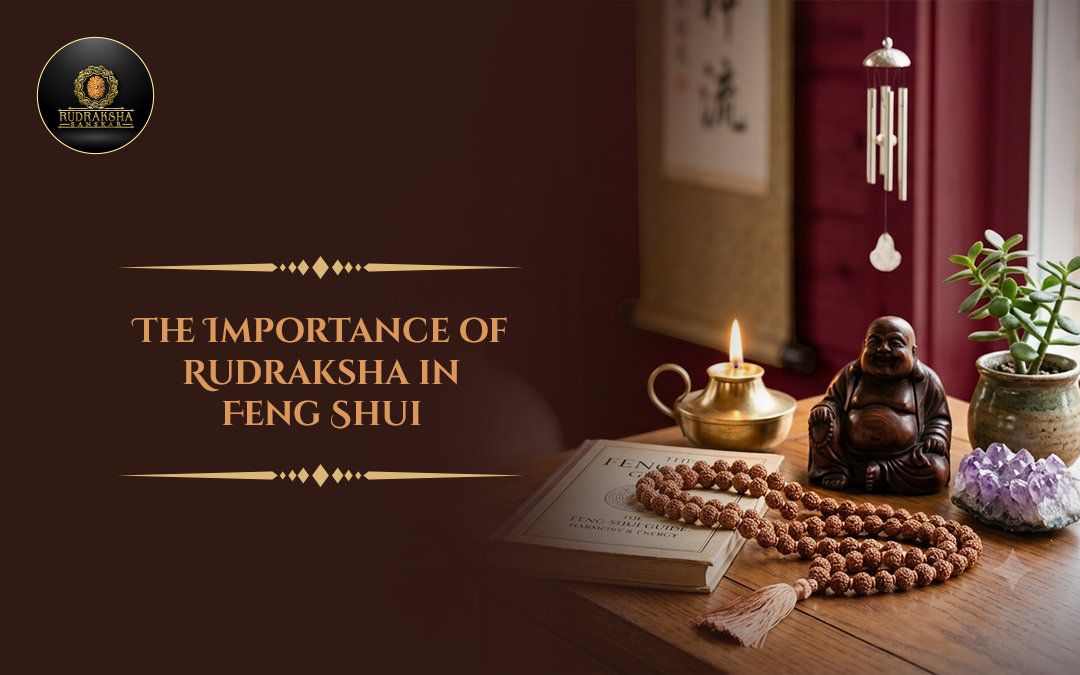
Creating a peaceful and balanced home is important to many people. From arranging furniture to selecting meaningful decorative objects, different cultures have developed traditional practices for making living spaces feel more harmonious.
Two such traditions are Feng Shui and the spiritual use of Rudraksha.
Feng Shui originated in China and focuses on the relationship between people and their surrounding environment. Rudraksha, on the other hand, holds religious significance in Hindu traditions, particularly in connection with Lord Shiva.
Today, some people combine these practices by incorporating Rudraksha into their homes, meditation areas and workspaces.
But what is the importance of Rudraksha in Feng Shui, and does this combination have any traditional basis?
Let’s explore the differences between these practices, their symbolic connections and how Rudraksha can be incorporated into a thoughtfully arranged space.
What Is Feng Shui?
Feng Shui is a traditional Chinese practice concerned with the arrangement of buildings, objects and surrounding environments.
The term Feng Shui translates to “wind and water.”
Its principles are associated with the concept of Qi, often described as the vital energy flowing through an environment.
Traditional Feng Shui considers several factors, including:
- The orientation of buildings and rooms
- The arrangement of furniture
- Natural light and ventilation
- The five elements: wood, fire, earth, metal and water
- The relationship between indoor spaces and their surroundings
Different schools of Feng Shui use different methods to evaluate spaces.
Although Feng Shui is culturally significant, claims that particular arrangements directly improve wealth, health or relationships are not scientifically established.
What Is Rudraksha and Its Spiritual Significance?
Rudraksha refers to the naturally formed seeds of trees belonging to the Elaeocarpus genus, particularly Elaeocarpus ganitrus.
The beads are traditionally associated with Lord Shiva and are used in Hindu devotional practices.
Rudraksha beads have natural facial divisions known as Mukhi.
Different Mukhi varieties carry different religious associations in various traditions.
For example, the 5 Mukhi Rudraksha is commonly used in prayer and meditation, while Gauri Shankar Rudraksha symbolises the union of Shiva and Parvati.
These associations explain why devotees may choose to wear Rudraksha or keep it in a personal worship space.
Is Rudraksha Traditionally Part of Feng Shui?
This is an important distinction.
Rudraksha is not a traditional or essential component of classical Chinese Feng Shui.
Its primary religious and cultural roots lie in Hindu traditions.
The practice of placing Rudraksha in Feng Shui-inspired spaces is better understood as a modern combination of two separate cultural systems.
Some people appreciate the symbolism of both practices and choose to incorporate them into their homes.
However, there is no universally accepted classical Feng Shui rule prescribing a particular Mukhi Rudraksha for wealth, relationships or specific directions.
Understanding this distinction helps avoid misleading claims about the bead’s historical role.
The Importance of Rudraksha in Feng Shui-Inspired Spaces
Although Rudraksha is not a classical Feng Shui object, it may have personal significance when included in a carefully arranged living space.
1. A Symbol of Spiritual Awareness
For Shiva devotees, Rudraksha represents devotion and spiritual reflection.
Keeping a bead in a meditation area may serve as a reminder to maintain a consistent spiritual routine.
Its importance comes from the meaning the individual associates with it, rather than a proven ability to alter environmental energy.
2. A Meaningful Addition to Meditation Areas
Many people use Feng Shui-inspired principles to create quiet, uncluttered spaces.
Rudraksha can complement such an environment for individuals who already use it in prayer or meditation.
A 5 Mukhi mala, for example, can be kept in a clean meditation area and used during mantra Japa.
3. A Reminder of Balance and Harmony
Certain Rudraksha varieties carry symbolism related to unity and togetherness.
The Gauri Shankar Rudraksha is traditionally associated with Shiva and Parvati.
Some devotees may choose it as a symbolic reminder of mutual respect and family harmony.
However, its presence does not automatically improve relationships.
4. A Connection With Natural Materials
Rudraksha is a natural seed, and its organic appearance can complement interiors that incorporate wood, plants and other natural materials.
In Feng Shui, wood is one of the five elements.
However, simply being a natural seed does not establish a classical Feng Shui classification or specific elemental function for Rudraksha.
Its use in this context remains a personal design and spiritual choice.
Which Rudraksha Can You Keep in Your Home?
If you appreciate both Feng Shui-inspired design and Rudraksha traditions, several varieties may be meaningful.
5 Mukhi Rudraksha for Meditation
The 5 Mukhi is traditionally associated with Kalagni Rudra, a form of Lord Shiva.
It is widely used for mantra Japa and devotional practice.
Suggested use: Keep a 5 Mukhi mala in a dedicated prayer or meditation space.
2 Mukhi Rudraksha for Unity Symbolism
The 2 Mukhi Rudraksha is commonly associated with Ardhanarishvara, the united form of Shiva and Shakti.
Its symbolism includes unity and complementary qualities.
Suggested use: Place it respectfully in a family worship space if the association is meaningful to you.
7 Mukhi Rudraksha for Prosperity Symbolism
The 7 Mukhi Rudraksha is associated with Goddess Mahalakshmi in several contemporary Rudraksha traditions.
Its traditional symbolism includes abundance and prosperity.
Suggested use: Include it in a home Puja arrangement dedicated to Lakshmi worship.
It should not be described as a classical Feng Shui wealth cure.
8 Mukhi Rudraksha for New Beginnings
The 8 Mukhi Rudraksha is commonly associated with Lord Ganesha.
Ganesha represents wisdom and new beginnings in Hindu traditions.
Suggested use: Keep it in a personal worship area or on a clean devotional shelf in your workspace.
Gauri Shankar Rudraksha for Togetherness
Gauri Shankar consists of two naturally joined Rudraksha structures.
It symbolises the divine union of Shiva and Parvati.
Suggested use: Display it respectfully in a family prayer space.
This is a Hindu devotional association rather than a traditional Feng Shui relationship remedy.
Where Should You Place Rudraksha in a Feng Shui-Inspired Home?
There is no universal Feng Shui direction specifically prescribed for Rudraksha.
However, you can select a location based on practical considerations and personal spiritual preferences.
| Location | Suggested use |
| Meditation corner | Keep a 5 Mukhi mala for prayer |
| Home temple | Arrange Rudraksha with devotional objects |
| Study room | Keep a bead as a personal spiritual reminder |
| Office prayer shelf | Display a Rudraksha respectfully |
| Family worship area | Keep Gauri Shankar or 2 Mukhi |
Avoid claiming that placing a specific Rudraksha in the southeast, southwest or another Bagua sector will guarantee a particular outcome.
Such directional prescriptions are not established rules of classical Feng Shui.
Can Rudraksha Improve Positive Energy in Your Home?
In spiritual discussions, Rudraksha is sometimes described as a bead associated with positive energy.
However, this expression requires careful interpretation.
There is no reliable scientific evidence that placing Rudraksha in a room changes measurable environmental energy, eliminates negative forces or produces financial success.
For devotees, the bead may have emotional and spiritual significance because it represents faith, meditation and personal values.
Similarly, a clean, organised and comfortable environment may help people feel more relaxed and focused.
These practical benefits should not be confused with unverified claims about supernatural effects.
How to Choose an Original Rudraksha for Your Home
If you decide to purchase Rudraksha for a meditation space or home temple, authenticity should be a priority.
Consider these points:
Natural Mukhi lines: Examine the bead’s facial divisions and look for artificial carving.
Specimen photographs: Request clear images of the actual Rudraksha.
Reliable documentation: For expensive varieties, review specimen-specific authentication reports.
Natural structure: Be especially careful with joined varieties such as Gauri Shankar.
Transparent pricing: Do not assume that a more expensive bead is automatically more spiritually meaningful.
Avoid sellers who promise that a particular Rudraksha will instantly attract money, remove negativity or correct every Feng Shui problem.
For further guidance, read how to identify an original Rudraksha.
FAQs
No. Rudraksha originates from Hindu devotional traditions and is not an established component of classical Chinese Feng Shui.
The 5 Mukhi is commonly used in meditation and prayer. Its suitability depends on personal beliefs rather than proven environmental effects.
Yes. You may keep it in a clean, protected location if that aligns with your religious practices.
The 7 Mukhi has prosperity-related associations in some Rudraksha traditions, but it is not a classical Feng Shui wealth remedy and does not guarantee financial gains.
Yes. You can combine decorative and devotional objects according to your preferences while respecting their different cultural origins.