Sawar Rudraksha is one of those names that can sound more complicated than it actually is.
The confusion usually starts because Sawar Rudraksha and Ganesh Rudraksha are often listed together, and some rare beads can even show characteristics of both formations.
But they are not the same thing.
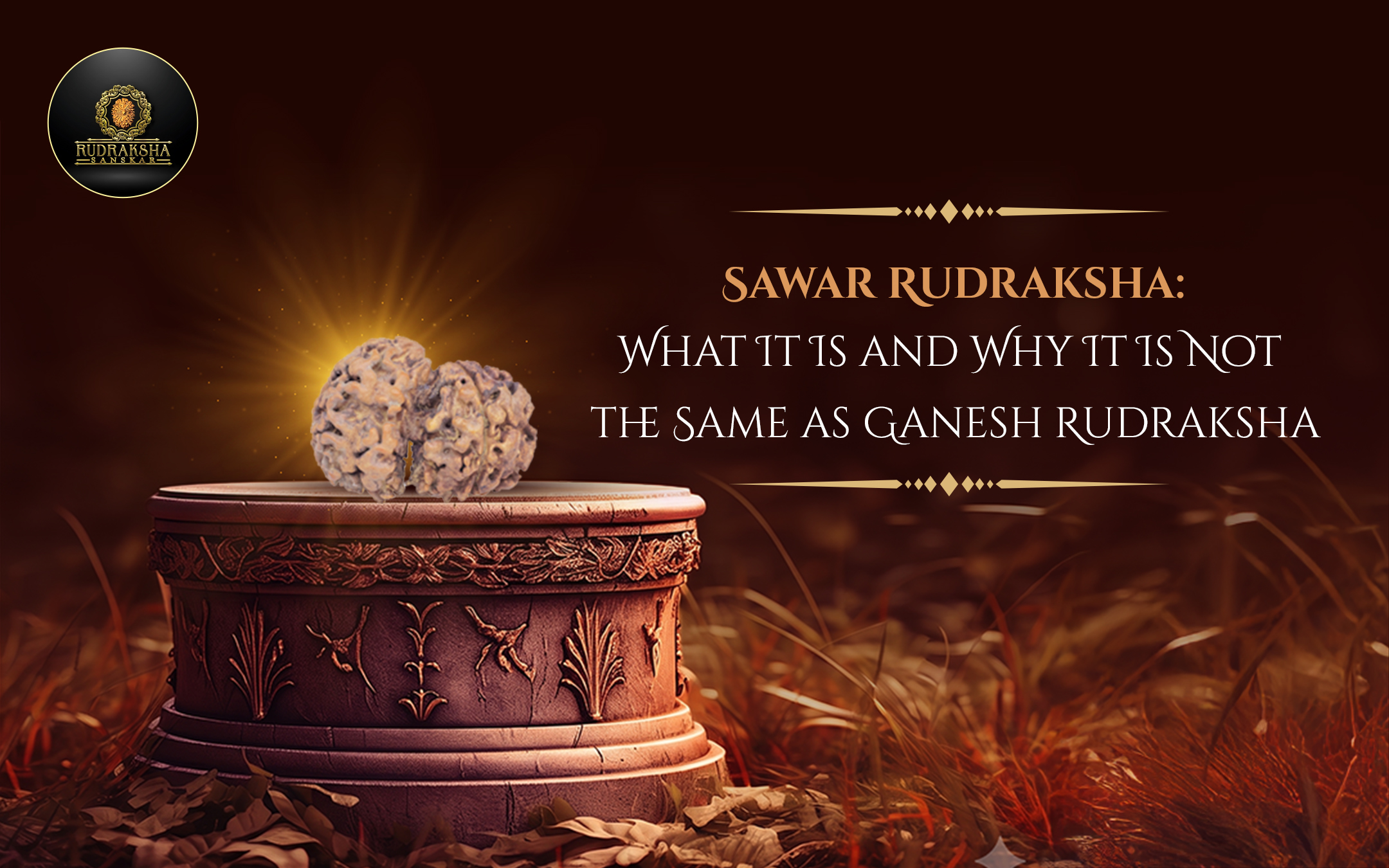
A Sawar Rudraksha is identified by a smaller Rudraksha formation naturally attached to a larger main bead, creating a rider-like appearance. Rudraksha Sanskar describes it as a rare natural formation where the smaller section appears to sit on the larger bead like a sawar, or rider.
A Ganesh Rudraksha, on the other hand, is identified by a naturally formed trunk-like protrusion resembling Lord Ganesha.
Both are rare formations.
They are simply rare for different physical reasons.
What Is a Sawar Rudraksha?
The word Sawar refers to a rider.
That gives the formation its name.
In a natural Sawar Rudraksha, a smaller bead-like growth develops attached to the main Rudraksha, creating the appearance of one form sitting on another. Rudraksha Sanskar’s current catalogue describes Sawar specifically through this smaller-on-larger natural structure.
This also explains names such as:
- 6+1 Sawar
- 7+1 Sawar
- 8+1 Sawar
The first number refers to the main Mukhi classification.
The “+1” refers to the additional attached natural formation.
For example, Rudraksha Sanskar currently lists certified Sawar/Ganesh 8+1 pieces from Nepal with individual certificate numbers, dimensions and weights.
The important point is that Sawar is not a separate Mukhi number by itself.
It is a formation added to the underlying Mukhi identity.
Why Is Sawar Rudraksha Considered Rare?
Most Rudraksha develop as individual seeds.
Sawar requires an unusual natural growth where the smaller secondary formation remains connected with the main bead.
That does not happen with every tree or every harvest.
This natural irregularity is what creates both the visual distinction and the rarity.
But rare should not automatically be interpreted as:
better for everyone
or
more spiritually powerful than every regular Mukhi.
Rarity explains why buyers may pay more for an unusual specimen.
It does not automatically tell you whether the bead suits your spiritual practice.
What Is Ganesh Rudraksha?
A Ganesh Rudraksha is another naturally unusual Rudraksha formation.
Instead of a smaller bead sitting on a larger one, its defining characteristic is a natural protrusion resembling the trunk of Lord Ganesha.
Rudraksha Sanskar’s current Ganesh collection includes Mukhi-specific examples such as 11 Mukhi Ganesh Rudraksha, showing that Ganesh formation can appear on different underlying Mukhi.
That is why “Ganesh” should not be treated as a Mukhi number.
It describes a natural physical characteristic.
Sawar vs Ganesh Rudraksha: The Difference
The simplest way to understand the difference is to look at what makes each formation special.
| Feature | Sawar Rudraksha | Ganesh Rudraksha |
| Identified by | Smaller natural formation attached to main bead | Natural trunk-like protrusion |
| Appearance | Rider-like, one form sitting on another | Resembles Ganesha’s trunk |
| Classification | Formation-based | Formation-based |
| Can occur with different Mukhi? | Yes | Yes |
| Example naming | 7+1 Sawar, 8+1 Sawar | 10 Mukhi Ganesh, 11 Mukhi Ganesh |
| Main verification point | Natural attachment | Natural protrusion |
Rudraksha Sanskar itself makes this distinction clearly: Sawar refers to a smaller bead naturally attached to a larger one, while Ganesh refers to the trunk-like formation.
Can One Rudraksha Be Both Sawar and Ganesh?
Yes.
This is where the naming can become confusing again.
A bead can theoretically show:
- an underlying Mukhi count
- a Sawar-style attached formation
- and a Ganesh-like protrusion
That is why Rudraksha Sanskar has live products categorised as Sawar/Ganesh (8+1) rather than forcing the bead into only one label.
So when you see a product name such as:
Sawar/Ganesh 8+1
it does not mean Sawar and Ganesh are interchangeable terms.
It means the individual specimen shows more than one notable natural characteristic.
This is exactly why rare Rudraksha should be judged from the actual bead, not just from the product title.
What Is Sawar Rudraksha Traditionally Associated With?
Because Sawar is primarily a rare natural formation rather than a standard Mukhi category, its interpretation can vary depending on the Mukhi of the main bead.
For example, a 7+1 Sawar and an 8+1 Sawar should not automatically be treated as spiritually identical.
The underlying Mukhi still matters.
Rudraksha Sanskar currently groups Sawar and Ganesh formations around themes such as:
- new beginnings
- overcoming obstacles
- focus
- clarity
- progress
- spiritual growth
But the exact traditional association should always be read together with the Mukhi count rather than from the word “Sawar” alone.
That is a more accurate way to choose the bead.
Who Should Consider Sawar Rudraksha?
Sawar is usually more relevant to someone who:
Already Understands Basic Mukhi Selection
If this is your very first Rudraksha, you probably do not need to begin with a rare natural formation.
A 5 Mukhi Rudraksha remains a simpler option for general Shiva worship and daily practice.
Wants a Specific Rare Formation
Collectors and experienced Rudraksha wearers may value Sawar specifically because of how unusually it develops.
In that case, rarity itself may form part of the interest.
Has Chosen the Underlying Mukhi for a Reason
A better buying sequence is:
first understand the Mukhi → then consider whether the Sawar formation adds meaning for you.
Not:
buy Sawar because it is rare → figure out the Mukhi later.
Values a Bead With Unique Natural Structure
Some wearers are drawn to unusual Rudraksha formations because the physical structure itself has devotional meaning for them.
That is valid.
Just keep the distinction between spiritual symbolism and guaranteed outcomes clear.
How Do You Verify a Natural Sawar Rudraksha?
Because Sawar depends entirely on the smaller attached formation being natural, that is where verification should begin.
Look Closely at the Attachment
The secondary formation should appear organically connected to the primary bead.
Be cautious if you notice:
- visible glue
- filler
- a mechanically smooth joining line
- mismatched texture
- signs that two separate beads have been attached afterward
Check the Surface From Multiple Angles
For a rare formation, a single front photograph is not enough.
Ask for:
- front view
- rear view
- side view
- close-up of the attached section
The physical relationship between the two forms should be easy to inspect.
Check the Underlying Mukhi
Do not become so focused on the “+1” formation that you ignore the main bead.
If the product is described as an 8+1 Sawar, the main Rudraksha should still show the claimed 8 Mukhi structure.
Match the Certificate With the Exact Bead
Rudraksha Sanskar’s current Sawar/Ganesh inventory provides individual information including:
- certificate number
- dimensions
- weight
- origin
For example, current 8+1 Sawar/Ganesh pieces are separately listed with their own DCL certificate references and measurements.
That specimen-level information is particularly important when the rarity itself contributes to the price.
For broader checking, use the original Rudraksha identification guide.
The “+1” Is the Clue
The easiest way to understand Sawar Rudraksha is to stop treating it like another Mukhi number.
The main number tells you the Mukhi.
The +1 tells you there is an additional natural attached formation.
Ganesh is different. Its identity comes from a trunk-like protrusion.
Both formations can be rare. Both can occasionally appear on the same specimen. But they should not be used as interchangeable names.
If you are considering Sawar, first understand the underlying Mukhi, then inspect the natural attachment carefully, and finally make sure the certificate and specifications belong to that exact bead.
If you plan to buy Rudraksha online, review the Sawar and Ganesh Rudraksha collection from a trusted seller like Rudraksha Sanskar and compare the actual formation, Mukhi and certification details before purchasing.
FAQs
Sawar is a rare natural formation where a smaller Rudraksha develops attached to a larger main bead, giving a rider-like appearance.
The “8” refers to the underlying 8 Mukhi main bead, while “+1” refers to the additional attached natural formation.
No. Sawar is identified by the smaller attached bead-like formation. Ganesh Rudraksha is identified by a natural trunk-like protrusion.
Yes. Rudraksha Sanskar currently lists Sawar/Ganesh 8+1 specimens where multiple natural characteristics appear on the same bead.
Yes. Its unusual naturally attached formation makes it less common than regular single-seed Rudraksha.
Start with the Mukhi of the main bead and its traditional association. Treat the Sawar formation as an additional characteristic rather than choosing from rarity alone.