Most Rudraksha are single beads.
Gauri Shankar forms when two Rudraksha naturally grow joined together.
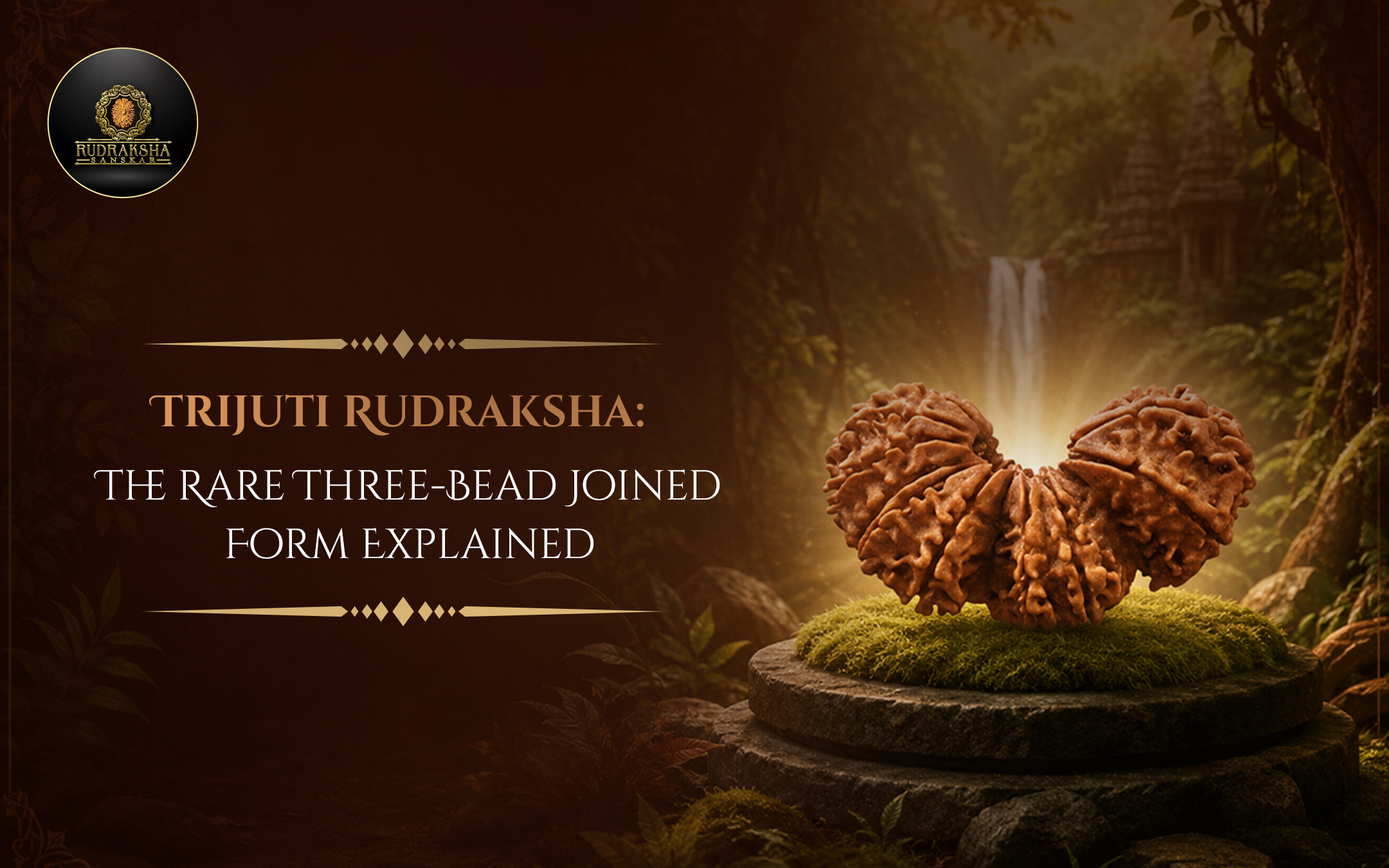
Trijuti Rudraksha goes one step further: three Rudraksha seeds grow naturally joined into a single formation.
That unusual structure is what makes Trijuti one of the rarest forms found in the Rudraksha market.
Traditionally, the three joined sections represent the Trimurti: Brahma, Vishnu and Mahesh, symbolising creation, preservation and transformation.
But rarity also creates a problem.
The more unusual and valuable a Rudraksha formation becomes, the more important it is to verify that what you are looking at actually formed naturally rather than being assembled afterward.
So before considering a Trijuti Rudraksha, it helps to understand what the formation really is and who it is actually suited to.
What Is Trijuti Rudraksha?
A Trijuti Rudraksha forms when three separate Rudraksha sections naturally develop together and remain fused into one structure.
The name itself points toward this three-part union.
Unlike Mukhi classification, Trijuti does not refer to a fixed number of faces.
A Trijuti specimen can still have its own underlying Mukhi characteristics.
That means the correct way to think about it is:
Mukhi = natural face count
Trijuti = three-bead natural formation
Rudraksha Sanskar’s current Trijuti collection demonstrates this clearly with individually identified pieces, including different Mukhi Trijuti specimens rather than one fixed “Trijuti Mukhi.”
Why Is Trijuti Considered So Rare?
Two Rudraksha naturally joining is already unusual.
Three naturally growing together is significantly less common.
That rarity comes from the physical formation itself.
For a genuine Trijuti, all three sections have to develop together naturally rather than being:
- glued
- tied together
- filled at the joints
- mechanically shaped
- artificially fused
That makes naturally occurring specimens limited.
It also means a genuine Trijuti can command a considerable premium compared with common single Rudraksha.
But price should follow verification.
Not the other way around.
What Does Trijuti Rudraksha Traditionally Represent?
The three joined sections are traditionally connected with the Trimurti.
Brahma: Creation
Brahma represents the force of creation and new ideas.
In practical symbolism, this can relate to:
- beginning something new
- vision
- creativity
- building
- generating ideas
Vishnu: Preservation
Vishnu represents stability and preservation.
This introduces the themes of:
- maintaining what has been built
- balance
- responsibility
- continuity
- steadiness
Mahesh: Transformation
Mahesh or Shiva represents transformation.
This is associated with:
- letting go
- changing direction
- deeper spiritual awareness
- transformation through experience
Together, the three sections are traditionally understood as representing balance between creating, sustaining and transforming.
That is why Trijuti is usually discussed as a higher-level spiritual or leadership bead rather than something selected for one narrow everyday concern.
Who Should Consider Wearing Trijuti Rudraksha?
Trijuti is not necessarily a first Rudraksha.
It is generally more relevant for someone who already understands why they want such a rare formation.
Experienced Spiritual Practitioners
Someone already involved in:
- meditation
- mantra
- Shiva worship
- regular sadhana
- deeper spiritual study
may value the three-part symbolism more meaningfully than a first-time buyer.
People in Leadership Roles
Leadership involves more than taking action.
A leader has to know:
when to create, when to maintain and when to change.
That makes the Trimurti symbolism especially relevant to:
- business owners
- founders
- senior managers
- decision-makers
- people carrying large responsibilities
This should still be understood symbolically.
A Trijuti does not replace judgment, experience or leadership skills.
Serious Rudraksha Collectors
Some people value Trijuti primarily because of its natural rarity.
For collectors, the exact formation, Mukhi structure, origin, size and certification become particularly important.
People Looking for a Broad Spiritual Symbol
Most Mukhi have a more focused traditional association.
Trijuti represents a wider idea of balance across multiple forces.
Someone looking for that broader symbolism may find it more appropriate than selecting one Mukhi for a specific purpose.
Who Probably Does Not Need Trijuti Yet?
Someone Buying Their First Rudraksha
If you are completely new to Rudraksha, starting with something this rare is usually unnecessary.
A 5 Mukhi Rudraksha gives a beginner a much simpler introduction to daily wearing, japa and Rudraksha care.
Someone Looking for a Quick Solution
Trijuti should not be sold as a guaranteed way to:
- grow a business
- become wealthy
- gain authority
- remove every planetary issue
- achieve instant spiritual advancement
Its traditional value lies in symbolism and spiritual practice, not a guaranteed outcome.
Someone Buying Only Because It Is Rare
Rarity makes something collectible.
It does not automatically make it suitable.
If the only reason is “this is one of the rarest Rudraksha,” that may not be enough reason to wear one.
Trijuti vs Gauri Shankar: What Is the Difference?
This distinction is simple.
A Gauri Shankar Rudraksha is formed when two Rudraksha naturally grow joined together.
A Trijuti is formed when three Rudraksha naturally join.
Their symbolism also differs.
| Formation | Natural Structure | Traditional Symbolism |
| Gauri Shankar | Two joined Rudraksha | Shiva-Parvati, partnership and unity |
| Trijuti | Three joined Rudraksha | Brahma-Vishnu-Mahesh, creation, preservation and transformation |
Neither should be considered universally better.
They represent different natural formations and different traditional ideas.
How Do You Verify a Natural Trijuti Rudraksha?
This is where the buying decision becomes serious.
Because the entire value of Trijuti depends on three sections being naturally joined, inspect the joints carefully.
Check All Three Connections
The formation should look organically grown rather than assembled.
Be cautious if you notice:
- visible glue
- filler material
- perfectly straight joining lines
- artificial smoothing
- sudden changes in surface texture
Look at the Surface Continuity
Natural Rudraksha is irregular.
The texture across the three sections should look consistent with natural growth.
If one part appears polished differently or looks like a separate bead attached afterward, investigate further.
Ask for Multiple Angles
A premium Trijuti should not be purchased from one front-facing photograph.
Ask to see:
- front
- back
- left side
- right side
- close-up of each natural joint
Check the Exact Specimen
Rudraksha Sanskar’s current Trijuti collection lists individual specimens with details such as:
- dimensions
- weight
- certification number
- X-ray number
That specimen-level approach is particularly important with a formation this rare.
Use Certification as Supporting Evidence
For example, current Rudraksha Sanskar Trijuti inventory includes individually certified specimens with their own DCL certification and X-ray references.
A certificate should still correspond to the exact physical bead being purchased.
For the wider verification process, read our guide to identifying an original Rudraksha.
Does Trijuti Rudraksha Cost More?
Generally, genuine Trijuti can command high prices because of its rarity.
The cost can depend on:
But there is no single Trijuti price.
- Mukhi characteristics
- size
- weight
- origin
- quality of natural joining
- physical condition
- certification
- individual rarity
Rudraksha Sanskar’s current catalogue includes certified Trijuti specimens at very different price levels, which is exactly why buyers should compare the specific bead rather than the category name alone.
Rare does not mean the seller can name any price without explanation.
How Is Trijuti Usually Worn?
Trijuti is most commonly treated as an individual spiritual piece rather than a basic everyday mala bead.
It may be:
- worn as a pendant
- kept in a puja space
- used during meditation
- included in a specialised spiritual practice
Monday is commonly considered suitable for beginning a Trijuti practice because of its strong Shiva association.
A simple practice can include Shiva worship and chanting:
Om Namah Shivaya
If your guru or spiritual tradition prescribes another method, follow that instead.
Three Beads Joined Naturally Is the Entire Point
Trijuti Rudraksha is rare because nature has to create something unusual three times over and join it into one structure.
That physical formation gives rise to its traditional symbolism:
Brahma creates.
Vishnu preserves.
Mahesh transforms.
Together, they represent balance across three fundamental forces.
That makes Trijuti meaningful for experienced seekers, leaders, collectors and people who genuinely connect with the Trimurti symbolism.
It does not make it necessary for everyone.
And because rarity carries a premium, never buy one without checking that all three sections are naturally joined and that the certificate belongs to the exact specimen.
If you plan to buy rudraksha online, review the current Trijuti Rudraksha collection and compare the exact formation, Mukhi characteristics and certification before choosing.
FAQs
It is a rare natural formation in which three Rudraksha seeds grow joined together.
It traditionally represents the Trimurti: Brahma, Vishnu and Mahesh.
No. Trijuti describes the three-bead natural formation. The individual specimen can still have its own Mukhi characteristics.
Generally, three naturally joined Rudraksha are considered rarer than the two-bead Gauri Shankar formation.
They can, but most beginners do not need to start with such a rare formation. A simpler Mukhi such as 5 Mukhi is usually more practical.
Check all three natural joints for glue, filler, artificial smoothing, mismatched texture or signs that separate beads have been assembled.
No. Leadership and clarity are traditional associations, not guaranteed professional outcomes.