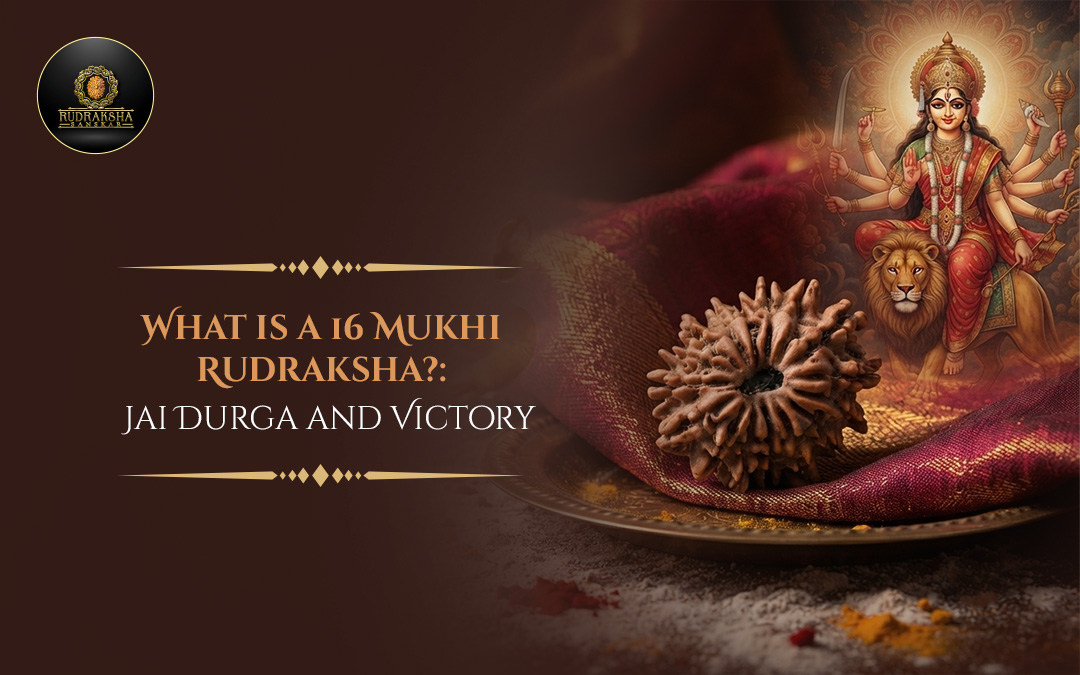
The 16 Mukhi Rudraksha belongs to the rare, premium end of the Rudraksha spectrum.
Traditionally, it is associated with themes of protection, courage, fearlessness and victory over difficult circumstances. This is why descriptions such as “Jai Durga” or “Victory Rudraksha” are sometimes used for it.
But at 16 Mukhi, buyers need to look beyond a simple deity-benefit chart.
Different Rudraksha traditions assign this bead to Mahamrityunjaya Shiva, Mahakala, Lord Rama and, in some later traditions, Durga-related protective forms.
That disagreement matters.
The higher Mukhi range does not have the same clean, universally agreed face-by-face textual attribution that sellers often imply.
Which Deity Is Associated With 16 Mukhi Rudraksha?
One of the most widely followed associations connects 16 Mukhi with Mahamrityunjaya Shiva, the form of Shiva associated with overcoming fear of mortality and maintaining spiritual courage during uncertainty.
Other traditions describe the deity as Mahakala, another protective Shiva form.
Rudraksha Sanskar’s own published material has also used an association with Lord Rama, particularly when explaining the bead through courage, truth and victory.
So where does “Jai Durga” fit?
Durga-oriented interpretations connect the sixteen faces with protective Shakti symbolism and victory over obstacles. This is meaningful within those traditions, but it should not be presented as the one universally settled scriptural attribution.
What Do the Classical Texts Say?
This is where a premium buyer should be sceptical.
The Shiva Purana is one of the principal classical sources repeatedly cited in Rudraksha literature. However, its commonly referenced face-by-face descriptions are much clearer through 14 Mukhi.
Claims that the Shiva Purana unambiguously assigns 16 Mukhi to one particular deity should therefore be accompanied by the exact chapter and verse.
The Padma Purana and Skanda Purana are also regularly invoked in modern Rudraksha literature, but clear and consistent face-specific attribution for 16 Mukhi is harder to establish.
So the responsible conclusion is:
16 Mukhi has a well-established later tradition around protection, fearlessness and victory, but its exact presiding-deity attribution is not uniform across traditions.
Mahamrityunjaya Shiva is one of the most commonly followed associations, while Mahakala, Rama and Durga-related interpretations also occur.
Which Planet Rules 16 Mukhi Rudraksha?
Planetary assignments are similarly inconsistent.
Some modern Rudraksha systems associate 16 Mukhi with the Moon, while others connect it with Saturn or treat it as a deity-specific Rudraksha without assigning one ruling graha.
This should not be disguised as consensus.
If someone is choosing 16 Mukhi specifically for an astrological remedy, the planetary system being followed should be identified first.
A seller should be able to explain why a particular graha has been assigned rather than simply printing it on a chart.
What Does “Victory” Actually Mean?
The word “victory” can easily become exaggerated in Rudraksha marketing.
16 Mukhi should not be presented as a bead that guarantees:
- winning legal disputes
- defeating competitors
- business success
- protection from every accident
- immunity from illness
- success in every risky decision
A more grounded interpretation is victory over fear and the ability to remain steady through adversity.
Traditional associations commonly centre on:
- courage
- fearlessness
- resilience
- stability during uncertainty
- spiritual confidence
- perseverance through difficult circumstances
This makes the bead traditionally relevant to people dealing with significant responsibility, uncertainty or demanding environments.
The spiritual symbolism is about how a person faces difficulty, not a promise that difficulty disappears.
Who Traditionally Wears 16 Mukhi Rudraksha?
Because of its rarity and price, 16 Mukhi is not normally the first Rudraksha a beginner needs.
It may appeal more naturally to:
Experienced Rudraksha Practitioners
Someone who already wears Rudraksha and understands higher Mukhi traditions may choose 16 Mukhi for its protective symbolism.
People Carrying Significant Responsibility
Business owners, senior professionals or people working in demanding environments may connect with its themes of courage and stability.
Spiritual Practitioners
Its Mahamrityunjaya-Shiva association makes it relevant to practitioners whose focus is overcoming fear, particularly fear around uncertainty and impermanence.
Collectors
At this level, some buyers are interested in the bead not only for wearing but because naturally occurring higher Mukhi Nepal specimens are difficult to source.
That is a legitimate reason to own one.
How Rare Is 16 Mukhi Rudraksha?
16 Mukhi sits firmly within the premium 15–21 Mukhi range.
It is substantially less common than ordinary lower Mukhi Rudraksha and is harder to source in large, well-developed Nepal-origin specimens.
However, there is no reliable universal scientific table proving that 16 Mukhi is exactly the “sixth-rarest” Rudraksha or assigning precise production percentages to every Mukhi from 1 to 21.
The defensible statement is simpler:
16 Mukhi is a rare higher-Mukhi category, and supply generally becomes much thinner as you move into the 15–21 range.
Rarity describes natural supply.
It does not prove greater spiritual potency.
What Does a Real 16 Mukhi Rudraksha Cost?
The best way to understand premium Rudraksha pricing is to compare actual specimens rather than quote one generic number.
Current Rudraksha Sanskar inventory provides useful examples:
| Origin | Dimensions | Weight | Certificate | Listed Price |
| Nepal | 31.9 × 24.3 × 21.1 mm | 6.11 g | DCL/2026/A/0201 | ₹1,80,000 |
| Nepal | 32.7 mm | 5.4 g | DCL/2026/A/0194 | ₹2,25,000 |
| Nepal | 33 × 27.4 × 17.6 mm | 7.6 g | DCL/2026/A/0208 | ₹3,00,000 |
| Nepal | 33 × 26.5 × 18.7 mm | 6.77 g | DCL/2026/A/0185 | ₹3,50,000 |
These examples show something important:
Mukhi count alone does not determine price.
At this tier, value is influenced by:
- origin
- dimensions
- weight
- development and shape
- clarity of natural Mukhi lines
- condition
- scarcity of comparable specimens
- certification
- X-ray documentation
- collector demand
A 16 Mukhi is therefore not a commodity with one fixed market price.
Why X-Ray Matters More for 16 Mukhi
Count sixteen natural lines on an irregular seed and authentication becomes considerably more demanding.
That also creates a financial incentive for alteration.
A lower Mukhi bead can potentially be manipulated by carving additional grooves to resemble a rarer category.
This is why premium authentication should go beyond:
“It looks original.”
A current Rudraksha Sanskar 16 Mukhi specimen weighing 7.6 g and measuring 33 × 27.4 × 17.6 mm, for example, carries certificate number DCL/2026/A/0208 and X-ray number 672.
Another 31.9 mm, 6.11 g specimen carries certificate DCL/2026/A/0201 and X-ray number 1027.
For a premium purchase, demand:
- photographs of the exact specimen
- front, back and side views
- fifteen? No: all sixteen natural Mukhi lines
- exact dimensions
- exact weight
- stated origin
- specimen-specific certificate number
- X-ray where available
- confirmation of natural versus artificial faces
The certificate should match the bead being sold.
A generic “lab-certified” badge is not enough.
What Should the X-Ray Show?
X-ray should be considered alongside surface examination rather than as a magical authenticity test on its own.
The purpose is to provide additional information about the bead’s internal compartment structure and whether that structure is consistent with its claimed Mukhi count.
Surface-line analysis is also important because artificial grooves can be carved externally.
For high-value Rudraksha, these forms of evidence should support one another:
physical bead + photographs + surface examination + X-ray + certificate.
The higher the price, the more documentation a buyer should expect.
How Do You Wear 16 Mukhi Rudraksha?
A premium bead does not require a more complicated ritual simply because it costs more.
A simple Shiva-centred wearing vidhi is sufficient:
- Bathe and wear clean clothes.
- Place the Rudraksha in a clean puja space.
- Rinse gently with clean water if required.
- Offer prayer to Shiva according to your tradition.
- Chant the prescribed mantra.
- Take a simple sankalp.
- Wear it as a pendant or keep it in the puja space.
Monday is a natural starting day for a Shiva-oriented practice.
Some traditions also use other days according to the deity or planetary attribution being followed.
Beej Mantra
A commonly followed 16 Mukhi mantra is:
Om Hreem Hoom Namah
Some traditions use other mantra forms, particularly where 16 Mukhi is worshipped specifically as Mahamrityunjaya Shiva.
Because higher-Mukhi mantra traditions vary, follow your guru or sampradaya where one has been given.
FAQs
Mahamrityunjaya Shiva is one of the most widely followed associations. Mahakala, Lord Rama and Durga-related interpretations also appear in different traditions. The attribution is not completely uniform.
The Shiva Purana is fundamental to Rudraksha tradition, but the commonly cited face-specific enumeration is clearer through 14 Mukhi. Claims of a precise 16 Mukhi attribution should therefore be supported with an exact textual reference.
Its later traditional symbolism connects it with courage, protection and overcoming fear. “Victory” should not be interpreted as guaranteed success over competitors or circumstances.
Modern systems disagree. Moon and Saturn associations both occur, while some traditions do not assign one planet at all.
Current Nepal-origin Rudraksha Sanskar specimens demonstrate a range from around ₹1.8 lakh to ₹3.5 lakh depending on size, weight, quality, certification and scarcity.
No. Price reflects rarity and specimen characteristics, not guaranteed spiritual effectiveness.
For a high-value specimen, X-ray documentation is strongly worth requesting alongside surface examination and specimen-specific certification.