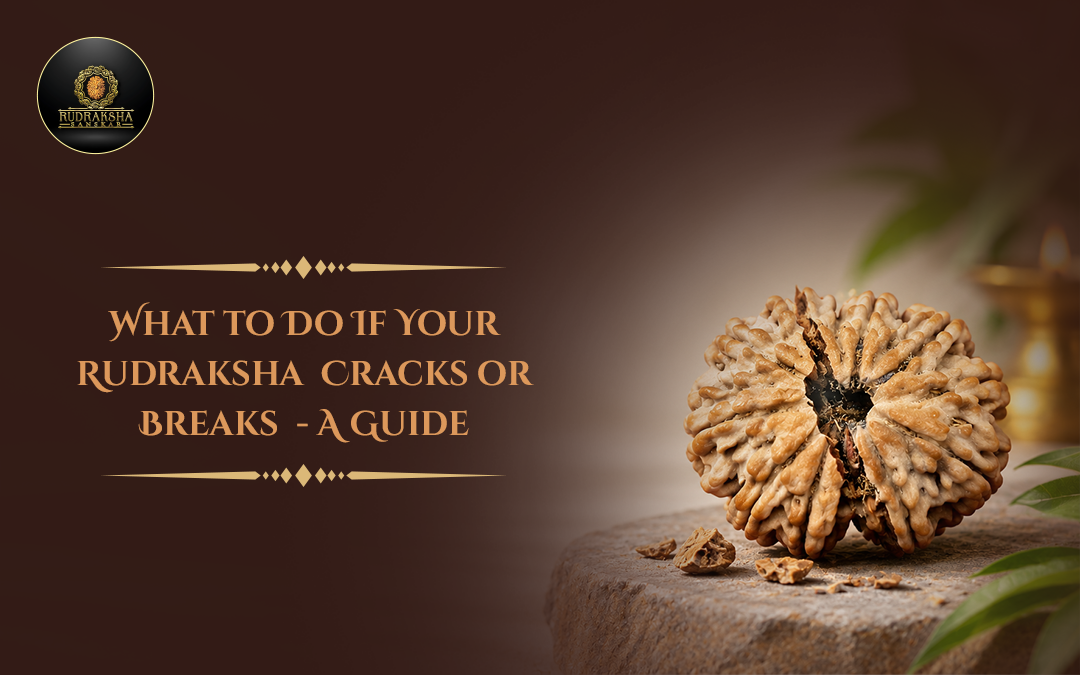
Finding a crack in a Rudraksha you have worn for months or years can be worrying.
The immediate questions are usually:
Can I still wear it?
Has it lost its spiritual significance?
Does a broken Rudraksha mean something bad?
Before assuming the worst, inspect the bead carefully.
Rudraksha is a natural seed, and natural material can change over time. A visible line may simply be part of its surface structure, while a deep crack, broken section or completely split bead is a different situation.
The right response depends on how badly the Rudraksha is actually damaged.
First: Is It Really a Crack?
Not every line on a Rudraksha means the bead is breaking.
A genuine Rudraksha naturally has:
- Mukhi lines
- deep grooves
- ridges
- irregular surface texture
- natural depressions
For someone unfamiliar with the bead, a deep Mukhi line can sometimes look like a crack.
Before doing anything, examine the Rudraksha under good light.
A Mukhi line is part of the bead’s natural structure and generally runs along its surface in a defined way.
A damage crack may appear newly opened, cut across the natural structure or expose an internal section that was not previously visible.
If you have photographs from when you purchased the bead, compare them.
This is one reason keeping specimen photographs and certification for valuable Rudraksha is useful.
Three Levels of Rudraksha Damage
Not every damaged bead needs the same response.
1. Minor Surface Damage
This may include:
- small chips
- superficial surface cracks
- minor wear around the drilling hole
- natural ageing
If the bead remains structurally intact and all Mukhi can still be clearly identified, it may not need immediate replacement.
Monitor the area.
Avoid putting unnecessary pressure on the bead and check whether the damage is becoming larger.
2. Deep Structural Crack
A deeper crack deserves more attention.
Signs include:
- the bead beginning to separate
- a crack extending deep into the body
- movement when gentle pressure is applied
- significant damage around the central hole
- part of the bead becoming loose
At this point, continuing to wear it may cause the Rudraksha to split completely.
It is usually better to stop wearing it and have the bead inspected.
3. Completely Broken or Split Rudraksha
If the bead has separated into pieces or lost a substantial part of its natural structure, retire it from regular wearing.
Trying to glue the pieces together and continuing to wear it as though nothing happened is generally not the best approach.
A repaired bead may also become difficult to authenticate later, particularly if it was a rare specimen.
Why Can Rudraksha Crack?
A cracked Rudraksha does not automatically have a mysterious explanation.
There are several practical possibilities.
Excessive Dryness
Rudraksha is organic material.
Extreme cycles of moisture and dryness may place unnecessary stress on its structure.
Repeated Soaking
Frequently soaking the bead for long periods and then drying it repeatedly is unnecessary and may be hard on both the bead and its stringing.
Physical Impact
A Rudraksha may crack if it:
- falls onto a hard floor
- is crushed
- repeatedly strikes a desk
- gets caught in equipment
- experiences pressure during physical activity
Bracelets can be especially exposed to impact because the wrist regularly contacts hard surfaces.
Age and Natural Wear
A Rudraksha worn for many years will not necessarily look the same as a newly purchased bead.
Colour changes, surface wear and other signs of ageing can occur.
That does not automatically make it unusable.
Poor Drilling or Jewellery Construction
Damage can sometimes begin around the hole used for stringing.
If a bead was poorly drilled or is held too tightly by jewellery fittings, stress may concentrate around this area.
Does a Broken Rudraksha Mean Something Bad Is Going to Happen?
There are many beliefs surrounding broken spiritual objects.
You may hear claims such as:
“The Rudraksha absorbed a major danger meant for you.”
or:
“A cracked bead is a warning that something bad is coming.”
These should not be presented as facts.
A Rudraksha can crack for ordinary physical reasons such as age, dryness, impact or stress.
There is no reason to become frightened because your bead has been damaged.
If your personal spiritual tradition gives a broken Rudraksha symbolic meaning, you can respect that interpretation.
But it should not become a source of fear.
Physical damage is not reliable evidence that a future event has been predicted.
Can You Continue Wearing a Cracked Rudraksha?
It depends on the crack.
A tiny superficial imperfection may not stop the bead from being wearable.
A deep structural crack is different.
Ask:
- Is the bead still structurally stable?
- Are the natural Mukhi still identifiable?
- Is any section separating?
- Is the crack becoming larger?
- Could normal wearing cause it to break completely?
When the structure has been seriously compromised, retiring the bead is the safer choice.
For an expensive or rare Rudraksha, have the specimen examined rather than experimenting with repairs yourself.
Should You Glue a Broken Rudraksha?
Generally, avoid treating glue as a solution for a valuable Rudraksha.
Glue can:
- cover the natural surface
- enter Mukhi lines
- hide the original break
- complicate later inspection
- affect collector value
- create confusion about whether a formation is natural
This becomes particularly important for rare formations such as:
- Gauri Shankar Rudraksha
- Garbh Gauri Rudraksha
- Trijuti Rudraksha
- Sawar
- Ganesh Rudraksha
Natural joints are part of what makes these formations special.
Adding adhesive can make future verification considerably more difficult.
What Should You Do With a Broken Rudraksha?
If the bead can no longer be worn, you do not need to throw it into household waste.
Depending on your tradition, you can respectfully retire it.
A simple approach is to:
- Remove the damaged Rudraksha from its thread or jewellery.
- Clean it gently if necessary.
- Offer a short prayer or Om Namah Shivaya.
- Keep it respectfully in your puja space if you wish.
Some traditions may recommend returning natural sacred items to nature or following a specific visarjan practice.
If you follow a guru, temple or family tradition, ask them about the appropriate method.
Avoid casually throwing a Rudraksha into a river or public water body simply because you saw an immersion instruction online. Spiritual disposal should also be environmentally responsible.
What If One Bead in a Mala or Bracelet Breaks?
You do not necessarily need to discard the entire mala.
For example, if one 5 Mukhi in a 108-bead mala cracks badly, the remaining beads do not automatically become unusable.
Instead:
- remove the damaged bead
- inspect the neighbouring beads
- check the thread
- replace the bead appropriately if required
- restring the mala securely
The same principle applies to a bracelet.
If the break happened because of excessive tension or impact, inspect the entire construction before wearing it again.
What If a Rare Rudraksha Breaks?
Be more cautious.
If a high-value 14 Mukhi, 18 Mukhi, 21 Mukhi or rare natural formation develops a serious crack, do not immediately:
- glue it
- polish it
- drill another hole
- reshape the damaged section
First document the damage with clear photographs.
Keep:
- the original certificate
- X-ray if available
- invoice
- original photographs
- current photographs
Then have the specimen assessed.
For a collector-grade Rudraksha, its history and original documentation remain important even after physical damage.
How Can You Reduce the Risk of Cracking?
You cannot guarantee that a natural seed will remain unchanged forever, but sensible care helps.
Avoid:
- harsh chemicals
- boiling
- repeated prolonged soaking
- aggressive scrubbing
- extreme heat
- hard physical impact
- badly fitted metal caps
- overly tight stringing
Also inspect bracelets and malas periodically.
Sometimes the problem is not the Rudraksha at all.
A weakening thread, tight wire or damaged mounting can place unnecessary stress on the bead.
For regular maintenance, follow the appropriate cleaning and care routine rather than repeatedly subjecting Rudraksha to aggressive treatments.
A Broken Rudraksha Is a Reason to Inspect, Not Panic
When you discover a crack, start with the physical evidence.
Is it actually damage?
How deep is it?
Is the bead separating?
Can it still be worn safely?
Then decide what to do.
A minor surface imperfection may require nothing more than monitoring.
A seriously cracked bead should usually be retired from regular wear.
A valuable collector specimen deserves professional assessment before any repair is attempted.
Most importantly, do not let a damaged natural seed become a source of fear.
Rudraksha is meant to support spiritual practice, not create anxiety about bad luck, predictions or punishment.
If you need a replacement and plan to buy rudraksha online, choose an individually identifiable Rudraksha from Rudraksha Sanskar and retain its photographs, certificate and other documentation so you can monitor the bead’s condition over time.
FAQs
A minor superficial crack may not necessarily make the bead unusable. If the crack is deep, expanding or causing the bead to separate, stop wearing it and have it inspected.
There is no reason to treat physical damage as proof of bad luck or an approaching negative event.
Possible reasons include impact, excessive dryness, repeated moisture cycles, ageing or stress around the drilling and mounting.
Glue is generally not advisable for valuable beads because it can obscure the natural surface and interfere with future verification.
If you regard it as spiritually significant, retire it respectfully rather than putting it casually into household waste.
Not necessarily. The damaged bead can often be removed or replaced while the remaining genuine beads are retained.