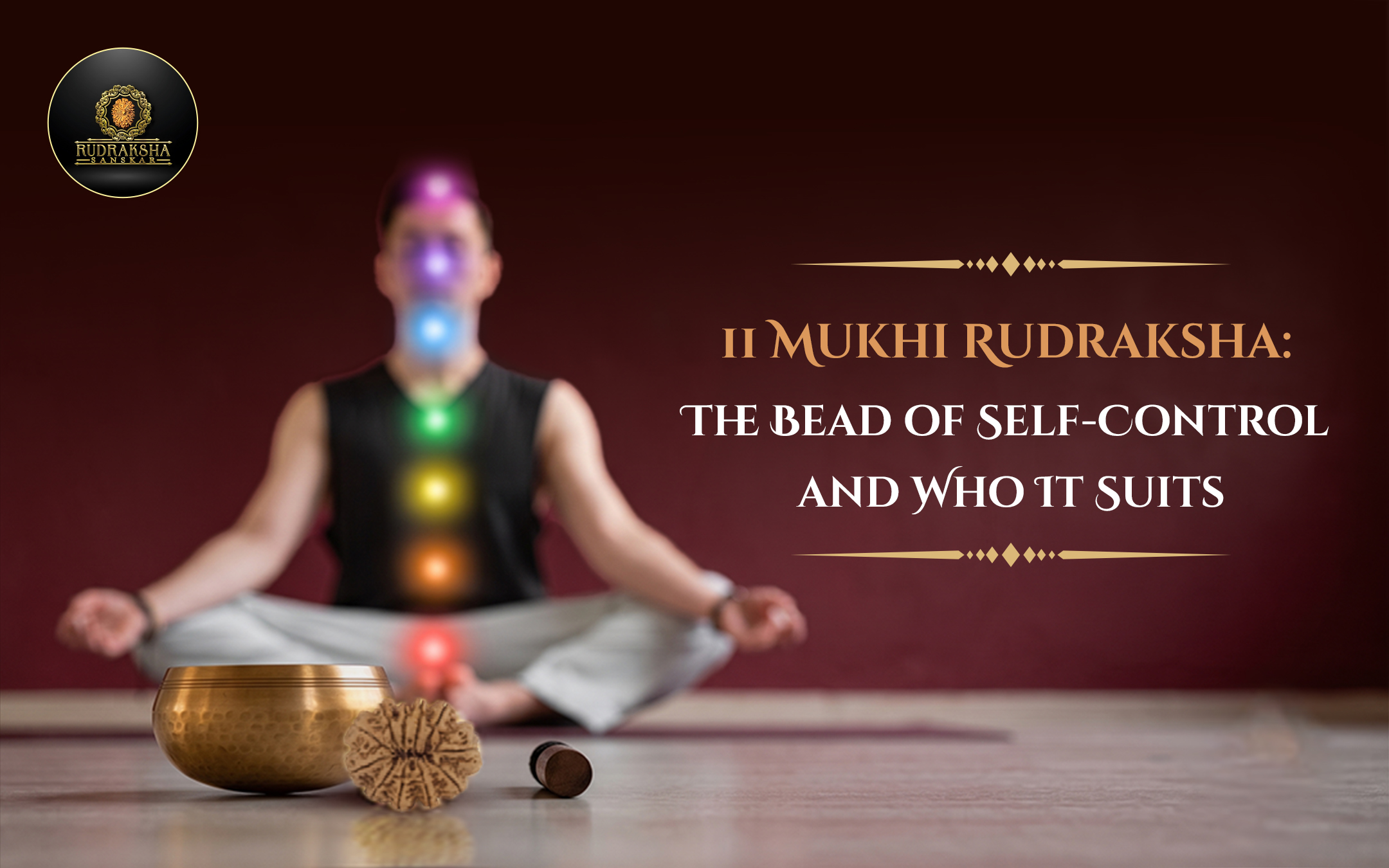
The 11 Mukhi Rudraksha is often described as a bead of courage, confidence and strength.
But those words can be misleading if they are understood as aggression or force.
The deeper traditional idea is controlled strength.
That is what makes 11 Mukhi different.
It is closely associated with Lord Hanuman, whose strength is remembered alongside devotion, discipline, humility and unwavering focus. Rudraksha Sanskar’s current guidance follows the same interpretation, presenting 11 Mukhi as especially relevant for people who need courage with self-control rather than confidence without restraint.
For someone considering an 11 Mukhi Rudraksha, that distinction matters.
The bead is not about becoming more forceful.
It is about becoming more deliberate.
What Is an 11 Mukhi Rudraksha?
An 11 Mukhi Rudraksha has eleven naturally formed Mukhi lines running across the bead.
Traditionally, it is associated with the Eleven Rudras and the Hanuman aspect, with qualities such as:
- courage
- discipline
- concentration
- self-control
- resilience
- devotion
- responsible use of personal strength
Rudraksha Sanskar’s current catalogue also links 11 Mukhi with Mars or Mangal within its astrological framework.
Still, its strongest practical identity is not planetary correction.
It is discipline under pressure.
Why Is 11 Mukhi Associated With Self-Control?
Most people do not struggle because they completely lack ability.
They struggle because ability becomes inconsistent.
You know what needs to be done but delay it.
You make a plan and abandon it.
You stay calm until one difficult conversation makes you react impulsively.
You have confidence in one situation and lose it under pressure.
That is where the symbolism of 11 Mukhi becomes useful.
Rudraksha Sanskar’s existing 11 Mukhi guidance describes self-control through qualities such as:
- consistency in habits
- control over impulsive reactions
- emotional steadiness during conflict
- commitment to work and goals
This is why the bead is often positioned as one of controlled power rather than raw power.
A Rudraksha does not create discipline for you.
But it can form part of a spiritual practice built around becoming more disciplined.
Who Should Wear 11 Mukhi Rudraksha?
11 Mukhi generally makes the most sense for people whose challenge is not lack of ambition, but maintaining control and consistency while carrying responsibility.
Leaders and Decision-Makers
Leadership tests emotional control as much as knowledge.
Managers, founders and business owners often have to:
- make difficult decisions quickly
- manage conflicting opinions
- stay composed under pressure
- communicate authority without aggression
- keep working through uncertainty
Rudraksha Sanskar’s current guidance specifically identifies leaders and decision-makers as people who may relate to the symbolism of 11 Mukhi because leadership requires clarity and self-control rather than authority alone.
People Who Struggle With Consistency
Some people start strongly and lose momentum.
That may appear as:
- abandoned routines
- unfinished projects
- inconsistent exercise or study
- difficulty maintaining focus
- frequent distraction
- repeated procrastination
For this type of person, the traditional association with discipline can be more relevant than the more dramatic word “fearlessness.”
Students Under Competitive Pressure
Competitive study is not only a test of knowledge.
It is also a test of:
- concentration
- confidence
- routine
- emotional control
- the ability to continue despite setbacks
Rudraksha Sanskar’s existing 11 Mukhi content specifically includes students preparing for competitive fields among the people who commonly consider this Mukhi.
It should not be treated as a replacement for preparation.
The symbolism fits the discipline required to prepare well.
Professionals in High-Pressure Roles
People working in demanding environments may relate to 11 Mukhi where the challenge is:
remaining calm without becoming passive.
This can include:
- entrepreneurs
- senior managers
- sales professionals
- people handling conflict
- people making high-stakes decisions
- professionals experiencing intense performance pressure
People Drawn to Hanuman Worship
For someone whose spiritual practice already centres around Lord Hanuman, 11 Mukhi has an obvious devotional connection.
In that case, the bead is not being chosen merely for a life problem.
It fits an existing spiritual relationship.
Who May Not Need 11 Mukhi?
Not every confidence problem requires a higher Mukhi Rudraksha.
Someone Completely New to Rudraksha
If your only purpose is daily Shiva devotion, meditation or japa, 5 Mukhi Rudraksha remains a simpler entry point.
11 Mukhi makes more sense when its specific symbolism actually fits your purpose.
Someone Looking for Aggression or Dominance
Self-control is the opposite of uncontrolled force.
If you are choosing 11 Mukhi because you want to “dominate people,” the traditional Hanuman symbolism has been misunderstood.
Someone Expecting Instant Confidence
Confidence usually grows through:
- preparation
- repeated action
- experience
- competence
- better emotional regulation
A Rudraksha does not replace those processes.
Someone Treating It as Mental-Health Treatment
If fear, anxiety, emotional reactivity or difficulty concentrating is significantly affecting daily life, appropriate professional support matters.
11 Mukhi may remain part of a spiritual practice, but it should not be presented as treatment.
Is 11 Mukhi Mainly for Men?
No.
The qualities associated with 11 Mukhi are not gender-specific.
Leadership, discipline, confidence and emotional control are relevant to both men and women. Rudraksha Sanskar’s existing 11 Mukhi guidance also explicitly presents the bead as suitable for either.
The better question is whether the bead’s traditional meaning aligns with what you are working on.
What Day Should You Wear 11 Mukhi Rudraksha?
Because of its Hanuman association, Tuesday is commonly chosen for beginning an 11 Mukhi practice.
Some Rudraksha Sanskar guidance also mentions Saturday, depending on the tradition followed.
A simple wearing practice can include:
- Bathe and wear clean clothes.
- Keep the Rudraksha in your puja space.
- Offer your regular prayer to Hanuman or Shiva.
- Chant Om Namah Shivaya or the mantra followed in your own tradition.
- Wear the bead consistently rather than repeatedly changing practices.
If your guru or family tradition provides a different vidhi, follow that instead.
How Do You Identify an Original 11 Mukhi Rudraksha?
A genuine 11 Mukhi should show eleven naturally formed Mukhi lines.
For a higher-value individual bead, also check:
- exact photographs
- dimensions
- weight
- stated origin
- certification number
- laboratory report
- X-ray where available
Rudraksha Sanskar already has a dedicated guide covering 11 Mukhi authenticity, price and certification.
Do not judge authenticity from price alone.
The fact that a bead is expensive does not prove the eleven faces formed naturally.
Strength Matters Most When You Can Control It
The 11 Mukhi Rudraksha is easy to market using words such as power and fearlessness.
Its more interesting meaning is restraint.
Hanuman’s strength was not remembered because it was uncontrolled.
It was disciplined, purposeful and directed toward service.
That is why 11 Mukhi makes the most sense for someone who wants to become more consistent, less reactive and steadier under responsibility.
Choose it if that symbolism fits what you are working on.
Do not choose it because a seller promises instant confidence or because a higher Mukhi sounds more advanced.
If you plan to buy Rudraksha online, explore the 11 Mukhi Rudraksha collection from a trusted seller like Rudraksha Sanskar and review the exact bead and authenticity information before purchasing.
FAQs
Traditionally, 11 Mukhi is associated with courage, confidence, concentration, discipline, self-control and inner strength.
It is commonly associated with the Eleven Rudras and particularly with Lord Hanuman.
It is often considered by leaders, entrepreneurs, students, professionals under pressure and people seeking greater discipline or courage.
Confidence is a traditional association of the bead, but it should not be interpreted as an automatic psychological effect. It works best understood within a wider practice of preparation, discipline and personal growth.
Yes. Its traditional associations with courage and self-control are not restricted by gender.
Rudraksha Sanskar’s catalogue connects it with Mars or Mangal, although other current guidance emphasises its broader stabilising and Hanuman-linked qualities rather than treating it purely as a planetary remedy.
They can if there is a clear reason for choosing it, but a 5 Mukhi remains a simpler option for general Rudraksha practice.