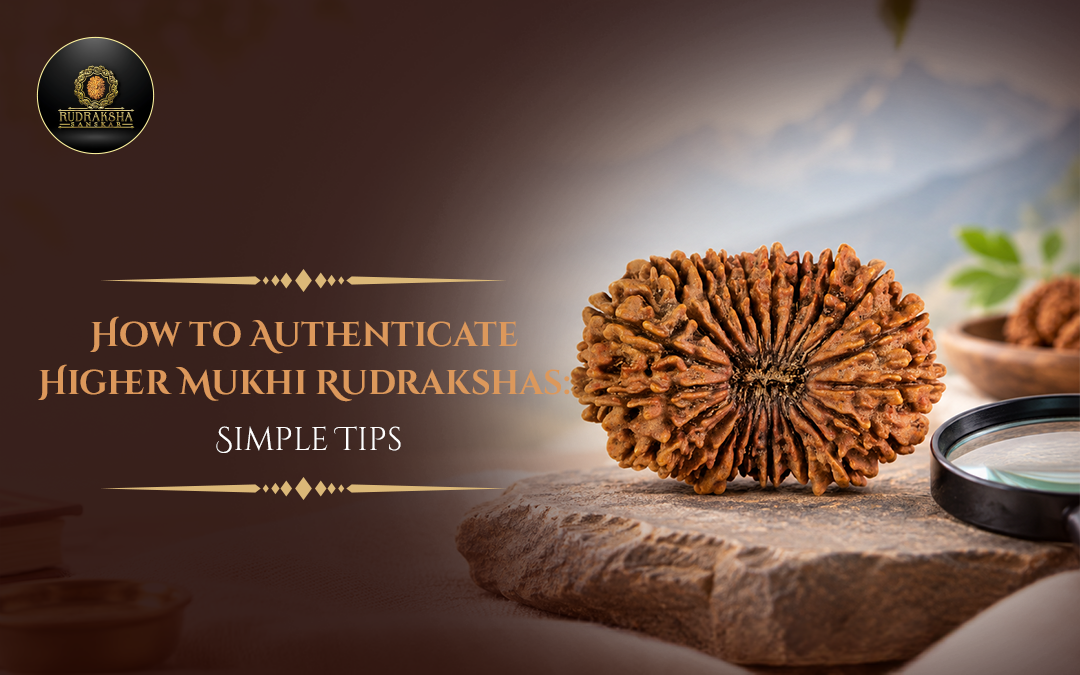
Buying a 5 Mukhi Rudraksha and buying a rare 18 or 21 Mukhi are very different decisions.
As the Mukhi becomes rarer, the price can increase substantially.
Unfortunately, so does the financial incentive to misidentify, modify or overprice a bead.
If you are considering a 15 Mukhi Rudraksha, 18 Mukhi Rudraksha or another higher Mukhi, do not rely only on appearance or the seller saying: “100% original.”
A better authentication process is:
Exact bead → Natural Mukhi → Surface analysis → Size and weight → Certificate → Supporting X-ray
Here is how to check each part.
1. Make Sure You Are Seeing the Exact Rudraksha
Start with something very simple.
Are the photographs showing the actual bead you will receive?
For an expensive higher Mukhi, generic category photographs are not enough.
Ask for clear images showing:
- front
- back
- top
- bottom
- all sides
- Mukhi lines
- natural surface texture
This matters because every Rudraksha is naturally different.
If you are paying a premium for one particular specimen, its documentation and photographs should correspond to that exact bead.
2. Count the Natural Mukhi Carefully
The Mukhi count is fundamental.
A genuine higher Mukhi should show naturally developed longitudinal divisions rather than suspicious lines that appear artificially added.
For example, if a specimen is being sold as 17 Mukhi Rudraksha, all 17 faces should be evaluated as part of the bead’s natural structure.
Do not simply count any visible scratch or groove as another Mukhi.
Look at whether the lines appear naturally integrated into the surface.
This becomes increasingly important as the claimed Mukhi count and price rise.
3. Look for Signs of Artificial Carving
Imagine the commercial difference between a common bead and a genuine 20 Mukhi.
That price gap creates an obvious incentive for manipulation.
Potential warning signs can include:
suspiciously sharp grooves
- unnatural cuts
- abrupt changes in surface texture
- lines that do not resemble the surrounding natural structure
- visible tool marks
- repaired or filled areas
You do not need to become a Rudraksha laboratory technician.
The goal is simply to understand why surface examination matters.
A certificate or X-ray should support this examination, not make you ignore the exterior of the bead.
4. Check the Size in Millimetres
For premium Rudraksha, “large size” is too vague.
Ask for actual dimensions.
A natural Rudraksha is not necessarily perfectly round, so a listing may provide more than one measurement rather than a single diameter.
Size matters because it helps identify the exact specimen and understand its physical characteristics.
It can also affect collector value.
But remember:
large ≠ authentic
and
large ≠ spiritually more powerful
A large fake is still a fake.
5. Check the Weight
Weight provides another specimen-specific data point.
It becomes particularly useful when combined with:
- dimensions
- photographs
- Mukhi count
- origin
- certificate details
If you are buying a premium higher Mukhi, the goal is to build a consistent identity for the bead.
The photograph should represent the same specimen described by the measurements.
The measurements should correspond to the certificate.
The certificate should correspond to the bead being delivered.
Everything should connect.
6. Ask What the Certificate Actually Verifies
The word “certified” sounds reassuring.
But buyers should ask a second question:
Certified for what?
A useful specimen-specific report may contain details such as:
- certificate number
- date
- weight
- dimensions
- shape
- number of natural faces
- artificial faces, if examined
- surface-line analysis
- X-ray findings
- botanical identification
- stated origin
Compare these details with the actual bead.
A generic card saying “Original Rudraksha Certified” tells you much less.
For a broader authentication framework, read how to identify an original Rudraksha.
7. Use X-Ray as Supporting Evidence
For rare higher Mukhi Rudraksha, X-ray examination can become particularly useful.
Why?
Because it provides information about the bead’s internal compartment structure.
This adds another layer of evidence when examining a specimen claimed to have many natural faces.
But there is an important limitation:
X-ray alone should not be treated as complete proof of authenticity.
It does not make surface examination unnecessary.
A stronger approach is:
Surface analysis + X-ray
The outside helps evaluate whether the Mukhi lines appear naturally developed.
The X-ray provides supporting evidence about internal structure.
Together, they are more informative than either being considered in isolation.
8. Match the X-Ray to the Exact Bead
Seeing an X-ray image is not enough.
For an expensive specimen, you want confidence that the X-ray actually belongs to that Rudraksha.
Check whether identifying details connect the:
bead → certificate → X-ray
If the seller shows a beautiful 21 Mukhi photograph, a certificate with unrelated measurements and a generic X-ray, the documentation chain becomes weak.
For premium Rudraksha, specimen-specific traceability matters.
9. Verify the Claimed Origin
Nepal-origin higher Mukhi Rudraksha can command substantial premiums.
That makes origin commercially important.
Nepali Rudraksha are generally associated with:
- larger size
- heavier structure
- deeper grooves
- pronounced texture
Indonesian beads are generally smaller, lighter and more compact.
But appearance alone should not be treated as perfect proof of geography.
More importantly:
Indonesian does not mean fake.
A genuine Indonesian Rudraksha is still genuine.
Origin and authenticity are two different questions.
10. Be Extra Careful With Rare Natural Formations
Higher Mukhi are not the only premium Rudraksha that require careful inspection.
Rare natural formations deserve similar scrutiny.
A Gauri Shankar Rudraksha consists of two naturally joined Rudraksha.
A Trijuti Rudraksha consists of three naturally joined Rudraksha.
A Ganesh Rudraksha has a naturally developed trunk-like protrusion.
Sawar has a smaller bead-like formation naturally attached to a primary Rudraksha.
For joined formations, inspect for suspicious signs such as:
- glue
- filler
- unnatural joints
- obvious repair material
- mismatched textures
- tool marks
The formation should be natural, not assembled to imitate a rare specimen.
11. Do Not Depend on the Water Test
One of the most common home tests involves placing Rudraksha in water.
You may hear:
“If it sinks, it is real.”
That is not a reliable authentication method.
Whether a natural object floats or sinks can be influenced by its physical properties and condition.
A manipulated or unrelated seed may sink.
A genuine bead’s behaviour in water does not provide the detailed evidence needed to verify its Mukhi, origin or natural structure.
Do not make a high-value buying decision from a glass of water.
12. Do Not Depend on the Copper Coin Test Either
Another popular claim is that an original Rudraksha will rotate when placed between copper coins.
This is sometimes presented online as definitive proof.
It is not a substitute for proper specimen examination.
For a premium Rudraksha, rely on measurable and inspectable information rather than demonstrations that cannot establish:
- Mukhi count
- natural formation
- origin
- internal structure
- specimen identity
A ₹5 lakh or ₹20 lakh buying decision deserves better evidence than a viral home test.
13. Be Suspicious of Authentication Through Price
An expensive Rudraksha is not automatically genuine.
Likewise, a very polished listing does not prove authenticity.
High prices can legitimately result from:
- rare Mukhi
- Nepal origin
- exceptional dimensions
- specimen quality
- condition
- unusual natural formation
- collector scarcity
But the seller should be able to explain what makes that exact specimen valuable.
“Very powerful” is not a measurable answer.
14. Ignore Vague Grades Unless They Are Explained
You may see labels such as:
AAA
AAA+
Super Premium
Collector Grade
These terms are not enough by themselves.
There is no single universal grading system under which every Rudraksha seller necessarily uses these labels identically.
Ask what the grade represents.
Does it refer to:
- size?
- condition?
- shape?
- surface development?
- rarity?
- origin?
Measurable characteristics are more useful than impressive terminology.
A Simple Higher Mukhi Authentication Checklist
Before buying a premium specimen, check these points:
1. Exact specimen photographs
Can you see the actual Rudraksha from multiple angles?
2. Natural Mukhi
Are the claimed faces naturally formed?
3. Surface analysis
Are there signs of carving, repair or artificial alteration?
4. Dimensions
Are exact measurements provided?
5. Weight
Is the specimen’s weight recorded?
6. Origin
Is the claimed geographic origin clearly stated?
7. Certificate
Does it describe the exact bead?
8. X-ray
For rare higher Mukhi, is supporting internal imaging available where appropriate?
9. Matching records
Do the bead, measurements, certificate and X-ray correspond?
10. Seller transparency
Can the seller clearly explain what has actually been verified?
The more expensive the bead, the fewer compromises you should accept in this chain.
Authenticating higher Mukhi Rudraksha does not need to begin with complicated rituals or home experiments.
Begin with evidence you can inspect.
See the exact bead.
Examine the natural Mukhi.
Check its surface.
Record its dimensions and weight.
Read what the certificate actually says.
Use X-ray as supporting evidence where appropriate.
Most importantly, make sure all those pieces refer to the same specimen.
That becomes increasingly important when purchasing rare categories such as 19 Mukhi Rudraksha, 20 Mukhi Rudraksha or 21 Mukhi Rudraksha.
If you plan to buy rudraksha online, remember one simple rule: As the rarity and price increase, the quality of evidence should increase with them.
FAQs
Examine the natural Mukhi lines, surface structure, dimensions, weight and exact specimen photographs. For premium higher Mukhi, specimen-specific certification and supporting X-ray can provide additional evidence.
No. X-ray can provide supporting information about internal structure, but it should be considered alongside external surface analysis and other specimen-specific details.
A document by itself should never end your investigation. Check who issued it, what was examined, what the report actually verifies and whether its measurements and identifiers match the exact bead.
No. The water test is not sufficient to establish authenticity, Mukhi count or origin.
Look for unnatural grooves, sharp cuts, tool marks, disrupted surface texture and suspicious transitions. Professional examination is preferable for expensive specimens.
No. Price is not evidence. Rare Mukhi may legitimately be expensive, but the exact specimen still needs appropriate verification.