A 5 Mukhi Rudraksha may be widely available.
A genuine 17, 18 or 21 Mukhi can be dramatically harder to find and far more expensive.
That naturally raises a question:
Why don’t farmers simply grow more higher Mukhi Rudraksha?
Because that is not how Rudraksha cultivation works.
Farmers cultivate Rudraksha trees. They do not normally plant separate “17 Mukhi trees” or “21 Mukhi trees” and reliably harvest only those beads.
The Mukhi count is a natural characteristic of the seed that develops inside the fruit.
This means higher Mukhi rarity begins with something growers cannot completely control: natural occurrence.
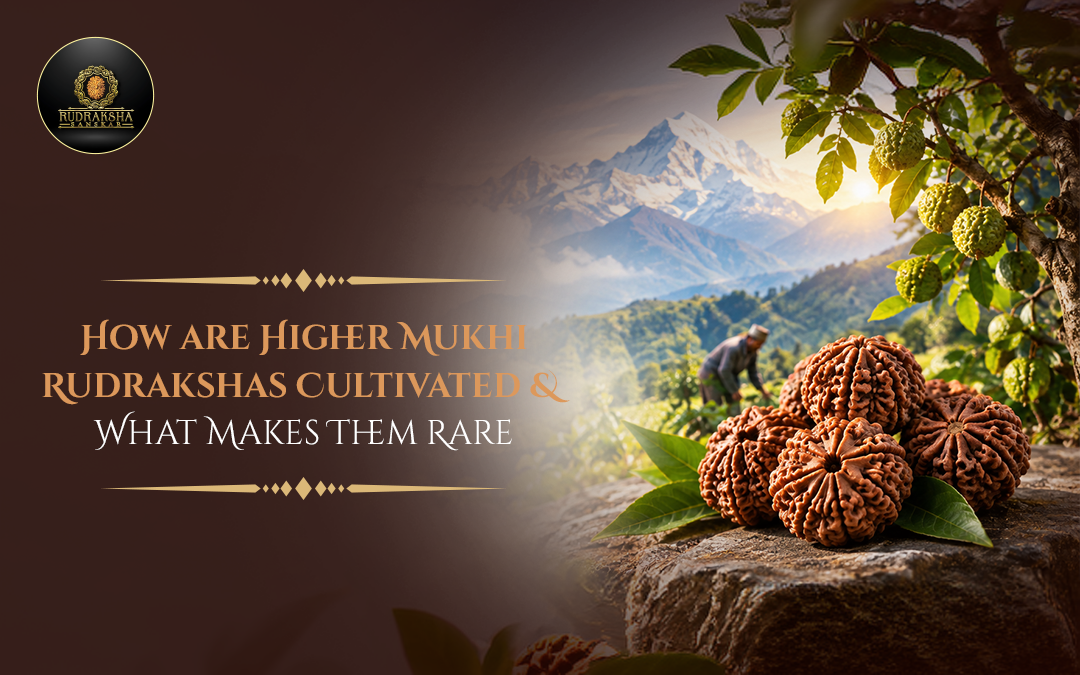
First, How Is Rudraksha Actually Cultivated?
Rudraksha comes from trees commonly identified botanically as Elaeocarpus ganitrus, with Elaeocarpus sphaericus also appearing in botanical references.
The cultivation process begins much like other tree crops.
Suitable trees are grown in environments with appropriate:
- climate
- rainfall
- soil
- drainage
- temperature
- humidity
Nepal is particularly important in the Rudraksha market, with cultivation and trade strongly associated with eastern hill regions such as Bhojpur and Sankhuwasabha.
Once a mature tree produces fruit, the Rudraksha seed develops inside it.
Only after that fruit is harvested and processed does the familiar hard, naturally grooved Rudraksha become available for detailed sorting.
Can Farmers Cultivate a Specific Mukhi?
This is where buyers should be careful with oversimplified claims.
A farmer cannot simply place an order with nature:
“This season I need 100 pieces of 18 Mukhi.”
The tree produces fruits, and the seeds inside develop their own natural characteristics.
After harvesting, the fruits are processed and the beads can be separated according to the number of naturally developed Mukhi.
The majority will not turn out to be extremely rare higher Mukhi.
That is one of the fundamental reasons genuine high-Mukhi Rudraksha command significant prices.
What Exactly Is a Mukhi?
Mukhi are the natural longitudinal faces or divisions visible on a Rudraksha.
They are used to classify beads into categories such as:
- 5 Mukhi
- 7 Mukhi
- 10 Mukhi
- 14 Mukhi
- 17 Mukhi
- 21 Mukhi
A higher number does not simply mean someone carved additional grooves into a normal bead.
For a genuine higher Mukhi Rudraksha, those faces need to be part of the bead’s natural development.
This becomes central to authentication because adding artificial lines to a lower-value specimen can potentially make it resemble a rarer Mukhi.
Why Are Higher Mukhi Rudraksha Rare?
The simplest answer is:
They occur less frequently in the natural harvest.
Common Mukhi can be available in substantial numbers.
As you move into rare categories such as:
and 21 Mukhi Rudraksha,
natural availability becomes much more limited.
That scarcity starts before certification, marketing or retail pricing enters the picture.
It begins at the tree.
Rarity Is More Than Just Mukhi Count
Suppose a genuine 18 Mukhi is discovered in a harvest.
That already makes the specimen uncommon.
But now consider additional characteristics:
Is it Nepal origin?
Is it unusually large?
Is it structurally well preserved?
Are all 18 natural faces clearly developed?
Does it have strong specimen-specific documentation?
The combination can make an already rare bead substantially more desirable.
So there are really multiple layers of scarcity:
rare Mukhi + desirable origin + exceptional size + good condition + documentation
This is why two authentic beads with the same Mukhi do not necessarily have the same market value.
Does a Bigger Higher Mukhi Become Rarer?
It can.
Imagine that 18 Mukhi is already uncommon.
Now imagine finding a genuine Nepal-origin 18 Mukhi with exceptional dimensions and good condition.
You are no longer asking:
“How rare is 18 Mukhi?”
You are asking:
“How rare is an 18 Mukhi with this particular combination of characteristics?”
That second question can produce a very different price.
This is why the Nepali Rudraksha Size Guide should be used to understand physical measurements rather than treating mm as a spiritual score.
A larger specimen may be rarer.
It is not automatically spiritually stronger.
Special Formations Add Another Kind of Rarity
Mukhi count is only one way Rudraksha can become unusual.
Natural formations can also occur.
Examples include:
Gauri Shankar Rudraksha – two naturally joined Rudraksha.
Trijuti Rudraksha – three naturally joined Rudraksha.
Ganesh Rudraksha – a Rudraksha with a natural trunk-like protrusion.
Sawar Rudraksha – a primary bead with a smaller naturally attached bead-like formation.
These characteristics arise through natural development.
When an unusual formation occurs together with an uncommon Mukhi, scarcity can increase considerably.
Can Better Farming Produce More 21 Mukhi Rudraksha?
Better cultivation can certainly support healthier trees and fruit production.
Good agricultural practices can influence:
- tree health
- fruit yield
- orchard productivity
- harvest quality
But this should not be confused with having complete control over the Mukhi distribution of every resulting seed.
Growing more healthy Rudraksha trees may increase the total number of fruits available for sorting.
It does not mean a farmer can guarantee that a fixed percentage will become 19, 20 or 21 Mukhi.
This distinction is important when discussing why supply cannot instantly expand in response to demand.
What Happens When a Rare Mukhi Is Found?
Once harvested fruit has been processed and an unusual Mukhi appears, the bead requires careful examination.
The process may include:
Mukhi counting
↓
Surface examination
↓
Size measurement
↓
Weight measurement
↓
Condition assessment
↓
Origin recording
↓
Laboratory examination
↓
X-ray where relevant
↓
Specimen-specific documentation
Higher market value also creates greater incentive for artificial modification.
So the rarer the claimed Mukhi, the more important careful verification becomes.
Why Does X-Ray Matter More With Higher Mukhi?
An X-ray can provide supporting information about the bead’s internal compartment structure.
That becomes useful when evaluating rare higher-Mukhi specimens.
But X-ray should not replace examination of the external surface.
A stronger authentication process considers both:
outside → natural Mukhi and surface continuity
inside → supporting internal structure
This is why a premium specimen should ideally have documentation connected to the exact individual bead, rather than a generic certificate for the category.
For a broader verification process, see how to identify an original Rudraksha.
Why Does Rarity Affect Price So Much?
Higher Mukhi pricing is largely a supply problem.
Consider the sequence:
A tree must mature and fruit.
↓
The fruit must be harvested.
↓
The seed must be processed.
↓
A naturally rare Mukhi must occur.
↓
The bead should be in acceptable condition.
↓
Buyers may prefer a particular origin.
↓
Larger specimens may be even scarcer.
↓
The specimen needs appropriate verification.
By the time all those factors overlap, the number of comparable beads available can become very small.
That is why rare Nepali higher-Mukhi Rudraksha can command substantial prices.
Does Higher Mukhi Mean More Powerful?
No.
Natural rarity should not be turned into a spiritual ranking system.
A 21 Mukhi is rarer than many common Rudraksha.
That does not mean:
21 Mukhi is 21 times stronger
or
everyone should upgrade to the highest Mukhi they can afford.
Different Mukhi have different traditional associations.
For example:
17 Mukhi is widely associated with Vishwakarma and creation or opportunity.
18 Mukhi is associated with Bhumi Devi and land or foundations.
21 Mukhi is widely associated in contemporary traditions with Kubera and abundance.
These are different traditional purposes, not levels in a video game.
Rare Does Not Mean Right for Everyone
This is particularly important because scarcity can create prestige.
A buyer may start thinking:
“If it costs more, it must be better for me.”
That is not a useful way to choose Rudraksha.
A common 5 Mukhi may be far more appropriate for someone’s everyday spiritual practice than an exceptionally expensive collector-grade 21 Mukhi.
The right bead should be selected according to:
- intended spiritual practice
- traditional association
- authenticity
- wearability
- budget
not simply rarity.
Be Careful With Artificially Created “Rare” Beads
Whenever natural scarcity creates a large price difference, authentication becomes critical.
Potential concerns include:
- carved additional lines
- modified surfaces
- repaired areas
- artificially joined formations
- misleading origin claims
For rare joined formations, also watch for:
- glue
- filler
- artificial joints
- abrupt texture changes
This is why an expensive bead deserves more documentation, not less.
A premium price should come with greater transparency.
The most important thing to understand about higher Mukhi Rudraksha is that their rarity begins before they ever reach the market. Farmers can cultivate healthy Rudraksha trees. They can care for orchards. They can harvest and process the fruit. But they cannot simply manufacture a harvest of 18 or 21 Mukhi beads because demand increases.
The Mukhi must naturally occur.
From there, rarity can increase further through:
Mukhi count → origin → size → condition → unusual formation → documentation
That is what makes an exceptional higher-Mukhi Rudraksha genuinely difficult to replace.
If you plan to buy rudraksha online, do not treat a high Mukhi number or high price as proof by itself. The rarer the claim, the more carefully the exact specimen should be verified.
FAQs
Farmers cultivate Rudraksha trees, but higher Mukhi are naturally occurring characteristics of the resulting seeds. They cannot simply be produced in fixed quantities on demand.
Higher Mukhi such as 17 Mukhi occur much less frequently in natural harvests than common Mukhi such as 5 Mukhi.
It is misleading to think of cultivation as planting a dedicated tree that reliably produces only 21 Mukhi beads. Mukhi classification is determined from the naturally developed seeds after fruit production.
They combine several scarcity factors: rare Mukhi, Nepal origin, exceptional dimensions, condition and collector demand.
Not simply because they are rarer or more expensive. Different Mukhi have different traditional associations and uses.
Look for the exact specimen, clear surface photographs, natural Mukhi analysis, dimensions, weight, origin, specimen-specific certification and supporting X-ray where appropriate.