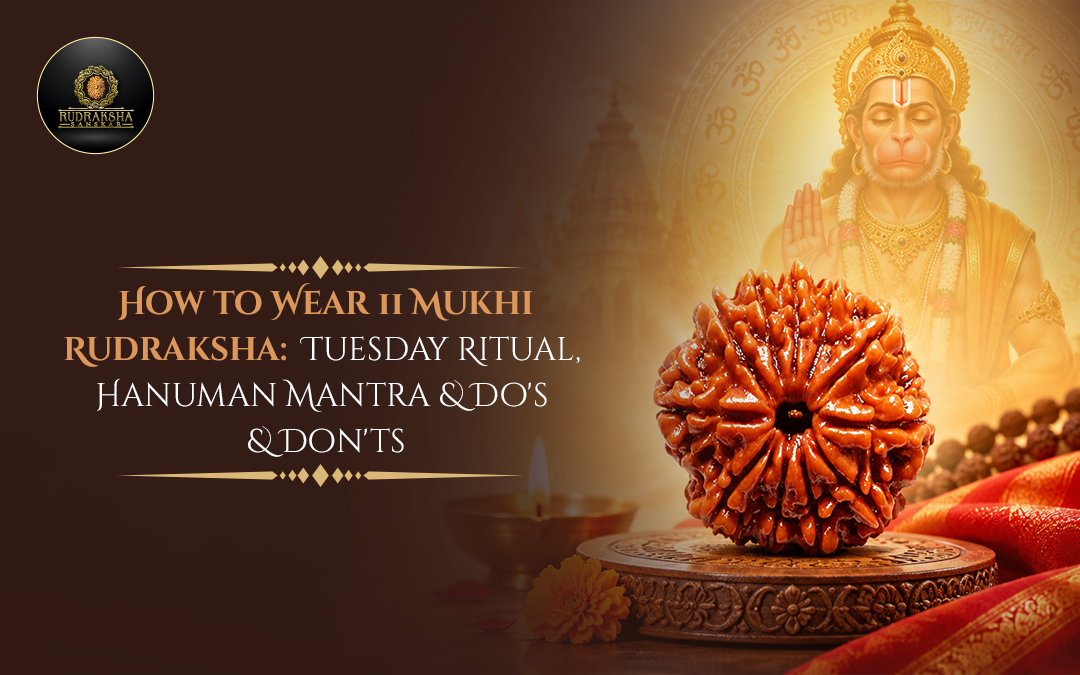
The 11 Mukhi Rudraksha is traditionally associated with the eleven forms of Rudra, known as Ekadasha Rudras. It is also connected with Lord Hanuman in several contemporary devotional traditions, making Tuesday a popular day for wearing this eleven-faced bead.
But how should you wear 11 Mukhi Rudraksha, which mantra should you chant, and what rules should you follow?
Many devotees begin wearing it on Tuesday after bathing, offering prayers to Lord Hanuman and chanting Om Hanumate Namah. However, specific rituals vary between spiritual traditions, and Tuesday is not universally compulsory.
This guide explains the wearing procedure, suitable mantras, thread and silver options, and important precautions.
1. What Is 11 Mukhi Rudraksha?
An 11 Mukhi Rudraksha is a natural Rudraksha bead with eleven facial divisions, called Mukhi.
The 11 Mukhi Rudraksha is traditionally associated with Ekadasha Rudras, the eleven manifestations of Rudra.
Some devotional interpretations also associate it with Lord Hanuman, who is regarded as a manifestation of Rudra in certain Hindu traditions.
Traditional Spiritual Significance
The bead is commonly connected with:
- Courage and determination
- Devotion to Lord Hanuman
- Spiritual discipline
- Perseverance during challenges
- Self-control and responsibility
These are religious associations rather than scientifically established effects of wearing Rudraksha.
2. Which Day Is Best to Wear 11 Mukhi Rudraksha?
Tuesday is a popular day for wearing 11 Mukhi Rudraksha in Hanuman-focused devotional practices.
Tuesday, or Mangalwar, is traditionally associated with Lord Hanuman.
Some devotees also choose Saturday for Hanuman worship or Monday because of Rudraksha’s connection with Lord Shiva.
What Is the Best Time?
Morning after bathing and completing regular prayers is a commonly preferred time.
There is no universally mandatory hour for wearing 11 Mukhi Rudraksha.
If your family follows a specific Panchang or spiritual lineage, you may observe its recommended Muhurat.
3. Which Mantra Should You Chant for 11 Mukhi Rudraksha?
Mantra selection depends on whether your devotional practice focuses on Hanuman or Rudra.
Hanuman Mantra
ॐ हनुमते नमः
Om Hanumate Namah.
This is a commonly recited mantra expressing reverence for Lord Hanuman.
Shiva Mantra
ॐ नमः शिवाय
Om Namah Shivaya.
This mantra is suitable for general Shiva-focused worship.
Mukhi-Specific Mantra
Some Rudraksha traditions prescribe:
ॐ ह्रीं हूं नमः
Om Hreem Hum Namah.
Mukhi-specific mantra recommendations vary between sources and spiritual lineages.
How Many Times Should You Chant?
Common devotional counts include 11, 21 and 108 repetitions.
Choose a count suitable for your routine or follow your guru’s instructions.
4. How to Wear 11 Mukhi Rudraksha on Tuesday: Step-by-Step Ritual
A simple Tuesday ritual can be performed at home.
Step 1: Verify the Rudraksha
Select a genuine eleven-faced bead with natural Mukhi divisions.
Request clear photographs and credible authentication documentation, particularly for expensive specimens.
Step 2: Clean the Bead
Gently remove surface dirt using a soft cloth.
Avoid harsh chemicals and prolonged soaking.
Step 3: Prepare Your Puja Space
After bathing, sit in a clean worship area.
Place the Rudraksha on a clean cloth or small tray near an image of Lord Hanuman.
Step 4: Offer Prayers
Offer flowers or other customary puja items according to your family tradition.
You may light a diya, ensuring the bead remains away from direct flames.
Step 5: Chant the Hanuman Mantra
Recite:
ॐ हनुमते नमः
Chant 11, 21 or 108 times according to your preference.
Step 6: Wear the Rudraksha
Wear the bead using a suitable thread or pendant setting.
Ensure that the mounting is comfortable and does not damage the bead.
Note: This is a commonly followed devotional approach, not a universally mandatory consecration procedure.
5. Should You Wear 11 Mukhi Rudraksha in Silver or Thread?
Both methods are used in contemporary Rudraksha practices.
| Feature | Thread | Silver pendant |
| Appearance | Simple and traditional | Decorative |
| Cost | Affordable | Generally higher |
| Durability | Requires replacement | Depends on setting quality |
| Comfort | Lightweight | Depends on design |
| Spiritual superiority | Not established | Not established |
Red or yellow threads may be preferred in some Hanuman-related devotional practices.
However, silver is not compulsory, and no reliable scientific evidence establishes that one mounting material provides greater spiritual benefits.
For an expensive bead, choose a secure setting that preserves its natural structure.
6. Do’s and Don’ts of Wearing 11 Mukhi Rudraksha
Different traditions follow different rules. The following recommendations combine common devotional practices with practical bead care.
Do’s
Wear an authentic bead: Verify the natural eleven-faced structure before purchasing.
Maintain cleanliness: Keep the Rudraksha reasonably clean and dry.
Follow a regular prayer routine: Recite a mantra according to your beliefs.
Inspect the mounting: Check threads, chains and fittings regularly.
Respect family customs: Follow appropriate practices within your spiritual lineage.
Don’ts
Don’t expose it to harsh chemicals: Perfumes, detergents and cleaning agents may affect the bead.
Don’t rely on miracle claims: Rudraksha does not guarantee wealth, victory or protection from every difficulty.
Don’t use unreliable authenticity tests: Floating and copper-coin tests cannot conclusively establish genuineness.
Don’t ignore physical safety: Remove necklaces or bracelets around machinery or activities where they may become entangled.
Don’t assume every online restriction is compulsory: Religious rules differ between traditions.
7. Can You Wear 11 Mukhi Rudraksha Every Day?
Yes. Many devotees wear Rudraksha during ordinary daily activities.
It may be worn at work, during travel or while performing routine responsibilities.
However, the bead should be protected from excessive moisture, chemicals and physical impact.
Can You Wear It While Sleeping?
Some devotees wear Rudraksha continuously, while others remove it before sleeping.
For an expensive 11 Mukhi bead, removing it at night may reduce the risk of accidental damage.
Can You Wear It While Bathing?
Avoid prolonged exposure to soap, shampoo and water.
If you remove the bead, store it in a clean, dry location.
These are practical preservation measures rather than universal religious restrictions.
8. Can Women Wear 11 Mukhi Rudraksha?
Yes. Women wear Rudraksha in many Hindu devotional traditions.
There is no universally accepted prohibition preventing women from wearing 11 Mukhi Rudraksha.
Some families observe specific customs concerning ritual practices during menstruation, while others do not.
Such customs should not be presented as universal rules.
There is no medical reason to avoid wearing Rudraksha solely because of menstruation.
9. How to Identify an Original 11 Mukhi Rudraksha
Authentication is particularly important for higher Mukhi varieties because they may command premium prices.
Check the Eleven Natural Faces
Inspect whether the bead has eleven naturally formed Mukhi divisions.
Examine the Surface
Look for suspicious tool marks, artificial grooves or filled areas.
Request Actual Photographs
Ask for images of the complete specimen from multiple angles.
Review Authentication Documentation
For premium beads, request credible specimen-specific documentation.
Avoid Misleading Tests
Floating tests, copper-coin demonstrations and other popular methods cannot reliably prove authenticity.
Read how to identify an original Rudraksha for more guidance.
Conclusion
The 11 Mukhi Rudraksha holds religious significance because of its traditional association with Ekadasha Rudras and its connection with Lord Hanuman in several devotional traditions.
Tuesday is a popular wearing day, and Om Hanumate Namah is a commonly recited mantra. However, there is no single universally mandatory ritual, wearing material or set of restrictions.
For devotees, authenticity, respectful handling and a consistent spiritual practice are more important than following exaggerated claims.
If you wish to buy rudraksha online, prioritise genuine natural structure, reliable authentication and transparent product information.
FAQs
Tuesday is commonly preferred in Hanuman-focused traditions. Monday is also observed in broader Shiva-related Rudraksha practices.
Om Hanumate Namah is a commonly used Hanuman mantra. Some traditions prescribe additional Mukhi-specific mantras.
Yes. Silver pendants are commonly used, but silver is not universally compulsory.
Yes. Many devotees wear it daily, provided the bead is comfortable, securely mounted and properly maintained.
No universally accepted rule requires every devotee to fast before wearing it. Fasting practices depend on individual religious customs.