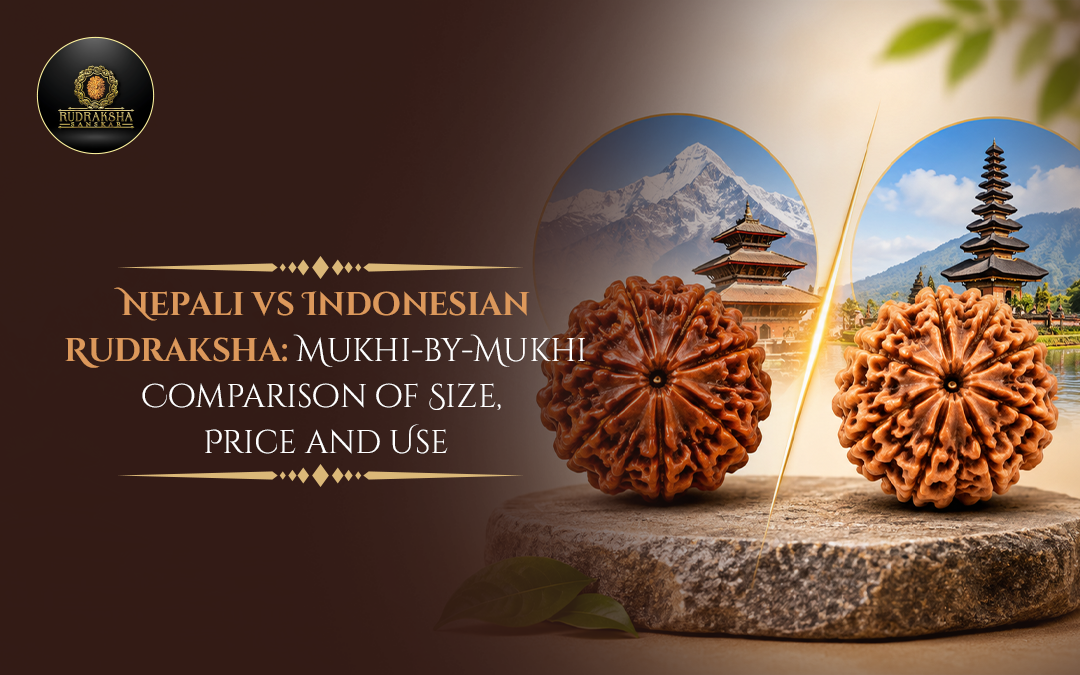
Nepali Rudraksha is generally larger, heavier and more expensive, while Indonesian Rudraksha is usually smaller, lighter and more affordable. Both can be genuine and are used in Hindu devotional practices.
The main differences involve bead size, surface texture, availability and market pricing. Neither origin has been scientifically proven to offer greater spiritual benefits.
This guide compares Nepali vs Indonesian Rudraksha across different Mukhi varieties to help buyers choose the right bead for their budget and intended use.
1. What Is the Difference Between Nepali and Indonesian Rudraksha?
Rudraksha beads are obtained from the hard inner stones of fruits produced by trees belonging to the Elaeocarpus genus, particularly Elaeocarpus ganitrus.
Their appearance varies depending on growing conditions, individual specimens and geographic origin.
| Feature | Nepali Rudraksha | Indonesian Rudraksha |
| Bead size | Generally larger | Generally smaller |
| Surface texture | Prominent ridges | Finer grooves |
| Weight | Usually heavier | Usually lighter |
| Mukhi visibility | Often easier to examine | May require magnification |
| Price | Generally higher | Generally lower |
| Common use | Pendants, worship, collections | Daily wear, Japa malas |
| Authenticity | Requires verification | Requires verification |
These are general market characteristics, not definitive methods of identifying origin.
2. Nepali vs Indonesian Rudraksha: Mukhi-by-Mukhi Comparison
The number of natural facial divisions, called Mukhi, influences availability and price.
The following comparison covers popular varieties.
| Mukhi | Traditional association | Nepali Rudraksha | Indonesian Rudraksha |
| 1 Mukhi | Lord Shiva | Extremely rare in the commonly recognised round form; premium pricing | Botanical identity and authenticity require particular scrutiny |
| 2 Mukhi | Ardhanarishvara | Less common; often premium-priced | Generally smaller; availability varies |
| 3 Mukhi | Agni | Larger specimens may cost more | Often a more affordable option |
| 4 Mukhi | Lord Brahma | Prominent ridges; higher pricing | Smaller and commonly used for personal wear |
| 5 Mukhi | Kalagni Rudra | Popular for larger Japa malas | Widely available for affordable malas |
| 6 Mukhi | Lord Kartikeya | Larger beads; pricing varies | Often economical for daily wear |
| 7 Mukhi | Mahalakshmi | Premium specimens may cost more | Smaller options may be more affordable |
| 8 Mukhi | Lord Ganesha | Less common; higher prices possible | Availability and pricing vary |
| 9 Mukhi | Goddess Durga | Often sold as premium individual beads | Smaller specimens may be available |
| 10 Mukhi | Lord Vishnu | Premium pricing for authenticated specimens | Prices vary with availability |
| 11–14 Mukhi | Various Shaiva and other deity associations | Rare varieties can command substantial premiums | Authentic specimens also require careful verification |
| 15–21 Mukhi | Varies by Mukhi and tradition | Highly specialised collector market | Availability is inconsistent |
Important: These are typical commercial tendencies, not verified live price quotations or fixed rarity rankings.
3. How Does Bead Size Differ?
Nepali Rudraksha commonly measures approximately 15–25 mm across many commercial specimens, while Indonesian varieties are frequently sold in smaller sizes, sometimes around 5–12 mm.
These ranges are illustrative and vary significantly by Mukhi and individual bead.
Does a Bigger Rudraksha Mean Better Quality?
No. Size affects appearance, weight, comfort and market value.
A genuine small Indonesian bead can be more suitable for everyday use than a large Nepali specimen.
The number of natural Mukhi divisions and authenticity matter more than size alone.
4. Nepali vs Indonesian Rudraksha Price in India
Nepali Rudraksha generally costs more than comparable Indonesian Rudraksha, particularly for larger, well-formed specimens.
However, there is no universal price difference applicable to every Mukhi.
What Determines the Price?
- Mukhi count: Less common facial patterns may command higher prices.
- Size: Large, well-formed specimens can attract premiums.
- Origin: Nepali beads often carry higher market pricing.
- Condition: Natural structure and physical integrity matter.
- Authentication: Credible documentation may affect buyer confidence.
- Demand: Rare Mukhi varieties attract collectors and devotees.
For example, an Indonesian 5 Mukhi mala may cost a few hundred rupees, while a large-bead Nepali 5 Mukhi mala may cost several thousand.
These are broad budgeting examples, not live-verified November 2026 quotations.
For a detailed explanation, read the original Rudraksha price guide.
5. Which Rudraksha Is Better for Daily Wear and Meditation?
The best choice depends on how you intend to use it.
For Daily Wear
Indonesian Rudraksha is often preferred because its smaller size makes pendants and bracelets lightweight and comfortable.
For Mantra Japa
Both origins are suitable. Indonesian 5 Mukhi malas are particularly practical for beginners seeking affordable 108-bead malas.
For Puja Room Worship
Some devotees prefer larger Nepali specimens because their natural structure is more prominent.
However, either origin can be kept in a home temple.
For Collectors
Rare, authenticated Nepali Rudraksha may appeal to collectors interested in larger specimens.
Origin alone does not guarantee collector value.
6. How to Identify Original Nepali and Indonesian Rudraksha
Authenticity is essential regardless of origin.
Examine natural Mukhi lines: Look for continuous, naturally formed facial divisions.
Request actual photographs: Check the complete bead from multiple angles.
Verify origin claims: Size and texture cannot conclusively prove geographic origin.
Check authentication documents: Premium specimens should have credible, specimen-specific documentation.
Avoid unreliable tests: Floating and copper-coin tests cannot establish authenticity.
Learn more about how to identify an original Rudraksha.
7. Which Should You Buy: Nepali or Indonesian Rudraksha?
Choose Nepali Rudraksha if you prefer larger beads, prominent surface texture and are comfortable with potentially higher prices.
Choose Indonesian Rudraksha if you want a lightweight, affordable option for regular wearing or mantra Japa.
For either origin, prioritise natural structure, transparent product information and credible authentication.
There is no established scientific evidence that one origin provides greater spiritual power than the other.
Conclusion
Nepali and Indonesian Rudraksha differ mainly in size, texture, availability and price.
Nepali varieties generally appeal to buyers seeking larger, more prominent beads, while Indonesian varieties are practical for affordable daily wear and Japa malas.
The right choice depends on your budget, intended use and preference rather than claims of superior spiritual power. If you want to buy rudraksha online, compare the Mukhi count, dimensions, origin information and authenticity documentation before purchasing.
FAQs
No scientific evidence establishes that Nepali Rudraksha is spiritually more powerful. Both are used in devotional traditions.
Indonesian beads are often smaller and more widely available in common Mukhi varieties, contributing to lower retail prices.
Both are suitable. Indonesian malas are generally lighter and more affordable, while Nepali malas may appeal to buyers who prefer larger beads.
Yes. Genuine Rudraksha can originate from Indonesia. Authenticity depends on the specimen, not whether it comes from Nepal.
Appearance provides clues, but size, colour and texture alone cannot conclusively establish geographic origin.