When buying a Nepali Rudraksha online, you may see product names such as:
10 Mukhi Rudraksha – 29 mm
14 Mukhi Rudraksha – 30.2 mm
18 Mukhi Rudraksha – 34 mm
But what does that millimetre measurement actually tell you?
The short answer is:
mm describes the physical size of the Rudraksha. It does not identify its Mukhi, prove its authenticity or measure its spiritual strength.
And there is no rule saying that every genuine Nepali Rudraksha of a particular Mukhi must fall within one exact size.
Understanding that distinction can prevent a lot of confusion when comparing certified beads online.
What Does mm Mean in a Rudraksha Listing?
mm means millimetres.
It is a unit used to describe the physical dimensions of a Rudraksha.
A proper listing may show dimensions such as:
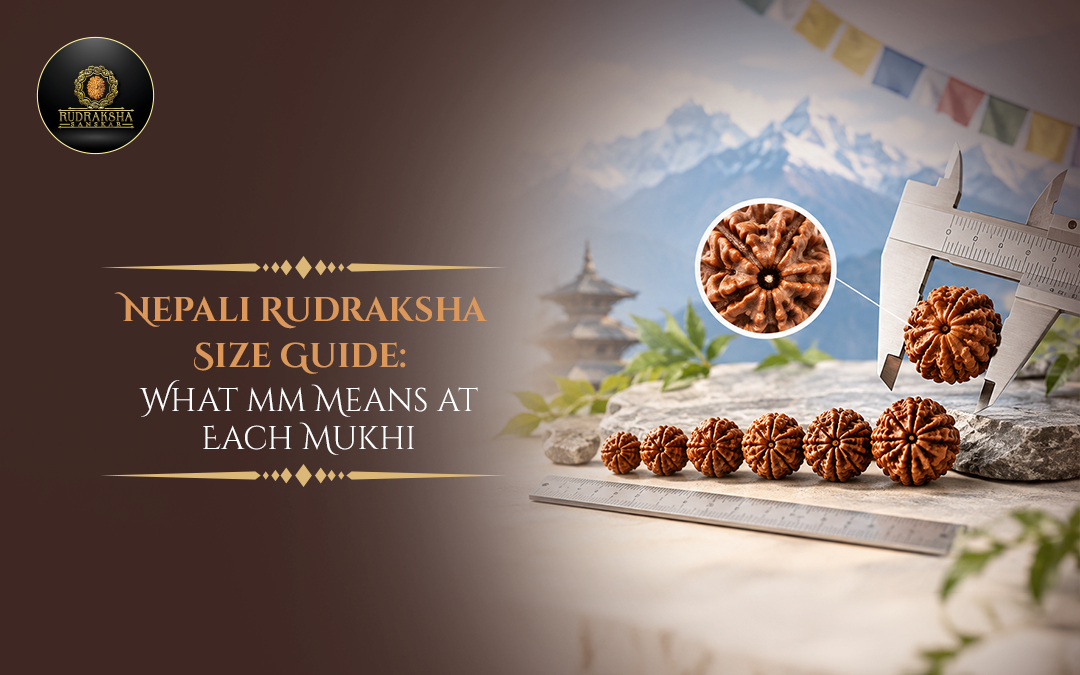
30.2 × 23.6 × 17.4 mm
This tells you more than simply calling the bead “30.2 mm.”
The three measurements describe the bead across different axes because a natural Rudraksha is not a perfectly round manufactured object.
It may be:
- oval
- elongated
- broad
- compressed
- irregular
- deeply grooved
So when a product title says 30.2 mm, that is usually a simplified headline measurement. The complete dimensions give you a much better understanding of the specimen.
Is There a Standard Size for Every Mukhi?
No.
This is one of the most important things to understand about Nepali Rudraksha.
There is no reliable rule such as:
5 Mukhi must be 20–25 mm
or
14 Mukhi must be above 30 mm
Natural seeds vary.
Even two authentic Nepali Rudraksha with the same Mukhi can have noticeably different dimensions and weights.
For example, current 14 Mukhi Rudraksha specimens can include Nepal-origin beads around 19–20 mm as well as much larger specimens around 30 mm and above.
So size should be treated as a specimen characteristic, not an authenticity threshold.
What Size Can You Expect Across Different Mukhi?
Rather than using rigid mm requirements, buyers should think in terms of natural variation.
Here is the more useful way to read size across the Mukhi spectrum:
| Mukhi | What Buyers Should Know About Size |
| 1–5 Mukhi | Size varies significantly by origin and natural form; Mukhi identification matters more than diameter |
| 6–9 Mukhi | Nepal beads may appear broader and deeply textured, but there is no mandatory mm |
| 10–12 Mukhi | Mid-to-large Nepal specimens are common in the market, with substantial individual variation |
| 13–14 Mukhi | Larger Nepal specimens may attract premiums, but smaller genuine specimens also exist |
| 15–17 Mukhi | Rarity becomes increasingly important; evaluate the exact bead rather than expecting a standard size |
| 18–21 Mukhi | Exceptional large Nepal specimens can command major collector premiums, but smaller genuine specimens also exist |
This is deliberately not a fixed-size chart.
The moment a seller tells you that a particular Mukhi “must” measure a certain number of millimetres to be genuine, ask for better evidence.
Real Examples Show Why Fixed Size Charts Fail
Consider the 14 Mukhi Rudraksha.
One Nepal specimen can measure approximately:
19 × 15.4 × 12.8 mm
while another can measure:
30.2 × 23.6 × 17.4 mm
Both can still be identified as 14 Mukhi.
The larger bead does not become “more 14 Mukhi” because it measures over 30 mm.
The same principle becomes even more important with very rare higher Mukhi.
Current 18 Mukhi Rudraksha inventory includes specimens extending beyond 30 mm, with some examples approaching or exceeding the mid-30 mm range.
At that level, an exceptional size may significantly affect collector value.
It still does not change what makes the bead an 18 Mukhi.
Does Mukhi Number Determine Size?
Not directly.
A common misunderstanding is that higher Mukhi should automatically mean larger Rudraksha.
Nature does not work that neatly.
You can find a relatively large lower-Mukhi bead and a smaller higher-Mukhi specimen.
What changes dramatically as the Mukhi count increases is usually rarity, not a guaranteed progression in diameter.
For example:
A 10 Mukhi can be close to 30 mm.
A 13 Mukhi can also be around 30 mm.
A 14 Mukhi can be around 19 mm, 25 mm, 30 mm or larger.
Rare 18–21 Mukhi specimens can also occur across noticeably different sizes.
So:
Mukhi tells you the number of natural faces.
mm tells you the physical dimensions.
Do not confuse the two.
Why Are Nepali Rudraksha Often Larger?
Nepal-origin Rudraksha are generally known in the market for their:
- larger physical form
- deeper natural grooves
- heavier structure
- more pronounced surface texture
Indonesian Rudraksha are generally smaller, lighter and more compact.
This distinction becomes obvious when comparing higher-Mukhi specimens.
For example, current 21 Mukhi inventory includes Indonesian specimens below 20 mm as well as Nepal specimens above 30 mm.
That does not mean the smaller Indonesian bead is fake.
It means origin affects the physical characteristics of the seed.
This is why buyers should never use a Nepal-size expectation to judge an Indonesian Rudraksha.
Does a Larger Rudraksha Work Better?
No reliable traditional rule establishes that a larger bead is spiritually stronger simply because it has a greater diameter.
A 30 mm Rudraksha is not automatically more spiritually effective than a 24 mm bead of the same Mukhi.
Size matters primarily because it can affect:
- rarity
- appearance
- wearability
- collector demand
- specimen value
- price
This distinction becomes particularly important with rare 15 Mukhi Rudraksha, 17 Mukhi Rudraksha, 18 Mukhi Rudraksha and higher categories.
A spectacularly large specimen may be much more expensive.
The premium reflects the physical rarity of that specimen, not proof of greater spiritual potency.
Why Can 2 mm Make Such a Big Price Difference?
At common Mukhi levels, a few millimetres may not dramatically alter value.
With extremely rare Mukhi, the situation can be different.
Imagine two authentic high-Mukhi Nepal beads.
Both have:
- clearly developed natural faces
- good condition
- laboratory documentation
- comparable origin
But one is significantly larger and heavier.
If specimens of that size are exceptionally scarce, collectors may pay a substantial premium.
That effect becomes especially visible in categories such as 21 Mukhi Rudraksha.
But size is still only one pricing variable.
mm vs Weight: Which Matters More?
Neither should be viewed alone.
Suppose two Rudraksha are both listed as approximately 30 mm.
One may weigh substantially more because its:
- width differs
- thickness differs
- overall shape differs
- natural structure differs
This is why a serious product listing should ideally provide both:
dimensions in mm + weight in grams
Rather than:
“Large premium Rudraksha.”
Actual measurements give the buyer something objective to compare.
What Should You Check Alongside Size?
When evaluating a Nepali Rudraksha, use mm as one piece of a larger verification process.
Check:
- Mukhi count
Are the natural facial lines clearly identifiable?
- Full dimensions
Look beyond the single headline mm measurement.
- Weight
Compare the physical size with the stated gram weight.
- Origin
Confirm whether the bead is actually listed as Nepal origin.
- Exact photographs
You should ideally see the specimen you are purchasing.
- Certificate
Check whether the certificate corresponds to that exact bead.
- X-ray where relevant
Particularly with rare high-Mukhi specimens, X-ray can provide supporting evidence about internal compartment structure.
For premium beads, the strongest buying approach is:
exact bead + dimensions + weight + surface analysis + certificate + supporting X-ray
Can Size Prove a Rudraksha Is Original?
No.
A large bead can still be altered.
A small bead can still be genuine.
Size does not prove:
- natural Mukhi
- origin
- absence of carving
- internal structure
- species
- authenticity
If you see a claim such as:
“It is 30 mm, therefore it is original Nepali Rudraksha,”
that is not sufficient evidence.
Use the detailed guide on how to identify an original Rudraksha when authenticity is the primary concern.
Read the Bead, Not Just the Number
The most useful way to understand Nepali Rudraksha sizing is simple:
Mukhi tells you what type of Rudraksha it is.
mm tells you how large that particular specimen is.
grams tell you its weight.
certification and physical examination help establish what the specimen actually is.
A 34 mm Rudraksha is not automatically better than a 27 mm bead, and a smaller specimen is not automatically less authentic.
When comparing beads, start with the correct Mukhi and purpose. Then evaluate origin, complete dimensions, weight, natural formation, condition and documentation.
If you plan to buy rudraksha online, treat the mm measurement as useful physical information, not as a shortcut for authenticity or spiritual quality.
FAQs
It means one of the bead’s physical measurements is approximately 25 millimetres. Check the complete dimensions because a natural Rudraksha has length, width and thickness.
There is no single standard size. Genuine Nepal-origin Rudraksha occur across different dimensions depending on the individual seed and formation.
Not spiritually by default. A larger specimen may be rarer or more valuable to collectors, but size alone does not establish spiritual superiority.
No. Mukhi count and physical size are different characteristics.
Large specimens can become exceptionally scarce when combined with a rare Mukhi count, good condition, natural development and strong documentation.