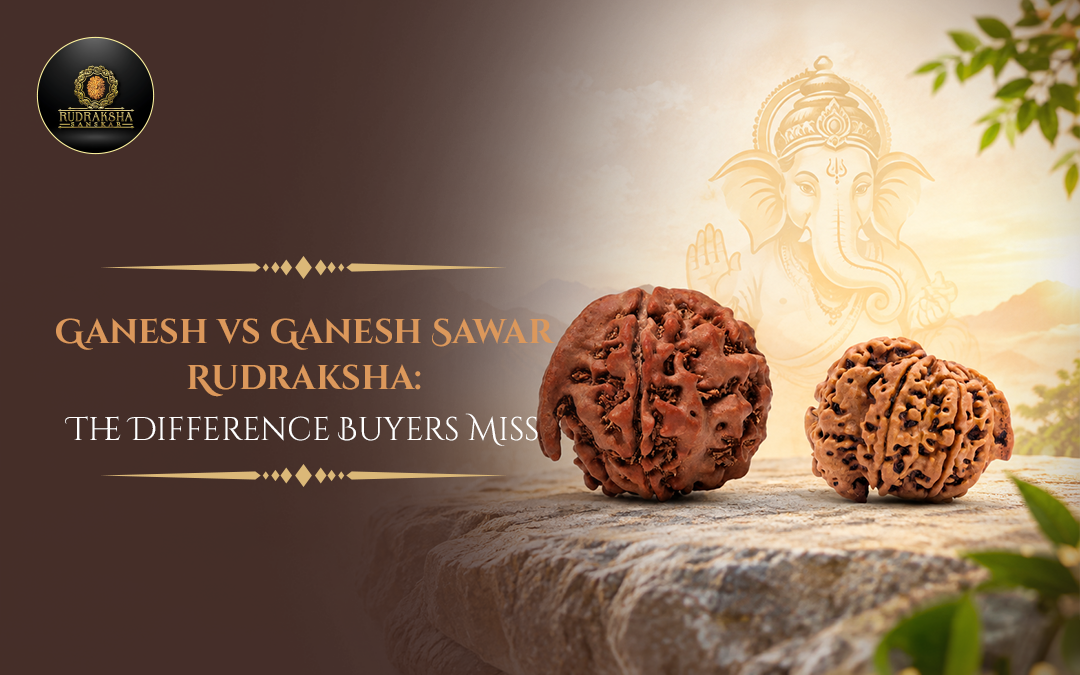
A Ganesh Rudraksha and a Ganesh Sawar Rudraksha may sound almost identical.
They are not.
A Ganesh Rudraksha is identified by a natural trunk-like protrusion on the bead that resembles Lord Ganesha.
A Ganesh Sawar combines two unusual natural characteristics:
- a Ganesh-like protrusion
- a Sawar formation, where a smaller Rudraksha growth is naturally attached to a larger primary bead
That makes Ganesh Sawar a more complex formation, not simply a larger or “stronger” version of Ganesh Rudraksha.
Understanding the difference matters because rarity, pricing and authentication are all affected by the actual physical formation.
What Is a Ganesh Rudraksha?
A Ganesh Rudraksha is classified by its natural physical shape, not by one fixed Mukhi number.
Its defining feature is a naturally developed protrusion resembling the trunk of Lord Ganesha.
That means a Ganesh formation can occur on beads with different Mukhi counts.
For example, Rudraksha Sanskar currently lists an 11 Mukhi Ganesh Rudraksha, which shows why “Ganesh” should not be confused with one specific number of faces.
Traditionally, Ganesh Rudraksha is associated with:
- Lord Ganesha
- removal of obstacles
- new beginnings
- wisdom
- decision-making
- success symbolism
But its identity comes from the trunk-like growth, not from the benefit list.
What Is a Sawar Rudraksha?
A Sawar Rudraksha has a different natural structure.
It forms when a smaller Rudraksha-like growth is naturally attached to a larger primary bead, creating the appearance of a rider sitting on the main Rudraksha.
This is why you may see notations such as:
- 5+1 Sawar
- 6+1 Sawar
- 7+1 Sawar
- 8+1 Sawar
The first number identifies the Mukhi of the primary bead, while +1 refers to the additional natural attached formation.
For a deeper explanation of this formation, see the Sawar Rudraksha guide.
So What Is a Ganesh Sawar Rudraksha?
A Ganesh Sawar is a specimen where Ganesh and Sawar characteristics occur together.
In other words:
Ganesh characteristic → natural trunk-like protrusion
Sawar characteristic → smaller natural growth attached to the main bead
The same specimen can show both.
Rudraksha Sanskar currently has a dedicated Sawar/Ganesh (8+1) category containing Nepal-origin specimens identified with both characteristics. Current examples include beads from 19.4 mm to 25.1 mm, with specimen-specific certification and X-ray numbers.
That is the important buyer distinction.
A Ganesh Sawar is not merely “Ganesh Rudraksha with a premium name.”
It should physically show both natural features.
Ganesh vs Ganesh Sawar: Quick Comparison
| Ganesh Rudraksha | Ganesh Sawar Rudraksha | |
| Main identifying feature | Natural trunk-like protrusion | Ganesh protrusion + Sawar attached formation |
| Classification | Natural formation | Combination of two natural formations |
| Fixed Mukhi? | No | No, though products may be labeled by underlying Mukhi |
| Traditional symbolism | Ganesha, obstacles, beginnings | Ganesha symbolism plus rare Sawar formation |
| Rarity | Rare natural formation | Generally rarer because two unusual traits occur together |
| Main fake risk | Artificially carved trunk | Artificial trunk and/or attached/glued smaller bead |
| Buyer priority | Verify protrusion is natural | Verify both protrusion and attached formation are natural |
The easiest way to remember it is:
Ganesh = trunk
Sawar = rider
Ganesh Sawar = both on the same natural specimen
Is Ganesh Sawar Spiritually Better Than Ganesh Rudraksha?
Not automatically.
A rarer formation is not necessarily a more suitable spiritual choice.
Ganesh Rudraksha already carries strong Lord Ganesha symbolism around:
- obstacles
- wisdom
- auspicious beginnings
- clarity
Ganesh Sawar adds the rarity and symbolism of the Sawar formation.
That may make it more interesting to:
- experienced collectors
- advanced Rudraksha buyers
- people specifically seeking unusual natural formations
But someone who simply wants Ganesh symbolism does not necessarily need the more complex and expensive Ganesh Sawar.
Rarity affects supply and collector value. It does not prove greater spiritual potency.
What Does 8+1 Ganesh Sawar Mean?
This is where product naming can confuse buyers.
A listing such as:
Sawar/Ganesh (8+1)
does not mean the bead has nine normal Mukhi.
The notation describes the physical specimen.
The 8 refers to the Mukhi classification of the main Rudraksha.
The +1 refers to the additional attached Sawar formation.
“Ganesh” indicates that the specimen also displays the characteristic natural trunk-like protrusion.
Rudraksha Sanskar’s current 8+1 Ganesh Sawar listings include certified Nepal specimens with exact dimensions, weights and X-ray references.
This is why buyers should understand the naming system before comparing prices.
Is Ganesh Rudraksha the Same as 8 Mukhi?
No.
This is another important distinction.
An 8 Mukhi Rudraksha is defined by eight naturally formed Mukhi lines.
It is traditionally associated with Lord Ganesha, which causes the confusion.
A Ganesh Rudraksha, however, is defined by a physical trunk-like formation and can occur with different Mukhi counts.
So you can have:
- ordinary 8 Mukhi
- Ganesh Rudraksha of another Mukhi
- 8 Mukhi Ganesh
- 8+1 Sawar
- 8+1 Ganesh Sawar
Those names describe different combinations of Mukhi count and natural formation.
Which Is Rarer?
A standard Ganesh formation is already uncommon because the trunk-like protrusion must develop naturally.
Ganesh Sawar adds another condition:
the same specimen must also develop a natural Sawar attachment.
That generally makes a genuine Ganesh Sawar more unusual.
But rarity still depends on the exact specimen, including:
- underlying Mukhi
- origin
- dimensions
- weight
- condition
- development of both formations
- certification
A generic rule such as “every Ganesh Sawar is worth more than every Ganesh Rudraksha” would be too simplistic.
Authentication: This Is the Difference Buyers Really Need to Know
Ganesh Rudraksha and Ganesh Sawar face different levels of alteration risk.
For Ganesh Rudraksha
The main question is:
Did the trunk form naturally?
Rudraksha Sanskar’s current authentication guidance warns about techniques such as:
- carving
- cutting away surrounding material
- reshaping a natural bump
- artificially attaching material
- polishing modified areas to hide tool marks
A natural Ganesh formation should not look like a perfectly sculpted miniature trunk.
For Ganesh Sawar
Now there are two things to authenticate:
- the Ganesh protrusion
- the Sawar attachment
The smaller section should appear naturally integrated with the main bead.
Be cautious if you see:
- visible adhesive
- artificial filler
- abrupt join lines
- excessive polishing around the attachment
- unnatural symmetry
This is one reason specimen-specific photographs and certification matter more for complex formations.
Why X-Ray Is Useful
X-ray does not magically prove a formation is authentic.
But it can provide useful supporting evidence about the bead’s internal structure.
Rudraksha Sanskar’s current Ganesh Sawar category publishes X-ray numbers for several specimens. For example:
- 19.4 mm, 1.34 g, Nepal — certificate DCL/2026/A/2737, X-ray 4480
- 21.6 mm, 1.66 g, Nepal — certificate DCL/2026/A/1249, X-ray 2898
- 22 mm, 2.66 g, Nepal — certificate DCL/2026/A/1252, X-ray 2903
At this level, the strongest evidence is:
exact specimen + surface inspection + formation analysis + certificate + matching X-ray
not one test alone.
Which One Should You Buy?
Choose Ganesh Rudraksha if your main interest is:
- Lord Ganesha symbolism
- obstacle-removal tradition
- new beginnings
- owning a natural Ganesh formation
Consider Ganesh Sawar if:
- you specifically want a rarer combined natural formation
- you understand the underlying Mukhi
- collector rarity matters to you
- the additional price is supported by physical evidence
Do not choose Ganesh Sawar simply because “more unusual” sounds spiritually better.
The Extra Name Should Correspond to an Extra Natural Feature
This is the main buyer lesson.
If a seller calls a specimen Ganesh Sawar, the bead should physically justify both words.
Ganesh → naturally formed trunk-like protrusion
Sawar → naturally attached smaller growth
If only one feature exists, the product should not be presented as though both are present.
For deeper comparison, explore the Ganesh Rudraksha collection, the Sawar Rudraksha guide, and the current Sawar/Ganesh 8+1 collection.
If you plan to buy rudraksha online, make sure every premium word in the product name corresponds to a natural physical characteristic you can actually verify.
FAQs
No. Ganesh Rudraksha has a natural trunk-like protrusion. Ganesh Sawar combines Ganesh characteristics with a natural Sawar attached formation.
8 refers to the main bead’s Mukhi count, while +1 describes the attached Sawar formation. The specimen also displays a Ganesh-like protrusion.
Generally, yes, because two unusual natural characteristics need to occur on the same specimen. Exact rarity still depends on the bead.
Yes. Both the trunk and attached section can potentially be artificially altered, which makes careful authentication important.
No. Ganesh is a formation, not a Mukhi count. It can occur on different Mukhi Rudraksha.