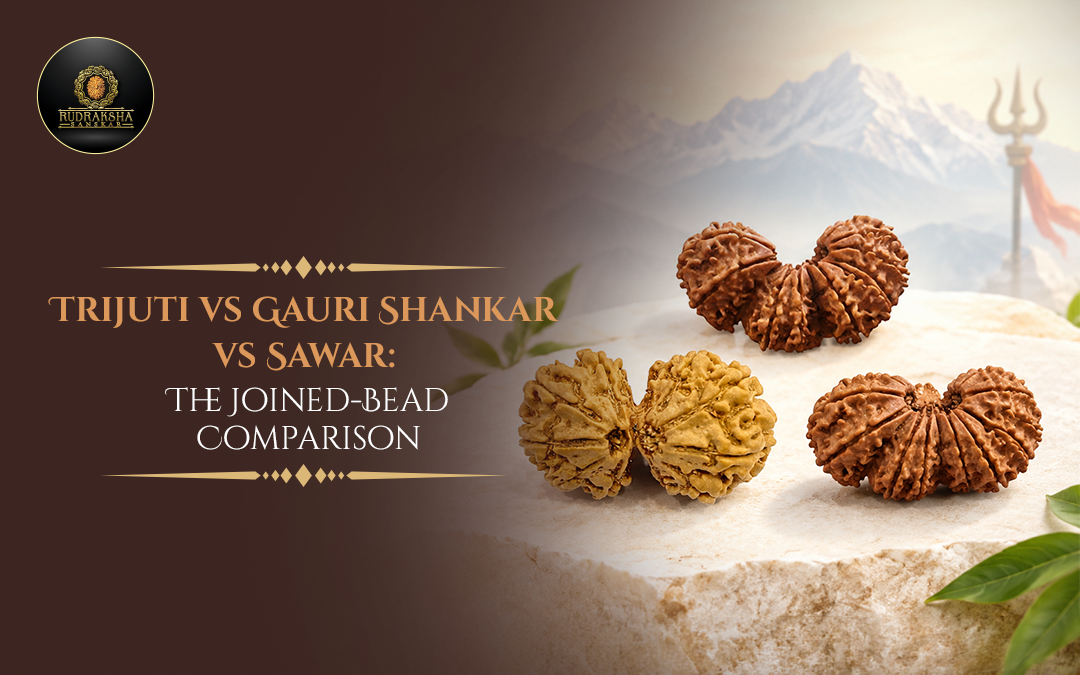
Trijuti, Gauri Shankar and Sawar Rudraksha are often grouped together because all three involve unusual natural formations rather than a simple single-bead structure.
But they are not the same formation.
A Gauri Shankar Rudraksha consists of two Rudraksha naturally joined together.
A Trijuti Rudraksha consists of three Rudraksha naturally fused into one formation.
A Sawar Rudraksha is different: it has a smaller bead-like Rudraksha growth naturally attached to a larger main bead, creating a rider-like appearance.
These structural differences also give each formation a different traditional meaning, rarity and authentication challenge.
Gauri Shankar Rudraksha: Two Beads, Shiva and Parvati
The Gauri Shankar Rudraksha is the most familiar of these three formations.
It develops when two Rudraksha grow naturally joined together.
Traditionally, the two sections represent:
Shankar → Lord Shiva
Gauri → Goddess Parvati
This gives Gauri Shankar its strong associations with:
- unity
- partnership
- marriage
- relationship harmony
- Shiva-Shakti balance
- emotional connection
Rudraksha Sanskar’s current Gauri Shankar collection includes different Mukhi variations, which highlights an important point:
Gauri Shankar is a formation, not one fixed Mukhi number.
A specimen may therefore be identified by both its Gauri Shankar formation and its underlying Mukhi characteristics.
Trijuti Rudraksha: Three Naturally Joined Beads
Trijuti Rudraksha takes the joined-bead concept further.
Instead of two sections, three Rudraksha grow naturally joined together.
Traditionally, these three sections are associated with the Trimurti:
- Brahma
- Vishnu
- Mahesh
representing:
creation → preservation → transformation
That gives Trijuti a much broader spiritual symbolism than the relationship-focused identity of Gauri Shankar. Rudraksha Sanskar’s current Trijuti guide specifically describes it as three naturally joined seeds and notes that it is generally considered a rare, advanced formation rather than something every beginner needs.
Sawar Rudraksha: The Rider Formation
Sawar Rudraksha has a different structure.
The word Sawar refers to a rider.
In this formation, a smaller Rudraksha growth is naturally attached to a larger primary Rudraksha, creating the appearance of one section sitting on another.
That is why Sawar may be described as:
- 5+1
- 6+1
- 7+1
- 8+1
The first number refers to the Mukhi of the primary bead, while the +1 identifies the additional attached natural formation.
Sawar should therefore not be treated as a separate Mukhi number.
It is an additional formation occurring on an underlying Rudraksha.
Trijuti vs Gauri Shankar vs Sawar: Quick Comparison
| Gauri Shankar | Trijuti | Sawar | |
| Natural structure | Two joined Rudraksha | Three joined Rudraksha | Smaller growth attached to main bead |
| Traditional symbolism | Shiva-Parvati | Brahma-Vishnu-Mahesh | Depends more on underlying Mukhi and rare formation |
| Core theme | Partnership and unity | Creation, preservation and transformation | Rare attached formation |
| Identified by | Natural twin fusion | Natural triple fusion | Main Mukhi + “+1” formation |
| Typical notation | Gauri Shankar + Mukhi | Trijuti | 6+1, 7+1, 8+1 etc. |
| Major authenticity risk | Two beads glued together | Three beads artificially assembled | Smaller bead artificially attached |
| Rarity | Rare | Extremely rare | Rare |
The easiest way to remember them is:
Gauri Shankar = two together
Trijuti = three together
Sawar = one main bead with an attached rider-like formation
Which Is Best for Relationships?
Among the three, Gauri Shankar has the clearest traditional relationship symbolism.
Its Shiva-Parvati association makes it particularly relevant to:
- marriage
- partnership
- relationship harmony
- emotional connection
- Shiva-Shakti balance
That does not mean wearing one guarantees marriage or repairs an unhealthy relationship.
The bead symbolizes partnership.
Real relationships still depend on communication, compatibility and mutual effort.
If relationship symbolism is the main purpose, Gauri Shankar usually makes more sense than choosing Trijuti simply because Trijuti is rarer.
Which Is Best for Broader Spiritual Practice?
Among these three, Trijuti has the broadest traditional symbolism.
Its Trimurti association brings together:
- creation
- preservation
- transformation
That may appeal particularly to experienced spiritual practitioners or collectors who understand why they want such a rare natural formation.
But Trijuti should not be treated as the ultimate upgrade from Gauri Shankar.
They represent different ideas.
Someone focused on partnership may find Gauri Shankar more meaningful than a far rarer Trijuti.
What Is Sawar Traditionally Chosen For?
Sawar is slightly different because its identity cannot be separated completely from the Mukhi of the main bead.
For example:
7+1 Sawar
and
8+1 Sawar
do not necessarily carry identical traditional associations.
The underlying Mukhi still matters.
Rudraksha Sanskar’s current guidance specifically recommends understanding the Mukhi of the primary bead first and treating the Sawar growth as an additional natural characteristic.
This makes Sawar less useful as a generic “benefits category” than either Gauri Shankar or Trijuti.
Is Sawar the Same as Gauri Shankar?
No.
Both can visually involve more than one bead-like section, but their formation is different.
Gauri Shankar: two Rudraksha naturally joined as a twin formation.
Sawar: one primary Rudraksha with a smaller attached growth.
The size relationship can often help illustrate the distinction.
Gauri Shankar commonly appears as two substantial connected sections.
Sawar has a clear main bead + smaller attached section structure.
Is Sawar the Same as Ganesh Rudraksha?
No.
This confusion is common because Rudraksha Sanskar and other catalogues may group rare formations together.
A Ganesh Rudraksha is identified by a natural trunk-like protrusion resembling Lord Ganesha.
A Sawar Rudraksha has a smaller bead-like section attached to the main bead.
Some rare specimens can display characteristics of both formations, but the terms should not be used interchangeably.
For the detailed distinction, see the Sawar vs Ganesh Rudraksha guide.
Which Is Rarest?
Trijuti is generally considered among the rarest natural Rudraksha formations because three separate Rudraksha sections must naturally develop together.
Sawar and Gauri Shankar are also uncommon, but rarity varies significantly according to:
- underlying Mukhi
- origin
- dimensions
- size of the formation
- condition
- quality of natural joining
- current availability
Therefore, there is no useful rule that every Trijuti must be more valuable than every Sawar or Gauri Shankar specimen.
The actual bead matters.
And rarity should not be confused with spiritual superiority.
Authentication: The Natural Join Is Everything
For these three formations, authenticity depends heavily on proving that the additional sections grew naturally together.
Gauri Shankar
Look for:
- an organic natural joint
- continuous surface growth
- no visible glue
- no artificial filling
Rudraksha Sanskar’s current guidance specifically warns buyers to inspect the joining area because artificially bonded twin beads exist.
Trijuti
All three sections need to appear naturally integrated.
Be cautious with:
- adhesive
- filler
- perfectly straight joints
- artificial smoothing
- abrupt changes in surface texture
These are among the authenticity checks highlighted in the existing Trijuti guide.
Sawar
The smaller section should be naturally connected to the main Rudraksha.
If it appears pasted, fixed or artificially attached, it should not be represented as natural Sawar.
For all three, premium specimens should ideally come with exact-piece photographs and specimen-specific certification.
Three Formations, Three Different Identities
The easiest mistake is seeing multiple joined sections and assuming all rare Rudraksha formations are variations of the same thing.
They are not.
Gauri Shankar → two naturally joined Rudraksha → Shiva-Parvati and partnership
Trijuti → three naturally joined Rudraksha → Trimurti and creation-preservation-transformation
Sawar → smaller growth attached to a primary bead → rare formation whose underlying Mukhi remains important
For deeper information, explore the Gauri Shankar Rudraksha, Trijuti Rudraksha guide and Sawar Rudraksha guide from Rudraksha Sanskar.
If you plan to buy rudraksha online, do not purchase a rare joined formation based only on its name. Verify the exact physical structure, natural joining, underlying Mukhi and specimen documentation first.
FAQs
Gauri Shankar contains two naturally joined Rudraksha, while Trijuti contains three.
Gauri Shankar is a natural twin formation. Sawar has a smaller Rudraksha-like growth attached to a larger main bead.
Gauri Shankar has the clearest traditional Shiva-Parvati and partnership symbolism.
No. Rarity affects availability and collector value, not universal spiritual suitability.
The 8 refers to an 8 Mukhi primary bead, while +1 identifies the additional natural attached formation.
Yes. Artificial joining is one of the key risks, so the joint and overall surface continuity should be carefully examined.