A Nepali Rudraksha does not come off the tree already labelled:
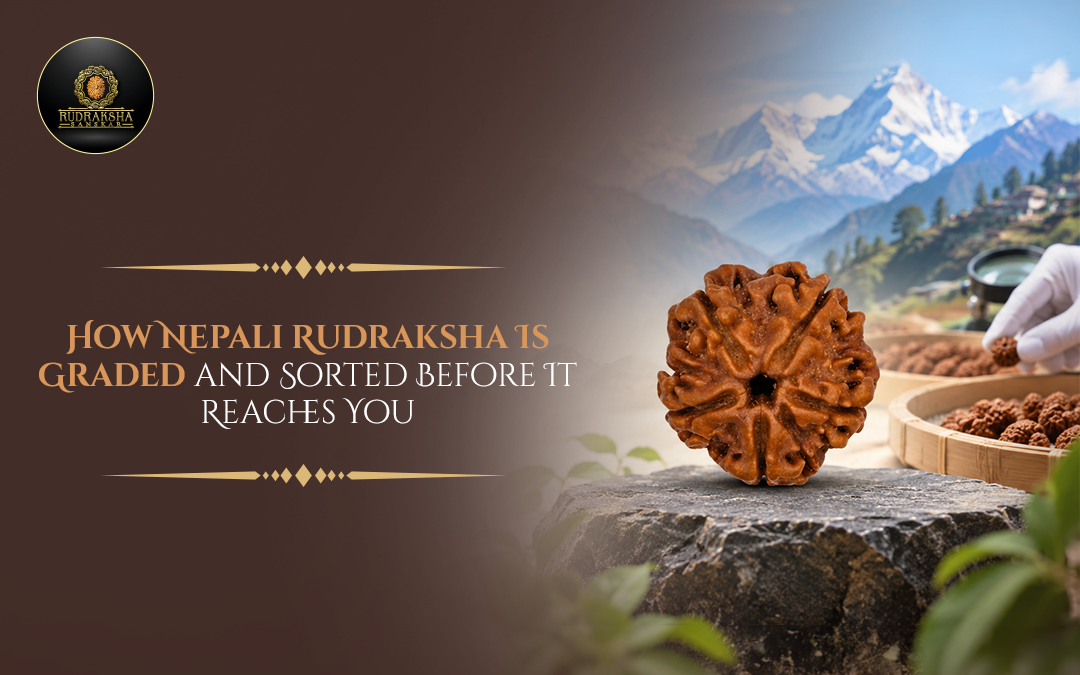
14 Mukhi | 29.6 mm | 4.2 g | Premium Grade
Before a bead reaches a buyer, it goes through several stages of cleaning, sorting, physical examination, classification and, for better-documented specimens, certification.
This process becomes increasingly important as the Mukhi count and value rise.
But there is something buyers should understand first:
Rudraksha does not have one universally accepted commercial grading system where “A,” “AA” or “AAA” means exactly the same thing everywhere.
Those labels can be seller-specific.
A better way to judge a Nepali Rudraksha is through measurable characteristics: Mukhi, dimensions, weight, condition, natural formation, origin and supporting documentation.
1. It Starts With the Rudraksha Fruit
Rudraksha beads are seeds found inside the fruit of the Rudraksha tree, commonly identified botanically as Elaeocarpus ganitrus.
Once mature fruits are collected, the outer fruit pulp has to be removed to expose the hard seed.
The seeds are then cleaned and dried before meaningful sorting can begin.
At this stage, the collector cannot simply decide which bead will become 5 Mukhi, 8 Mukhi or 14 Mukhi.
The Mukhi are naturally developed characteristics of the seed.
For a closer look at this earlier stage, see the guide on how Rudraksha is harvested and where it originates.
2. First Major Sort: Mukhi Count
Once the bead is sufficiently clean, one of the most important steps is identifying its Mukhi.
Mukhi are the natural longitudinal divisions or faces visible on the Rudraksha.
A bead may be classified as:
- 2 Mukhi
- 5 Mukhi
- 7 Mukhi
- 10 Mukhi
- 14 Mukhi
- 18 Mukhi
and so on.
This classification dramatically affects rarity and commercial value.
Common Mukhi can occur in much larger quantities, while naturally occurring higher-Mukhi specimens become increasingly scarce.
But simply counting visible grooves is not enough for expensive specimens.
The question is whether those faces are naturally formed.
3. Natural Mukhi Lines Are Examined
A genuine Mukhi should not simply look like a line scratched into the surface.
Examination may consider:
- continuity of the line
- depth and natural texture
- how it travels across the bead
- surrounding surface structure
- signs of cutting or carving
- artificial modification
This becomes particularly important with premium higher-Mukhi Rudraksha.
Why?
Because the price difference between Mukhi can create an obvious incentive to modify a lower-value bead and present it as something rarer.
So sorting by Mukhi should eventually lead into verification of the Mukhi, especially when the specimen commands a significant price.
4. Size Is Measured in Millimetres
After Mukhi classification, physical size becomes another useful sorting characteristic.
A Nepal-origin Rudraksha may be recorded with measurements such as:
29.4 × 23.1 × 18.6 mm
rather than simply “large.”
This matters because natural Rudraksha are rarely perfect spheres.
One bead may be:
- broad
- elongated
- compressed
- oval
- unusually thick
while another bead of the same Mukhi may have completely different proportions.
As explained in the Nepali Rudraksha size guide, millimetres describe the specimen, not its spiritual strength.
Larger examples of an already rare Mukhi may attract collector premiums because such specimens can be harder to find.
5. Weight Is Recorded Separately
Size and weight should ideally be considered together.
Two Rudraksha may both have a headline measurement of around 30 mm but differ considerably in:
- width
- thickness
- shape
- overall mass
Recording weight in grams therefore creates another objective point of comparison.
Instead of saying:
“Extra-large premium bead”
a transparent listing can provide:
dimensions + weight
That gives the buyer actual information rather than a marketing grade.
6. Shape and Overall Formation Are Assessed
Natural Rudraksha vary considerably in appearance.
A sorter may encounter beads that are:
- round
- oval
- elongated
- broad
- irregular
- deeply grooved
An unusual shape is not automatically a defect.
What matters is whether the formation is natural and structurally sound.
For collectors, certain well-developed or visually distinctive specimens may be more desirable.
But shape alone should never establish authenticity.
7. Condition Matters
Two genuine Nepali Rudraksha of the same Mukhi and similar size may still differ in value because of their condition.
A specimen should be examined for issues such as:
- major cracks
- broken sections
- damaged Mukhi lines
- excessive erosion
- structural weakness
- artificial repairs
Natural texture and minor irregularities should not automatically be treated as defects.
Rudraksha are botanical objects, not machine-cut gemstones.
In fact, an excessively perfect appearance can sometimes deserve more scrutiny rather than less.
8. Special Natural Formations Are Separated
During sorting, some Rudraksha stand out because they have formations beyond the normal Mukhi structure.
Examples include:
Gauri Shankar Rudraksha – two naturally joined Rudraksha.
Ganesh Rudraksha – a bead with a natural trunk-like protrusion.
Trijuti Rudraksha – three naturally joined Rudraksha.
Sawar Rudraksha – a formation with a smaller bead-like growth naturally attached to the primary bead.
These should be separated and classified according to their actual physical formation.
A rare formation can substantially influence collector interest and price.
But again:
rarer does not automatically mean spiritually stronger.
9. Origin Becomes Part of the Classification
Origin also matters commercially.
Nepal Rudraksha are generally known for being:
- larger
- heavier
- more deeply textured
- visually pronounced
Indonesian Rudraksha tend to be:
- smaller
- lighter
- more compact
- subtler in surface appearance
Both can be genuine.
So “Nepali” should describe origin, not act as a synonym for “original.”
Likewise, Indonesian should not be treated as a synonym for inferior or fake.
Origin is simply another characteristic used to classify the specimen.
10. Rare Beads Need a Higher Level of Verification
For a common everyday Rudraksha, buyers may not expect the same documentation as they would for an exceptionally rare specimen.
Once you enter categories such as:
15 Mukhi Rudraksha, 17 Mukhi Rudraksha, 18 Mukhi Rudraksha and beyond, the financial stakes change.
That makes verification more important.
A premium specimen should ideally have a clear chain of information:
exact bead → photographs → Mukhi analysis → dimensions → weight → origin → certificate → supporting X-ray where relevant
The higher the price, the less acceptable vague documentation becomes.
11. What Does Certification Add?
A proper certificate should provide more than the phrase:
“100% original Rudraksha.”
Depending on the laboratory and examination performed, documentation may record details such as:
- certificate number
- date
- weight
- dimensions
- shape
- natural faces
- artificial faces
- surface-line observations
- X-ray findings
- botanical identification
- stated origin
For buyers, this information is much more useful than a seller-created grade such as “Super Premium AAA.”
You can also read the detailed guide on how to identify an original Rudraksha before evaluating expensive specimens.
12. Where Does X-Ray Fit Into Sorting?
X-ray becomes especially useful for rare higher-Mukhi specimens because it can provide supporting evidence about internal compartment structure.
But an X-ray should not be treated as a magic authenticity test.
A strong assessment combines:
external surface analysis + internal evidence
rather than relying exclusively on either one.
The X-ray should also correspond to the same specimen being sold.
For a high-value Rudraksha, a random X-ray image with no connection to the exact bead provides little reassurance.
Is There an Official AAA Rudraksha Grade?
This is where buyers need to be careful.
Terms such as:
- AAA
- AAA+
- Super Premium
- Collector Grade
- Museum Grade
may be useful descriptions within an individual seller’s catalogue, but they should not automatically be interpreted as globally standardized grades.
There is no simple universal rule saying:
AAA Rudraksha = exactly these dimensions, this weight and this quality.
If a seller uses a premium grade, ask what that grade actually measures.
Does it refer to:
- size?
- condition?
- shape?
- rarity?
- origin?
- surface quality?
- all of the above?
A meaningful grade should be supported by measurable information.
What Actually Determines a Premium Nepali Rudraksha?
A more useful assessment considers the complete specimen:
Mukhi: How rare is the naturally occurring face count?
Origin: Is it Nepal-origin as represented?
Size: Is the specimen unusually large for what is available?
Weight: How substantial is the bead?
Condition: Is it structurally sound?
Formation: Is there an unusual natural feature?
Authenticity evidence: Are the Mukhi natural?
Documentation: Does the certificate correspond to the exact bead?
This gives the buyer much more information than a single grade.
From Tree to Certified Specimen
By the time a well-documented Nepali Rudraksha reaches a buyer, there is much more information attached to it than simply its Mukhi number.
A useful sorting process moves through:
harvesting → cleaning → Mukhi classification → surface examination → size → weight → condition → special formation → origin → certification → X-ray where relevant
For buyers, the lesson is straightforward.
Do not pay a premium simply because a product description says AAA, rare or collector grade.
Ask what makes that particular specimen exceptional.
If you plan to buy rudraksha online, measurable details and specimen-specific documentation tell you far more than a grading label ever can.
FAQs
They can be sorted according to Mukhi, size, weight, shape, condition, rarity, natural formations and documentation. Commercial grade names can vary between sellers.
Not by itself. A grade is not a substitute for physical examination and appropriate certification.
Not spiritually by default. Exceptional size can increase rarity and collector value, but it does not establish greater spiritual potency.
Their greater rarity and market value make accurate identification and documentation particularly important.
X-ray can provide useful supporting evidence about internal structure, but it should be considered alongside surface examination and other specimen-specific evidence.