If two Rudraksha are both 2 Mukhi, why can one be large, deeply grooved and expensive while another is tiny, lighter and considerably more affordable?
Often, the answer is origin.
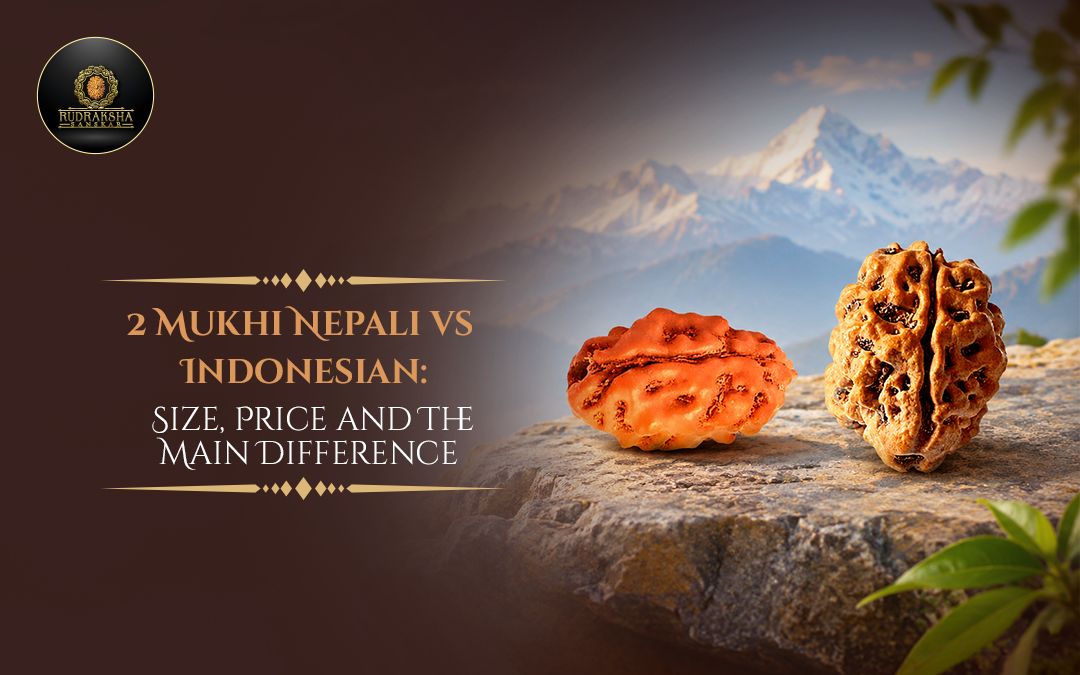
Nepali and Indonesian 2 Mukhi Rudraksha can both be genuine 2 Mukhi beads. What changes is primarily their physical appearance, availability, size and market price.
The simplest distinction is:
Nepali 2 Mukhi → generally larger, heavier and more prominently textured
Indonesian 2 Mukhi → generally smaller, lighter and more compact
Neither origin automatically makes the Rudraksha spiritually better.
What Is a 2 Mukhi Rudraksha?
A 2 Mukhi Rudraksha is identified by its two naturally formed faces or Mukhi.
Traditionally, it is strongly associated with Ardhanarishvara, the unified form of Shiva and Shakti.
Because of this symbolism, 2 Mukhi is commonly connected with:
- unity
- partnership
- emotional balance
- relationships
- harmony between two sides
- inner balance
In contemporary Rudraksha astrology, it is also commonly associated with the Moon or Chandra.
These traditional associations come from the Mukhi classification.
They do not disappear simply because one bead grew in Nepal and another in Indonesia.
Nepali vs Indonesian 2 Mukhi: Quick Comparison
| Feature | Nepali 2 Mukhi | Indonesian 2 Mukhi |
| Origin | Nepal | Indonesia |
| Typical appearance | Larger and more pronounced | Smaller and more compact |
| Mukhi grooves | Usually deeper and easier to see | Often finer and subtler |
| Weight | Generally heavier | Generally lighter |
| Wearability | More noticeable as a single bead | Easier for discreet daily wear |
| Availability | Can be more limited | Generally more accessible |
| Price | Usually higher | Usually more affordable |
| Spiritual identity | 2 Mukhi | 2 Mukhi |
The important line is the last one.
Both remain 2 Mukhi Rudraksha if their two faces are naturally formed and correctly identified.
Size: The Difference Buyers Notice First
Place a typical Nepali and Indonesian Rudraksha beside each other and size is often the first visible difference.
Nepali Rudraksha are generally known for:
- larger dimensions
- deeper grooves
- broader physical structure
- heavier feel
- rugged surface texture
Indonesian Rudraksha generally have:
- smaller dimensions
- finer surface lines
- lighter weight
- more compact structure
This difference can be particularly noticeable when buying a single bead rather than a full mala.
But there is no universal rule saying:
“A genuine Nepali 2 Mukhi must be X mm.”
Natural seeds vary from specimen to specimen.
Millimetres describe the size of the individual bead, not whether it is genuine.
Does a Smaller Indonesian 2 Mukhi Mean It Is Fake?
No.
This is one of the biggest mistakes buyers can make when comparing origins.
If someone has only seen large Nepal-origin Rudraksha, a small Indonesian specimen can initially look unusual.
But smaller size is characteristic of many Indonesian Rudraksha.
Authenticity should instead be evaluated through factors such as:
- natural Mukhi formation
- surface structure
- specimen condition
- botanical identification where available
- certification
- seller transparency
A bead should not be rejected simply because it is smaller.
Likewise, a large bead should not automatically be accepted as genuine because it “looks Nepali.”
Why Is Nepali 2 Mukhi Usually More Expensive?
Price is where the difference becomes especially important for buyers.
A Nepali 2 Mukhi can command a higher price because the market may place premiums on:
- Nepal origin
- larger size
- heavier structure
- pronounced Mukhi
- specimen quality
- limited availability
- collector demand
An Indonesian 2 Mukhi is generally more accessible because smaller Indonesian beads are available at a different supply and pricing level.
That does not mean the price difference represents spiritual power.
A more expensive Nepali specimen is not automatically “five times more effective” because it costs five times as much.
Price reflects the physical specimen and market.
Does Nepali 2 Mukhi Have Stronger Energy?
There is no reliable basis for turning origin into a spiritual strength scale.
You may encounter claims such as:
Nepali Rudraksha are more powerful because they are larger.
That confuses physical morphology with spiritual tradition.
Traditional identity comes primarily from the bead’s Mukhi and associated symbolism.
If both specimens are genuine 2 Mukhi, both belong to the same basic Mukhi category.
The Nepal bead may be:
- larger
- rarer
- more visually dramatic
- more collectible
But those characteristics do not objectively prove greater spiritual potency.
Which Is Better for Daily Wearing?
This depends on what you prefer.
Nepali 2 Mukhi
Consider Nepal origin if you prefer:
- a prominent individual Rudraksha
- clearly visible surface features
- a larger bead
- collector appeal
- a substantial pendant-style appearance
Indonesian 2 Mukhi
Consider Indonesian origin if you prefer:
- a smaller bead
- lighter daily wear
- discreet appearance
- easier incorporation into jewellery
- a more accessible price
This makes Indonesian Rudraksha particularly practical for people who want to wear the bead regularly without a large Rudraksha being visually prominent.
Is Nepali 2 Mukhi Better for Collectors?
Often, yes, but for a different reason.
Collectors may value a high-quality Nepal specimen because of its:
- dimensions
- weight
- surface development
- condition
- visual character
- scarcity
A particularly large, well-developed Nepal 2 Mukhi can therefore attract a premium.
But collector value and spiritual suitability are different questions.
A person seeking a practical 2 Mukhi for daily spiritual practice may be perfectly satisfied with a genuine Indonesian specimen.
Do Both Have the Same Ardhanarishvara Association?
The traditional 2 Mukhi identity is associated with duality becoming unity, commonly represented through Ardhanarishvara.
That association comes from the two-faced classification, not from Nepal or Indonesia.
So the origin does not turn them into two different spiritual categories.
The same distinction applies to the contemporary Moon association.
Origin describes where the bead developed.
Mukhi describes what type of Rudraksha it is.
2 Mukhi Is Not the Same as Gauri Shankar
This is another distinction buyers frequently miss.
A 2 Mukhi is:
one Rudraksha seed with two natural faces.
A Gauri Shankar Rudraksha is:
two Rudraksha naturally joined together.
Both carry strong symbolism around unity and partnership, which is why they are sometimes confused.
But physically they are completely different formations.
If relationship symbolism is your primary reason for researching either bead, the detailed 2 Mukhi vs Gauri Shankar comparison can help distinguish the two.
How Should You Compare Prices?
Never compare only:
Nepali 2 Mukhi price vs Indonesian 2 Mukhi price
without looking at the specimens.
For a useful comparison, check:
Origin: Nepal or Indonesia?
Dimensions: What are the actual measurements in mm?
Weight: How heavy is the specimen?
Mukhi: Are both natural faces clearly identified?
Condition: Is the bead intact and structurally sound?
Documentation: What exactly has been verified?
A very small Indonesian bead and an exceptional large Nepal specimen are not physically equivalent products simply because both say “2 Mukhi.”
How to Check Authenticity
For either origin, avoid relying on folklore tests such as whether the bead:
- floats or sinks in water
- rotates between coins
- behaves in a copper test
These methods are not sufficient proof of authenticity.
Instead, examine the actual specimen.
Look for:
- two naturally developed Mukhi
- uninterrupted natural surface characteristics
- no suspicious carving
- no artificial alteration
- exact photographs
- dimensions and weight
- appropriate certification
For a detailed process, see how to identify an original Rudraksha.
The easiest way to understand this comparison is:
Nepali vs Indonesian tells you about origin and physical character.
2 Mukhi tells you the Rudraksha classification.
A Nepali 2 Mukhi may appeal to someone who wants a larger, visually prominent or collector-oriented specimen.
An Indonesian 2 Mukhi may suit someone looking for a smaller, lighter and more affordable bead for regular wear.
Neither should be chosen solely because someone claims one country produces “more powerful” Rudraksha.
Choose based on authenticity, natural Mukhi, physical preference, documentation and budget. If you plan to buy rudraksha online, compare the exact specimens rather than comparing country names alone. A genuine, correctly identified 2 Mukhi is more important than simply choosing the biggest bead.
FAQs
The biggest practical difference is physical morphology. Nepal-origin beads are generally larger, heavier and more deeply textured, while Indonesian specimens are typically smaller, lighter and more compact.
It can absolutely be genuine. Origin and authenticity are separate questions.
Nepal specimens may command premiums because of size, morphology, availability, specimen quality and collector demand.
There is no reliable basis for declaring one origin spiritually stronger simply because it is larger or more expensive.
No. Size alone should not be used to establish geographic origin.
No. A 2 Mukhi is one seed with two natural faces. Gauri Shankar consists of two naturally joined Rudraksha.