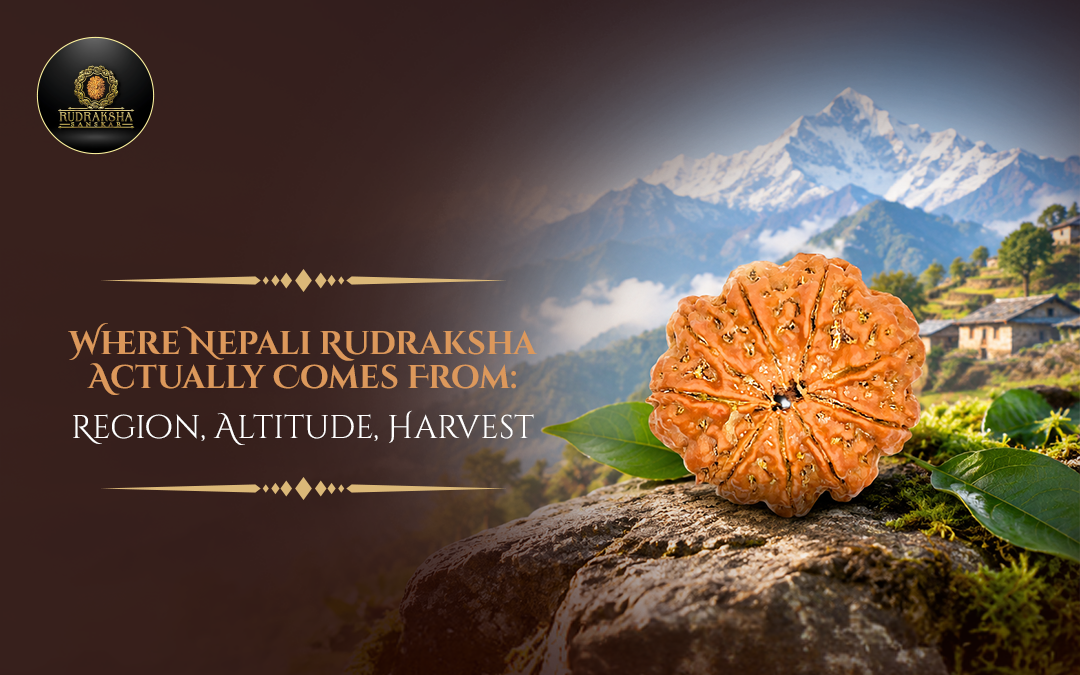
“Nepali Rudraksha” is often treated like a product category. But before it becomes a certified bead, it begins as the seed inside a fruit growing on a tree in Nepal.
That raises several useful questions for buyers:
Where in Nepal does Rudraksha actually grow?
Does it grow high in the Himalayas?
When is it harvested?
And does higher altitude automatically mean a better Rudraksha?
The reality is more interesting than the usual “Himalayan Rudraksha” description.
Much of Nepal’s important Rudraksha production is associated with the eastern hill regions, particularly areas around Bhojpur and Sankhuwasabha. And despite its Himalayan reputation, Rudraksha is not primarily a high-altitude alpine tree.
First, What Tree Does Nepali Rudraksha Come From?
The Rudraksha bead is the hard seed, or stone, found inside the fruit of a tree commonly identified as Elaeocarpus ganitrus.
Botanical references may also use Elaeocarpus sphaericus, with E. ganitrus treated as a synonym.
The tree produces rounded fruits that eventually reveal the naturally grooved seed inside.
Those natural divisions become the Mukhi used to classify Rudraksha as:
and so on.
The farmer does not carve or create the Mukhi after harvesting.
They are natural characteristics of the seed.
Where Does Rudraksha Grow in Nepal?
Rudraksha occurs in parts of central and eastern Nepal, but eastern Nepal is particularly important commercially.
Two names appear repeatedly when discussing the Nepali Rudraksha trade:
Bhojpur
Bhojpur is one of Nepal’s best-known Rudraksha-producing districts.
The Dingla area of Bhojpur has become especially associated with commercial Rudraksha cultivation and trade.
Rudraksha is grown across multiple local areas around the district, and the crop has become an important source of agricultural income for many families.
Sankhuwasabha
Neighbouring Sankhuwasabha is another important part of the Rudraksha-growing and trading landscape.
Khandbari and surrounding areas have historically played an important role in the collection and movement of Rudraksha from the eastern hills toward larger markets.
Together, these eastern hill districts form an important part of the supply chain behind what buyers eventually see labelled as Nepal-origin Rudraksha.
Does Nepali Rudraksha Grow in the High Himalayas?
Not in the way the phrase “Himalayan Rudraksha” sometimes suggests.
A Rudraksha tree should not be imagined growing beside glaciers at extremely high Himalayan elevations.
Nepalese forestry references describe Rudraksha as occurring up to approximately 1,400 metres above sea level in Nepal.
It is much more at home in suitable warm, humid hill environments than in alpine terrain.
So when you see the term:
Himalayan Rudraksha
it should not automatically be interpreted as:
grown at extreme Himalayan altitude.
Nepal is a Himalayan country, but the commercial Rudraksha-growing belt sits considerably lower than its famous high-mountain landscapes.
Why Does Altitude Get So Much Attention?
Altitude matters because it is part of a growing environment.
But it is not a grading system.
A tree’s development can be influenced by:
- elevation
- temperature
- rainfall
- humidity
- soil
- drainage
- local microclimate
- age and condition of the tree
These variables can influence the fruit and seed that eventually develop.
But a claim such as:
“Higher altitude means more powerful Rudraksha”
should be treated cautiously.
There is no reliable spiritual scale where a bead grown 200 metres higher automatically becomes more powerful.
Altitude is useful origin and growing-condition information, not a measure of spiritual potency.
Why Are Nepali Rudraksha Usually Larger?
Nepal-origin Rudraksha are widely recognized in the market for characteristics such as:
- relatively larger size
- substantial weight
- deeper grooves
- pronounced Mukhi lines
- rugged surface texture
That contrasts with many Indonesian Rudraksha, which tend to be smaller and more compact.
This does not mean every Nepali bead is large.
As explained in the Nepali Rudraksha Size Guide, authentic specimens of the same Mukhi can vary considerably in millimetres.
Nor does it mean Indonesian Rudraksha are fake.
Origin affects morphology. It does not decide authenticity by itself.
When Is Rudraksha Harvested in Nepal?
Rudraksha fruit develops on the tree before reaching maturity and being collected for processing.
In eastern Nepal, commercial collection is associated with the late monsoon and autumn period, with activity beginning around late August or September in some producing areas.
Harvest timing can vary according to location, tree and fruit maturity.
This is an important detail because the Rudraksha sold throughout the year does not represent a continuous year-round harvest.
Beads can be harvested, processed, sorted and then held in inventory for later sale.
So a Rudraksha purchased months after harvest is not automatically inferior or “old.”
What Does the Fruit Look Like?
Before becoming the familiar brown bead, Rudraksha develops inside a fleshy fruit.
As the fruit matures, its exterior can develop a bluish to bluish-purple appearance.
Inside is the hard stone that becomes the Rudraksha used for malas, individual wearing and spiritual practice.
The journey therefore begins as:
tree → fruit → hard seed → cleaned Rudraksha
The brown textured bead seen in a jewellery box is very different from how it first appears on the tree.
What Happens After Harvest?
Harvesting is only the beginning.
Once fruits are collected, the outer fleshy material needs to be removed so the hard Rudraksha seed can be examined.
The general journey then becomes:
Collection
↓
Removal of fruit pulp
↓
Cleaning
↓
Drying
↓
Mukhi sorting
↓
Size and weight measurement
↓
Condition inspection
↓
Rare-formation separation
↓
Certification and X-ray where appropriate
↓
Final listing or sale
This is why a premium Rudraksha should be evaluated as an individual specimen rather than merely as “a bead from Nepal.”
How Are Rare Mukhi Found During Harvest?
Farmers do not plant a “14 Mukhi tree” and wait for 14 Mukhi beads.
Rudraksha trees can produce seeds with different natural Mukhi characteristics.
After the fruit has been processed and the seed is visible, beads can be examined and separated according to their natural faces.
Most harvested beads will not be extremely rare high-Mukhi specimens.
When a genuine rare bead appears, such as a 14 Mukhi Rudraksha or 18 Mukhi Rudraksha, its scarcity can make the individual specimen significantly more valuable.
The same applies to unusual natural formations such as:
and Sawar formations.
These are discovered through natural growth, not manufactured as part of the harvesting process.
Does “Nepal Origin” Prove Authenticity?
No.
This is an important distinction for buyers.
A seller writing:
Origin: Nepal
does not, by itself, prove:
- the Mukhi count
- that all faces are natural
- absence of carving
- absence of repair
- exact geographical source
- internal structure
Origin and authenticity are related questions, but they are not the same question.
For a premium specimen, you should still look for:
- exact bead photographs
- dimensions
- weight
- natural Mukhi lines
- condition
- specimen-specific certification
- X-ray where relevant
The guide on how to identify an original Rudraksha explains these checks in greater detail.
Nepal vs Indonesia: Does Origin Decide Which Is Better?
Not automatically.
Nepal and Indonesia both produce genuine Rudraksha.
Nepal-origin beads are generally preferred by buyers who want:
- larger specimens
- prominent surface texture
- deeply visible Mukhi
- substantial individual beads
- collector-grade high-Mukhi specimens
Indonesian beads can be especially practical when smaller, lighter beads are preferred.
The right question is therefore not:
“Which country produces spiritually stronger Rudraksha?”
It is:
“Is this particular bead authentic, correctly identified and suitable for what I need?”
Understanding where Rudraksha comes from makes one buyer lesson especially clear.
Nepali is an origin description.
It should not automatically mean:
bigger = better
higher altitude = more powerful
Nepal = automatically authentic
or
expensive = spiritually superior
A Nepali Rudraksha begins with a real tree growing in suitable hill conditions, particularly in eastern regions such as Bhojpur and Sankhuwasabha. Its fruit is harvested, processed, cleaned and sorted before the individual seed can even be evaluated for Mukhi, size, condition and rarity.
From there, the exact specimen matters.
If you plan to buy rudraksha online, look beyond the word “Nepali.” Ask what is known about the bead’s origin, natural Mukhi, dimensions, weight, condition and specimen-specific documentation.
FAQs
Eastern Nepal is especially important, with Bhojpur and Sankhuwasabha closely associated with Rudraksha cultivation, collection and trade.
No. Rudraksha is a tree of suitable warmer hill environments, not extreme alpine or glacial elevations.
Nepalese forestry references document Elaeocarpus sphaericus or E. ganitrus in central and eastern Nepal up to around 1,400 metres. Local cultivation conditions vary.
Commercial collection generally begins around the late monsoon and autumn period, although exact timing varies with location and fruit maturity.
There is no reliable basis for assuming spiritual strength increases with bead size. Larger rare specimens can, however, have greater collector value.
No. Rare high-Mukhi beads represent a small part of the natural harvest and cannot simply be produced on demand by the farmer.