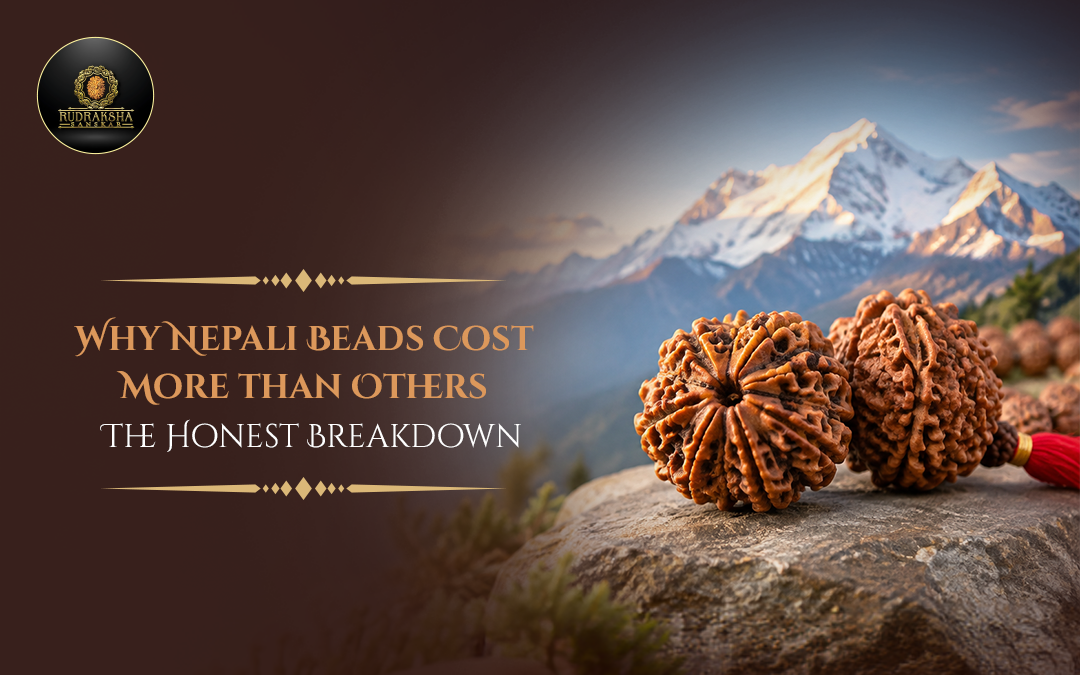
If you compare Rudraksha online, one pricing pattern becomes obvious very quickly.
A Nepali Rudraksha often costs more than an Indonesian bead with the same Mukhi.
Sometimes the difference is modest.
With rare higher-Mukhi Rudraksha, it can become substantial.
So why are buyers paying more?
The answer is not simply:
“Nepali Rudraksha are more powerful.”
Price is influenced by a combination of physical size, morphology, natural supply, rarity, specimen quality, collector demand and documentation. Understanding these factors helps you separate a justified premium from marketing.
First: Nepal Origin Does Not Automatically Mean Better
Nepal and Indonesia both produce genuine Rudraksha.
They simply tend to look different.
Nepal-origin Rudraksha are generally known for:
- larger physical size
- heavier structure
- deeper grooves
- prominent Mukhi lines
- rugged surface texture
Indonesian Rudraksha are generally:
- smaller
- lighter
- more compact
- finer in surface texture
These differences affect how the market values individual beads.
But they do not establish a spiritual hierarchy.
A genuine Indonesian Rudraksha does not become inferior simply because it is smaller.
1. Larger Size Can Increase the Price
Size is one of the easiest differences to notice.
Nepal-origin beads can develop into substantial individual specimens, particularly when compared with many Indonesian Rudraksha.
That matters commercially.
Suppose two genuine beads have the same Mukhi:
Bead A: relatively small and lightweight
Bead B: unusually large, heavy and well developed
If Bead B is significantly harder to find in that Mukhi, collectors may value it more highly.
This effect becomes increasingly important with rare higher-Mukhi Rudraksha.
But remember:
larger does not mean spiritually stronger.
Size affects physical rarity and market value, not proven spiritual potency.
2. Pronounced Mukhi Make Nepali Beads Visually Desirable
Nepal Rudraksha often have deep, clearly visible natural grooves.
For many buyers, this makes the bead visually impressive.
A large Nepali specimen may allow its:
- Mukhi divisions
- surface texture
- natural shape
- individual character
to be seen more easily.
This is particularly attractive when someone is buying a single Rudraksha to wear as a pendant or preserve as a collector specimen.
Visual desirability contributes to demand.
And greater demand can contribute to higher prices.
3. Rare Mukhi Change the Equation Completely
The price difference becomes much more dramatic once you move beyond common Mukhi.
Consider categories such as:
At this level, you are combining two scarcity factors:
rare Mukhi + desirable Nepal specimen
Add exceptional size and condition, and the price can rise significantly again.
That is why comparing the price of a common 5 Mukhi with an exceptional Nepal 21 Mukhi tells you very little about Rudraksha pricing overall.
4. Not Every Harvest Produces Rare Beads
A farmer cannot simply decide to grow a 17 Mukhi or 21 Mukhi Rudraksha.
The Mukhi develops naturally.
After the fruits are harvested and processed, the resulting seeds need to be cleaned and sorted.
Only then can uncommon Mukhi and unusual natural formations be identified.
This means supply is constrained by nature.
When demand exists for a naturally scarce category, prices rise.
The previous guide on where Nepali Rudraksha actually comes from explains why harvest, growing region and sorting all matter before a bead reaches the buyer.
5. Special Natural Formations Add Another Layer of Rarity
Mukhi count is not the only source of rarity.
Nepal can also produce unusual formations such as:
Gauri Shankar Rudraksha, where two Rudraksha naturally grow joined together.
Ganesh Rudraksha, identified by a natural trunk-like protrusion.
Trijuti Rudraksha, where three Rudraksha naturally grow joined together.
Sawar, where a smaller bead-like formation is naturally attached to the primary bead.
These formations cannot simply be produced whenever market demand increases.
A particularly rare formation combined with an uncommon Mukhi and desirable size can therefore command a major premium.
Again, that premium represents scarcity, not proof that the bead is spiritually superior.
6. Exceptional Size Matters More When the Mukhi Is Already Rare
A few millimetres do not have the same economic meaning across every category.
For common Rudraksha, the market may have many specimens available across different sizes.
For a rare Mukhi, finding an unusually large Nepal specimen can be much harder.
Consider two authentic high-Mukhi Rudraksha.
Both are:
- Nepal origin
- naturally formed
- properly documented
- in good condition
But one is significantly larger and heavier.
If specimens of that Mukhi and size rarely appear, the larger bead may command a substantial collector premium.
This is why the Nepali Rudraksha Size Guide treats millimetres as a specimen characteristic rather than a spiritual rating.
7. Condition Also Affects Value
Rudraksha are natural botanical objects.
They are not manufactured to identical specifications.
Two specimens of the same Mukhi can differ in:
- surface condition
- structural integrity
- clarity of natural lines
- cracks
- damaged areas
- shape
- overall preservation
A rare bead in excellent condition may be valued more highly than another specimen of the same Mukhi with substantial structural damage.
Condition therefore becomes another part of commercial grading.
8. Certification Adds Cost, but It Also Adds Information
Premium Rudraksha require more scrutiny.
For expensive specimens, a buyer should ideally receive more than a handwritten tag saying:
“Original Nepali Rudraksha.”
Useful documentation may record:
- certificate number
- dimensions
- weight
- shape
- natural faces
- artificial faces
- surface analysis
- botanical identification
- stated origin
- X-ray findings where relevant
Laboratory examination and specimen-specific documentation add work and cost to the supply chain.
But for a high-value bead, that information can be far more meaningful than a generic authenticity claim.
9. X-Ray Becomes More Relevant With Premium Mukhi
With rare higher-Mukhi specimens, X-ray can provide supporting evidence about internal compartment structure.
It should not replace external surface examination.
The stronger approach is:
surface analysis + specimen-specific documentation + supporting X-ray
rather than:
“It has an X-ray, therefore everything about it is proven.”
The X-ray should also correspond to the exact bead being purchased.
As the value of the specimen rises, the quality of documentation should rise with it.
10. Collector Demand Influences Price Too
Not every buyer purchases Rudraksha purely for wearing.
Some rare specimens attract:
- collectors
- temples
- spiritual institutions
- experienced practitioners
- buyers building complete Mukhi collections
For example:
Collectors may value characteristics that an everyday wearer does not particularly need.
- exceptional dimensions
- unusual shape
- rare natural formation
- uncommon Mukhi
- outstanding condition
That creates another layer of demand for premium Nepal specimens.
Why Indonesian Rudraksha Can Cost Less
A lower price does not automatically mean lower authenticity.
Indonesian Rudraksha often occupy a different part of the market because they tend to be:
- smaller
- lighter
- more compact
- easier to incorporate into malas and jewellery
For many people, those characteristics are actually advantages.
Someone looking for discreet daily wear may prefer an Indonesian Rudraksha over a large Nepal specimen.
The lower price should therefore not automatically be interpreted as lower spiritual value.
What Does NOT Justify Paying More?
This is where buyers should be cautious.
A higher price is not automatically justified by words such as:
AAA
Super Premium
Divine Grade
Extremely Powerful
Miracle Rudraksha
100X Energy
Unless the seller explains what a grade actually measures, it is just a label.
Likewise, statements such as:
“This bead is larger, therefore it is more powerful.”
or
“Nepali Rudraksha gives faster results.”
should not be treated as objective reasons for a higher price.
Pay for characteristics you can evaluate.
What Actually Justifies a Premium?
When comparing an expensive Nepali Rudraksha, ask what you are actually paying for.
A legitimate premium may reflect:
Mukhi rarity
How difficult is that natural Mukhi to find?
Origin
Is the specimen genuinely represented as Nepal origin?
Size
Is it unusually large for its category?
Weight
Does it have a substantial natural structure?
Condition
Is the bead well preserved?
Formation
Does it have an uncommon natural characteristic?
Documentation
Is the exact specimen properly recorded?
Collector scarcity
How often do comparable specimens actually become available?
The more expensive the Rudraksha, the more specific these answers should become.
Are Expensive Nepali Rudraksha More Powerful?
Price should never be used as a spiritual ranking system.
A ₹2 lakh bead is not automatically more spiritually suitable for someone than a much more accessible 5 Mukhi.
Likewise, 21 Mukhi is not universally “better” than 7 Mukhi simply because it is rarer and more expensive.
Different Mukhi carry different traditional associations.
The correct question is not:
“What is the most expensive Rudraksha I can afford?”
It is:
“Which Rudraksha is appropriate for my purpose, and is this particular specimen genuine?”
Before you buy rudraksha online, do not ask only, “Why is this Nepali Rudraksha expensive?”
FAQs
Nepal specimens often command premiums because of their larger size, pronounced morphology, collector demand and the scarcity of exceptional specimens.
It can, especially when an unusually large size occurs within an already rare Mukhi. Size alone does not determine price.
There is no reliable basis for saying that smaller Indonesian Rudraksha are spiritually weaker simply because of their origin or size.
These Mukhi are naturally scarce. Combining rare Mukhi with Nepal origin, large size, good condition and strong documentation can make individual specimens particularly valuable.
Not automatically. Ask what the seller means by AAA and which measurable characteristics support the grade.
For premium specimens, detailed specimen-specific documentation is particularly important. Buyers should understand what the certificate actually verifies.