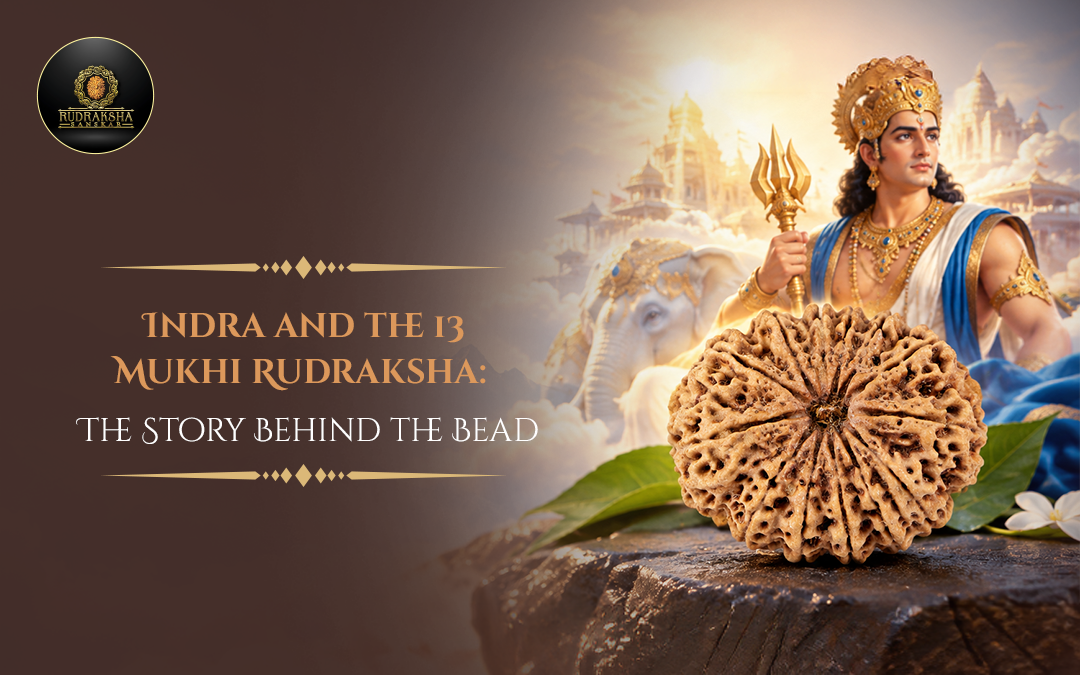
What connects the king of the gods, Lord Indra, with a Rudraksha that has thirteen natural faces?
The answer lies in Hindu spiritual traditions, where the 13 Mukhi Rudraksha is associated with Indra, the ruler of Svarga, and Kamadeva, the deity of love and desire.
At first, these associations may seem unrelated.
Indra represents divine authority, prosperity and leadership. Kamadeva represents attraction, desire and the power of connection.
Yet both are connected through ideas of influence, fulfilment and the responsibilities that accompany worldly success.
Understanding these traditions helps explain why the 13 Mukhi Rudraksha has become associated with confidence, charisma and achievement.
Who Is Lord Indra in Hindu Mythology?
Lord Indra is one of the most prominent deities in early Vedic literature.
He is celebrated as a powerful warrior, the wielder of the Vajra and a deity associated with storms, rain and victory.
In later Hindu mythology, Indra is widely recognised as the king of the Devas and ruler of Svarga, the heavenly realm.
His traditional attributes include:
- Divine leadership and authority
- Courage in confronting challenges
- Prosperity and abundance
- Victory and achievement
- Responsibility for maintaining his heavenly kingdom
One of Indra’s best-known mythological stories concerns his battle with Vritra, a powerful adversary associated with the obstruction of waters.
In the Rigveda, Indra defeats Vritra and releases the waters.
The story highlights his strength and his role in overcoming formidable obstacles.
However, Indra is not portrayed as a flawless ruler in every tradition.
Later stories also explore his pride, insecurity and attachment to power.
This makes Indra a complex figure whose mythology addresses both the opportunities and responsibilities of leadership.
What Is the 13 Mukhi Rudraksha?
The 13 Mukhi Rudraksha is a naturally formed Rudraksha with thirteen distinct facial divisions, called Mukhi.
These divisions appear as natural longitudinal grooves on the bead.
The Mukhi count is a physical characteristic, while the bead’s religious significance comes from traditional interpretation.
The 13 Mukhi is commonly associated with:
Lord Indra: Authority, prosperity, influence and leadership.
Lord Kamadeva: Attraction, desire, charm and personal magnetism.
These associations are followed in different Rudraksha traditions, although their emphasis can vary.
The connection with Indra is especially interesting because it links the bead’s symbolism with the idea of worldly responsibility and accomplishment.
Why Is the 13 Mukhi Rudraksha Associated With Indra?
Indra’s association with the 13 Mukhi Rudraksha is generally explained through his position as king of the Devas.
He represents the ability to lead, exercise influence and enjoy the responsibilities and privileges of a powerful position.
Within contemporary Rudraksha interpretations, the 13 Mukhi is therefore connected with qualities such as:
- Confidence
- Leadership
- Recognition
- Prosperity
- Influence
- Personal achievement
However, it is important to distinguish traditional symbolism from a documented mythological event.
There is no need to invent a story claiming that Indra personally discovered, created or wore a particular 13 Mukhi Rudraksha.
The association is better understood through religious interpretations that connect the bead with Indra’s divine attributes.
The Deeper Meaning of Indra’s Story
Indra’s mythology is not only about power.
It also contains stories about the challenges that come with authority.
As king of the Devas, Indra is responsible for defending his kingdom and maintaining his position.
Yet several narratives describe moments when pride, fear or desire influence his decisions.
This creates an interesting spiritual lesson.
Achieving influence is one thing. Using it wisely is another.
For someone drawn to the Indra association of 13 Mukhi Rudraksha, the symbolism may serve as a reminder to develop confidence without arrogance.
It can also represent the importance of balancing ambition with responsibility.
These are reflective interpretations of Indra’s mythology, not promises that wearing a bead will produce professional success.
Why Is Kamadeva Also Connected With 13 Mukhi?
The 13 Mukhi Rudraksha is also widely associated with Lord Kamadeva.
Kamadeva is the Hindu deity connected with love, desire and attraction.
In traditional iconography, he is often depicted carrying a sugarcane bow and flower arrows.
His symbolism extends beyond physical attraction.
It also concerns desire, emotional connection and the motivating force behind human aspirations.
This association gives the 13 Mukhi a different emphasis.
While Indra represents authority and worldly accomplishment, Kamadeva represents attraction and personal influence.
Together, these associations explain why the bead is often discussed in relation to confidence, charisma and relationships.
However, neither association guarantees romantic success or the ability to influence another person’s feelings.
The Story of Kamadeva and Lord Shiva
One of the best-known stories involving Kamadeva appears in the broader mythology of Shiva and Parvati.
According to popular versions of the narrative, the gods seek to awaken Shiva from deep meditation.
Kamadeva attempts to stir desire in Shiva by using his flower arrow.
Shiva opens his third eye, and Kamadeva is burned by its fire.
In some versions, Kamadeva is later restored or continues in a bodiless form.
The story explores the relationship between desire, self-control and spiritual awareness.
It also offers a useful way to understand the Kamadeva symbolism associated with 13 Mukhi Rudraksha.
Desire can motivate action, but wisdom is needed to guide it.
Importantly, this mythological story should not be presented as a verified account of the origin of the 13 Mukhi Rudraksha itself.
Indra and Kamadeva: Two Interpretations of One Bead
The two traditional associations can be understood through their different symbolic qualities.
| Aspect | Lord Indra | Lord Kamadeva |
| Divine identity | King of the Devas | Deity of love and desire |
| Primary symbolism | Authority and leadership | Attraction and desire |
| Associated qualities | Confidence, influence, prosperity | Charm, connection, creativity |
| Spiritual reflection | Responsibility in positions of power | Balance between desire and self-control |
These interpretations are not necessarily contradictory.
Both concern the relationship between personal aspirations and the way individuals engage with the world.
This is one reason the 13 Mukhi Rudraksha attracts interest among people exploring traditional symbolism connected with worldly life.
What Are the Traditional Benefits of 13 Mukhi Rudraksha?
The 13 Mukhi is commonly discussed in relation to several traditional benefits.
Confidence and Personal Influence
Its Indra association connects it with leadership and authority.
Some practitioners choose it as a spiritual reminder to approach responsibilities with confidence.
Creativity and Expression
Its Kamadeva association is sometimes interpreted through creativity, personal expression and attraction.
Prosperity and Achievement
Indra’s position as ruler of Svarga contributes to the bead’s association with abundance and accomplishment.
Relationships and Connection
Kamadeva’s symbolism connects the bead with affection, emotional expression and interpersonal relationships.
These are traditional beliefs rather than scientifically established effects.
A Rudraksha cannot guarantee wealth, promotions, attraction or relationship outcomes.
Who May Consider Wearing a 13 Mukhi Rudraksha?
Someone interested in the 13 Mukhi may be drawn to its traditional associations with:
- Leadership and responsibility
- Confidence and self-expression
- Creativity
- Personal development
- Prosperity symbolism
- Love and relationships
However, there is no universal rule that a particular profession or personality requires this bead.
A person’s religious tradition, spiritual interests and comfort with the purchase should guide the decision.
If you are exploring different higher Mukhi, comparing their traditional meanings can be more useful than selecting the most expensive option.
How to Identify an Original 13 Mukhi Rudraksha
Because higher Mukhi Rudraksha can command significant prices, authenticity is important.
Before purchasing, examine the following.
Natural Mukhi lines: The bead should have thirteen naturally developed facial divisions.
Surface texture: Look for signs of artificial carving or modification.
Exact photographs: Request images of the actual specimen from multiple angles.
Dimensions and weight: These details help identify the individual bead.
Certificate: Check whether the report corresponds to the specimen and states what has been examined.
Supporting X-ray: For premium specimens, internal imaging may provide additional evidence, but it should not replace external examination.
Avoid relying on water tests, copper tests or claims of guaranteed spiritual results.
For further guidance, read how to identify an original Rudraksha.
The Meaning Behind Indra and the 13 Mukhi Rudraksha
The story behind the 13 Mukhi Rudraksha is best understood through its traditional associations rather than an invented origin legend.
Indra represents leadership, prosperity and the responsibilities that come with authority.
Kamadeva represents attraction, desire and personal connection.
Together, their symbolism gives the 13 Mukhi a distinctive place among higher Mukhi Rudraksha.
But the deeper lesson is not simply about gaining power or fulfilling desires.
It is about understanding how confidence, ambition and self-control can coexist.
If you plan to buy rudraksha online, choose a genuine specimen and understand the tradition behind it. The significance of 13 Mukhi Rudraksha lies not only in its association with Indra’s power, but also in the wisdom required to use influence responsibly.
FAQs
The 13 Mukhi Rudraksha is commonly associated with Lord Indra and Lord Kamadeva in different traditions.
The association reflects Indra’s traditional attributes as king of the Devas, including authority, leadership, prosperity and influence.
Both associations are found in Rudraksha traditions. Their emphasis can vary according to the interpretation being followed.
The bead is traditionally associated with confidence, achievement and prosperity, but wearing it does not guarantee professional or financial success.
A specific account of Indra creating the 13 Mukhi should not be assumed without an identifiable scriptural source. Its connection with Indra is generally explained through traditional symbolic associations.
Check the thirteen natural Mukhi, surface condition, exact specimen photographs and appropriate authentication documentation.